


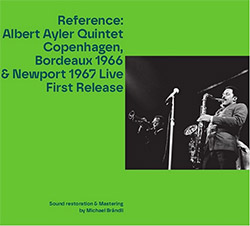
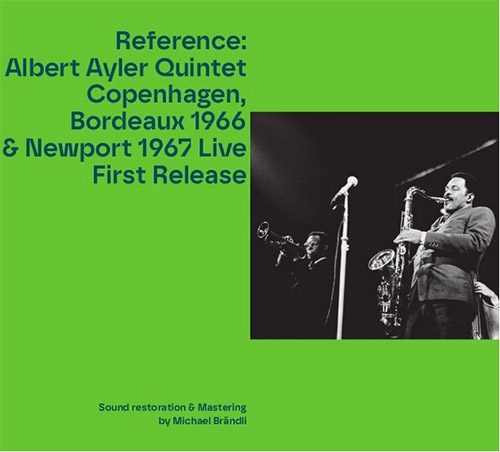
Previously unreleased recordings from the Albert Ayler Quintet — captured in Copenhagen and Bordeaux during the 1966 Newport in Europe tour and at the Newport Jazz Festival in 1967 — present Ayler with Donald Ayler, Michel Samson, Bill Folwell, and Beaver Harris/Milford Graves in fiercely expressive performances, newly restored and mastered from rediscovered tapes.
In Stock
Quantity in Basket: None
Log In to use our Wish List
Shipping Weight: 3.00 units
EU & UK Customers:
Discogs.com can handle your VAT payments
So please order through Discogs
Sample The Album:
Albert Ayler-tenor saxophone
Donald Ayler-trumpet
Michel Samson-violin
Bill Folwell-double bass
Beaver Harris-drums
Click an artist name above to see in-stock items for that artist.
Includes two postcards with an image of Ayler and credits.
UPC: 764998716805
Label: ALAY
Catalog ID: thingamajig 2501
Squidco Product Code: 37036
Format: CD
Condition: New
Released: 2025
Country: Switzerland
Packaging: Cardboard Gatefold
Tracks 1-4 recorded at the Tivoli Koncertsal, in Copenhagen, Denmark, on November 11th, 1967.
Track 5 recorded at Sigma Festival Bordeaux, in France, on November 14th, 1966.
Tracks 6-8 recorded at Newport Jazz Festival, in Newport, Rhode Island, on June 30th, 1967.
"The 1966 "Newport in Europe" tour organized by George Wein featured such mainstream jazz stars as Dave Brubeck, Stan Getz, Max Roach, Sonny Rollins, and remarkably, the Albert Ayler Quintet. Although primarily known, and certainly controversial, at this time for his 1964 recordings on the independent ESP label, earlier sessions for the even more obscure Bird Notes (Sweden) and Debut (Denmark) companies had introduced him initially to a limited Scandinavian and European avant-garde audience. What no one knew at the time was that the concert performances on this tour - in Berlin, Lörrach, Rotterdam, Helsinki, Stockholm, Copenhagen, Paris, and Bordeaux - recorded by local radio and television stations, produced tapes that would survive and more than fifty years later substantially increase the documentation and appreciation of this extraordinary group.
Ayler's musical conceptions, of course, went through significant changes in his all-too-brief eight-year career, which could be characterized as his developmental period (1962-63), the breakthrough year (1964), ensemble expansion (1965-67), and the "other" Ayler (1968-70). These powerful performances from Copenhagen and Bordeaux, released officially here for the first time, and the Newport Festival in the U.S., provide further evidence of the music's collective necessity - the true ensemble coordination which Ayler adopted, elaborated and romanticized, from his awareness of historic New Orleans precedents, with direct emotional and constructive links in the march themes (interactive repetition and commentary), layers of tonal contrast (Donald Ayler's piercing, pungent brass; Albert's melismatic reeds; the driving and droning strings; Beaver Harris' propulsive drums), and explosive cohesion in and out of the melodic currents.
Nevertheless, despite its undeniable energy and audible passion, the extreme nature of Ayler's music, his willingness to exploit the unrecognizable peripheries of freedom (that is, a rejection - or such a radical reorganization - of musical orthodoxy) as a conduit to spiritual transformation, has led to much speculation and interpretation. The position of Ayler as an innovator is not in question; what is not considered often enough is his relationship to an equally fervent, maverick attitude of jazz and blues-based improvisation - in addition to the Holiness Church tradition of saxophone and vocal catharsis - that sought a similar moment of escape, of ecstasy, through Ayler's same procedures, pure sound and energy. Ayler acknowledged this relationship; just as Robert Palmer, in his liner notes to The Village Concerts, perceptively compared Ayler's other-worldly tonal extravagances and fluid, emotionally-registered phrasing to that of the haunting sound of bluesman Blind Willie Johnson - and further back to villagers in Guinea and the Ivory Coast of Africa - there are further correspondences in Ayler's impulsive upper-register squeals and sharp attack to the apocalyptic fervor and hyper-expressionistic shrieks of r&b saxophonists like Big Jay McNeely (for example, "Blow, Blow, Blow" of 1955) and Willis Jackson ("Gator Tail," 1949 with Cootie Williams).
The two jazz musicians most influential on Ayler were Sidney Bechet and Sonny Rollins (it's arguable that Ayler influenced John Coltrane, musically, more than Coltrane influenced Ayler). Bechet's vibra-to-rich tone and intensity of phrasing prompted Ayler to admit (in a down beat interview), "I was crazy about him. For me, he represented the true spirit, the full force of life, that many of the older musicians had - like in New Orleans jazz - and which many musicians today don't have. I hope to bring that spirit back into the music we're playing." Another clue to Ayler's devotion was his choice of songs to record while still focusing on standards in 1962 and '63. He chose "Summertime," one of Bechet's greatest performances from 1939, twice, in Helsinki in '62 and on My Name is Albert Ayler from Copenhagen in '63.
Much of Ayler's early repertoire was also drawn from Rollins' recordings, including his compositions "Sonnymoon for Two" and "The Stopper" (under the title "Rollins' Tune"), plus "On Green Dolphin Street" (twice), "I'll Remember April," "Tune Up," and "Softly, as in a Morning Sunrise." Moreover, Rollins' obsessive struggle to liberate himself from the confining harmonic and formal procedures of popular songs led to his pianoless trio of 1957 (which likely eased Ayler into a similar format, first for his Swedish studio session in '62, and then with Gary Peacock and Sonny Murray by '64), as well as his far-reaching solo excursions and phrasing disruptions, which found their freest expression in the 1962-63 quartet with trumpeter Don Cherry. Rollins biographer Aidan Levy reported that Ayler attended the quartet's Copenhagen concert in January '63, and afterwards met and jammed with Cherry, anticipating their collaboration the next year.
Once Donald Ayler replaced Cherry on trumpet in 1965, it seems the die was cast; the Town Hall recording of Bells confirmed the coexistence of free interplay and a further appropriation of hymns and marches; Dutch violinist Michel Samson joined the ensemble following an unlikely meeting in Cleveland, Albert's hometown; the new rhythm section quickly adapted to their roles. This quintet made no studio recordings, but we are fortunate to have the 1966 tour documenting so thoroughly what may have been Ayler's most successful ensemble."-Art Lange, Chicago, August 2025
Includes two postcards with an image of Ayler and credits.

The Squid's Ear!
Artist Biographies
• Show Bio for Albert Ayler "Albert Ayler (born July 13, 1936 - November 25, 1970) was an American avant-garde jazz saxophonist, singer and composer. After early experience playing R&B and bebop, Ayler began recording music during the free jazz era of the 1960s. However, some critics argue that while Ayler's style is undeniably original and unorthodox, it does not adhere to the generally accepted critical understanding of free jazz. In fact, Ayler's style is difficult to categorize in any way, and it evoked incredibly strong and disparate reactions from critics and fans alike. His innovations have inspired subsequent jazz musicians. His trio and quartet records of 1964, such as Spiritual Unity and The Hilversum Session, show him advancing the improvisational notions of John Coltrane and Ornette Coleman into abstract realms where whole timbre, and not just mainly harmony with melody, is the music's backbone. His ecstatic music of 1965 and 1966, such as "Spirits Rejoice" and "Truth Is Marching In", has been compared by critics to the sound of a brass band, and involved simple, march-like themes which alternated with wild group improvisations and were regarded as retrieving jazz's pre-Louis Armstrong roots. Early life and career Born in Cleveland, Ohio, Ayler was first taught alto saxophone by his father Edward, who was a semiprofessional saxophonist and violinist. Edward and Albert played alto saxophone duets in church and often listened to jazz records together, including swing era jazz and then-new bop albums. Ayler's upbringing in the church had a great impact on his life and music, and much of his music can be understood as an attempt to express his spirituality, including the aptly titled Spiritual Unity, and his album of spirituals, Goin' Home, which features "meandering" solos that are meant to be treated as meditations on sacred texts, and at some points as "speaking in tongues" with his saxophone. Ayler's experience in the church and exposure to swing jazz artists also impacted his sound: his wide vibrato was similar to that of gospel saxophonists, who sought a more vocal-like sound with their instruments, and to that of brass players in New Orleans swing bands. Ayler attended John Adams High School on Cleveland's East Side, and graduated in 1954 at the age of 18. He later studied at the Academy of Music in Cleveland with jazz saxophonist Benny Miller. Ayler also played the oboe in high school. As a teenager, Ayler's understanding of bebop style and mastery of standard repertoire earned him the nickname of "Little Bird", after Charlie "Bird" Parker, in the small Cleveland jazz scene. In 1952, at the age of 16, Ayler began playing bar-walking, honking, R&B-style tenor with blues singer and harmonica player Little Walter, spending two summer vacations with Walter's band. In 1958, after graduating from high school, Ayler joined the United States Army, where he switched from alto to tenor sax and jammed with other enlisted musicians, including tenor saxophonist Stanley Turrentine. Ayler also played in the regiment band, along with future composer Harold Budd. In 1959 he was stationed in France, where he was further exposed to the martial music that would be a core influence on his later work. After his discharge from the army, Ayler tried to find work in Los Angeles and Cleveland, but his increasingly iconoclastic playing, which had moved away from traditional harmony, was not welcomed by traditionalists. Ayler relocated to Sweden in 1962, where his recording career began, leading Swedish and Danish groups on radio sessions, and jamming as an unpaid member of Cecil Taylor's band in the winter of 1962-63. (Long-rumored tapes of Ayler performing with Taylor's group were released by Revenant Records in 2004, as part of a 10-CD set.) The album My Name Is Albert Ayler is a session of standards recorded for a Copenhagen radio station with local musicians including Niels-Henning Ørsted Pedersen and drummer Ronnie Gardiner, with Ayler playing tenor and soprano on tracks such as "Summertime".Early recording career In 1963, Ayler returned to the US and settled in New York City, where he continued to develop his personal style and occasionally played alongside free jazz pianist Cecil Taylor. 1964 was the most well-documented year of Ayler's career, during which he recorded many albums, the first of which was Witches and Devils in March of that year. Ayler also began his rich relationship with ESP-Disk Records in 1964, recording his breakthrough album (and ESP's very first jazz album) Spiritual Unity for the then-fledgling record label. ESP-Disk came to play an integral role in recording and disseminating free jazz. Spiritual Unity featured the trio that Ayler had just assembled that summer, including bassist Gary Peacock and drummer Sunny Murray. The liner notes of Spiritual Unity include a brief description of the musicians on that day, July 10, 1964, in the Variety Arts Recording Studio. Just before 1 PM, Sunny Murray arrived, a large, genial walrus....Gary Peacock was next, tall, thin, ascetic looking, and soft spoken....Albert Ayler was last, small, wary, and laconic. On July 17, 1964 the members of this trio, along with trumpet player Don Cherry, alto saxophonist John Tchicai, and trombonist Roswell Rudd, collaborated in recording New York Eye and Ear Control, a freely improvised soundtrack to Canadian artist and filmmaker Michael Snow's film of the same name. During this time, Ayler began to garner some attention from critics, although he was not able to foster much of a fan following. However, later in 1964, Ayler, Peacock, Murray, and Cherry were invited to travel to Europe for a brief Scandinavian tour, which too yielded some new recordings, including The Copenhagen Tapes, Vibrations, and The Hilversum Session. Ayler recorded Bells on May 1, 1965. It is a ferociously-paced 20-minute improvisation featuring his signature military-march influenced melodies. Spirits Rejoice was recorded on September 23, 1965 at Judson Hall in New York City, and features a much larger band than the sparse trio of his earlier album Spiritual Unity. The Encyclopedia of Popular Music describes Spirits Rejoice as a "riotous, hugely emotional and astonishingly creative celebration of the urge to make noise." Both albums feature Albert's brother, trumpet player Donald Ayler, who translated his brother's expansive approach to improvisation to the trumpet. Donald played with Albert until he experienced a debilitating nervous breakdown in 1967. In 1966 Ayler was signed to Impulse Records at the urging of Coltrane, the label's star attraction at that time. But even on Impulse, Ayler's radically different music never found a sizable audience. Ayler's first set for Impulse was recorded a few weeks before Christmas in 1966, entitled Albert Ayler in Greenwich Village. Ayler performed with his brother, Michel Samson, Beaver Harris, Henry Grimes, and Bill Folwell, and his Coltrane was in attendance. For a tune titled "For John Coltrane," Ayler returned to the alto saxophone for the first time in years. Ayler first sang on a recording in a version of "Ghosts" performed in Paris in 1966, in which his vocal style was similar that of his saxophone, with an eerie disregard for pitch. Ayler continued to experiment with vocals for the rest of his career. In 1967, John Coltrane died of liver cancer, and Ayler was asked to perform at his iconic funeral. It is said that during his performance, Ayler ripped his saxophone from his mouth at two points: once, to emit a cry of anguish, the other a cry of joy to symbolize his friend and mentor's ascension into heaven.Final years For the next two and half years Ayler began to move from a mostly improvisatory style to one that focused more closely on compositions. This was largely a result of pressures from Impulse who, unlike ESP-Disk, placed heavier emphasis on accessibility than artistic expression. In 1967 and 1968, Ayler recorded three LPs that featured the lyrics and vocals of his girlfriend Mary Maria Parks and introduced regular chord changes, funky beats, and electronic instruments. Ayler himself sang on his album New Grass, which hearkened back to his roots in R&B as a teenager. However, this album was remarkably unsuccessful, scorned by Ayler fans and critics alike. Ayler staunchly asserted that he wanted to move in this R&B and rock-and-roll direction, and that he was not simply succumbing to the pressures of Impulse and the popular music of that day, and it is true that Ayler heavily emphasizes the spirituality that seems to define the bulk of his work. New Grass begins with the track "Message from Albert," in which Ayler speaks directly to his listener, explaining that this album was nothing like his ones before it, that was of "a different dimension in [his] life." He claims that, "through meditation, dreams, and visions, [he has] been made a Universal Man, through the power of the Creator..." In 1968, Ayler submitted an impassioned, rambling open letter to Cricket magazine entitled "To Mr. Jones-I Had a Vision," in which he describes startling apocalyptic spiritual visions. He "saw in a vision the new Earth built by God coming out of Heaven," and implores the readers to share the message of Revelations, insisting that "This is very important. The time is now." His final album, Music Is the Healing Force of the Universe, featured rock musicians such as Henry Vestine of Canned Heat alongside jazz musicians like pianist Bobby Few. This was a return to his blues-roots with very heavy rock influences, but did feature more of Ayler's signature timbre variations and energetic solos than the unsuccessful New Grass. In July 1970 Ayler returned to the free jazz idiom for a group of shows in France (including at the Fondation Maeght), but the band he was able to assemble (Call Cobbs, bassist Steve Tintweiss and drummer Allen Blairman) was not regarded as being of the caliber of his earlier groups. Ayler disappeared on November 5, 1970, and he was found dead in New York City's East River on November 25, a presumed suicide. For some time afterwards, rumors circulated that Ayler had been murdered, with a long standing urban legend that the Mafia tied him to a jukebox. Later, however, Parks would say that Ayler had been depressed and feeling guilty, blaming himself for his brother's problems. She stated that, just before his death, he had several times threatened to kill himself, smashed one of his saxophones over their television set after she tried to dissuade him, then took the Statue of Liberty ferry and jumped off as it neared Liberty Island. He is buried in Highland Park Cemetery in Beachwood, Ohio." ^ Hide Bio for Albert Ayler • Show Bio for Donald Ayler "Donald Ayler (October 5, 1942 - October 21, 2007) was a jazz trumpeter and younger brother to saxophonist Albert Ayler. Born in Cleveland Heights, Ohio, he went on to work with his brother in the mid-1960s. In 1967 Donald had what he termed a "nervous breakdown", which affected his brother's life as well. In 1970 his brother's death affected him deeply. After that he did work with a septet in Florence, but remains best known for his connection to Albert. Donald appears in the documentary film My Name Is Albert Ayler where he talks about his and Albert's life, their music and their relationship. He is also featured in archival footage from concerts in Europe in 1966. The new sequences with him were filmed in Cleveland, Ohio in 2001 and 2002. Ayler suffered a sudden heart attack on Sunday October 21, 2007, and died at home in Northfield, Ohio." ^ Hide Bio for Donald Ayler • Show Bio for Michel Samson Michel Samson, born in 1944 in Rijswijk, was an American violinist of Dutch origin best known for being a member of the Albert Ayler Quintet. Samson began began studying the violin when he was five years old, receiving a grant from the Dutch Government to study in Germany at the age of 11. After that he studied with Yehudi Menuhin in Rome, where composer Gian-Carlo Menotti arranged a grant for him to study in New York with Ivan Gelamian. He met Albert Ayler in 1966 while performing with the Cleveland Orchestra and joined his band. He also was a professor and violinist in residence at the Farleigh Dickinson University in New Jersey. ^ Hide Bio for Michel Samson • Show Bio for Bill Folwell William Folwell was a Jazz bassist and trumpet player, Born May 1, 1939 in Rochester, NY; died on October 2, 2019. In 1968 he was a string bassist, vocalist and trumpet player for Ars Nova. He is known for the groups Albert Ayler Quintet, Ars Nova, The Mystic Knights Of The Oingo Boingo, The Oddyssey Quartet. ^ Hide Bio for Bill Folwell • Show Bio for Beaver Harris "William Godvin "Beaver" Harris (April 20, 1936 - New York, New York, December 22, 1991) was an American jazz drummer who worked extensively with Archie Shepp. Harris was born in Pittsburgh, Pennsylvania. Coming from an athletic family, he played baseball as a teenager for the Kansas City Monarchs (then part of the Negro American League) and was scouted by major league teams Brooklyn Dodgers and New York Giants. It was only after he was in the army that he began playing drums. After his national service ended in 1963 he moved to New York City and was encouraged to pursue a musical career by Max Roach. While in New York he worked and/or toured with Marion Brown, Dexter Gordon, Albert Ayler, Joe Henderson, Freddie Hubbard, Clifford Jordan, Howard Johnson, Sheila Jordan, Lee Konitz, Thelonious Monk, Roswell Rudd, Sonny Rollins, McCoy Tyner, Sonny Stitt, Clark Terry, Chet Baker, Doc Cheatham and Larry Coryell among other musicians. In addition, Harris founded a "world music" band and called it "The 360 Degree Music Experience". The band included some of the most significant artists of the time, including Buster Williams, Hamiet Bluiett, Don Pullen, Jimmy Garrison, Ron Carter, Ricky Ford, Titos Sompa and many others. Harris died of prostate cancer in New York at the age of 55. His children, William Godvin Harris III, Verna Harris Vaughn, and Portia Harris." ^ Hide Bio for Beaver Harris
10/16/2026
Have a better biography or biography source? Please Contact Us so that we can update this biography.
10/16/2026
Have a better biography or biography source? Please Contact Us so that we can update this biography.
10/16/2026
Have a better biography or biography source? Please Contact Us so that we can update this biography.
10/16/2026
Have a better biography or biography source? Please Contact Us so that we can update this biography.
10/16/2026
Have a better biography or biography source? Please Contact Us so that we can update this biography.
Track Listing:
1. Truth Is Marching In 9:58
2. Holy Ghost / Bells / Light In Darkness 8:44
3. Our Prayer 3:58
4. Spiritual Rebirth 3:45
5. Infinite Spirit 5:32
6. Truth Is Marching In 8:58
7. Japan (traditional) 5:41
8. Our Prayer 7:42
March 2026
Hat Art
Improvised Music
Jazz
Free Improvisation
NY Downtown & Metropolitan Jazz/Improv
Quintet Recordings
Staff Picks & Recommended Items
New in Improvised Music
Recent Releases and Best Sellers
Search for other titles on the label:
ALAY.
 |
| Harris, Beaver / Don Pullen 360-degree Experience A Well-Kept Secret (Corbett vs. Dempsey) |
| Released in 1984 on Hal Wilner's Shemp records, this is the 1st reissue for late drummer Beaver Harris' 360-degree Experience with pianist Don Pullen on piano, in a stellar band with saxophonists Ricky Ford, Hamiet Bluiett, bassist Buster Williams, percussion from Candido & steel drummer Francis Haynes, and four french horn players, a truly forward-thinking jazz album. |
 |
| Ayler, Albert Quartet Reference: Goin' Home 1964 (ALAY) |
| A strikingly restrained side of Albert Ayler emerges on this 1964 session of spirituals and devotional songs, with his tenor and soprano saxophones joined by Call Cobbs Jr. on piano, Henry Grimes on double bass and Sunny Murray on drums, emphasizing melody, blues-inflected tone and deep vibrato while revealing the gospel and New Orleans roots underlying his more radical later language. |
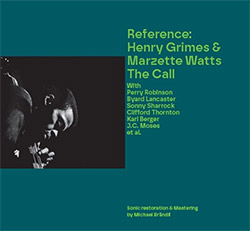 |
| Grimes, Henry / Marzette Watts (w/ Robinson / Lancaster / Sharrock / Thornton / Berger / Moses &c) The Call (ALAY) |
| Reissuing Henry Grimes' concise, darkly lyrical 1965 trio album with clarinetist Perry Robinson and drummer Tom Price alongside Marzette Watts' turbulent 1966 octet session, this remastered edition contrasts free improvisation with a dense collective of Byard Lancaster, Clifford Thornton, Sonny Sharrock, Karl Berger, Juini Booth and J. C. Moses, Grimes the link between two vital expressions of 1960s freedom |
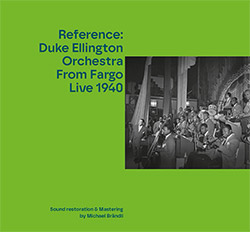 |
| Ellington, Duke Orchestra From Fargo Live 1940 (ALAY) |
| A legendary 1940 live document of Duke Ellington's Blanton-Webster orchestra, captured in Fargo by Jack Towers and Richard Burris, with Ellington on piano, Johnny Hodges and Otto Hardwick on alto saxophones, Ben Webster on tenor, Harry Carney on baritone, Barney Bigard on clarinet, Rex Stewart, Ray Nance and Wallace Jones in the brass, Jimmy Blanton on bass, Sonny Greer on drums, and Ivie Anderson and Herb Jeffries on vocals. |
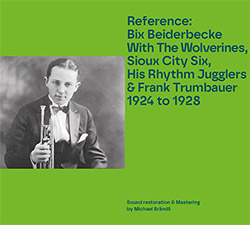 |
| Beiderbecke, Bix Reference: Bix Beiderbecke, 1924 to 1928 [2 CDs] (ALAY) |
| Gathering 45 small-group recordings from 1924-1928, this restored 2-CD reference traces Bix Beiderbecke's singular cornet and piano artistry alongside Frankie Trumbauer, Miff Mole, Don Murray, Tommy Dorsey, Eddie Lang, Joe Venuti and others, revealing a poised, lyrical and formally lucid voice whose economy, harmonic curiosity and graceful invention helped shape early jazz beyond its dance-band conventions. |
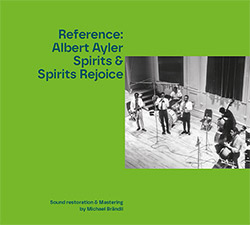 |
| Ayler, Albert Reference: Albert Ayler, Spirits & Spirits Rejoice [CD + POSTCARD] (ALAY) |
| Uniting Albert Ayler's 1964 New York sessions for Spirits (Debut) and Spirits Rejoice (ESP, with Donald Ayler, Charles Tyler, Call Cobbs, Henry Grimes, Gary Peacock, Sunny Murray, Normand Howard and Earle Henderson, this remastered edition captures Ayler's volatile balance of spiritual song, sculptural horn lines, churning bass motion, ecstatic fanfare and free jazz intensity. |
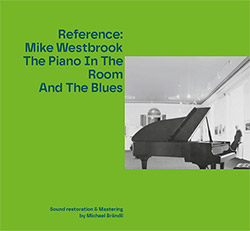 |
| Westbrook, Mike The Piano In The Room And The Blues (ALAY) |
| Recorded on a Steinway in the gallery of Falmouth Arts Centre, pianist Mike Westbrook delivers an introspective solo exploration of the blues, revisiting its forms — eight, twelve, sixteen, and extended bar structures — through spontaneous variations that blur improvisation and instant composition, blending traditional feeling with modern harmonic invention and the ambient sounds around him. |
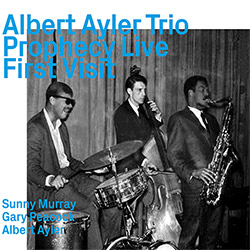 |
| Ayler, Albert Trio Prophecy Live, First Visit (ezz-thetics by Hat Hut Records Ltd) |
| Recorded live at New York City's Cellar Café in June 1964, this essential document captures Albert Ayler, bassist Gary Peacock, and drummer Sunny Murray in a pivotal moment of spiritual free jazz, expressing motifs like 'Ghosts' and 'Spirits' into an ecstatic, ever-evolving language, with this remastered edition offering a refined perspective on a landmark session that shaped Ayler's uncompromising vision. |
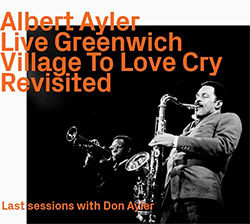 |
| Ayler, Albert Live Greenwich Village To Love Cry, Revisited (ezz-thetics by Hat Hut Records Ltd) |
| Bringing together two contrasting Impulse! albums from Aylers late 60's output: the exemplary free jazz release Live Greenwich Village in two sessions with core Ayler associates, brother Donald, Michael Sampson, Henry Grimes, Beaver Harris, &c.; then Ayler's challenging attempt to reach a more popular following in Love Cry, with Milford Graves taking the drummers chair. |
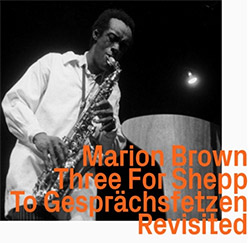 |
| Brown, Marion Three For Shepp to Gesprachsfetzen Revisited (ezz-thetics by Hat Hut Records Ltd) |
| Remastering and restoring Marion Brown's 1967 Impulse! album with Grachan Moncure III, Dave Burrel, Stanley Cowell, Sirone, Beaver Harris & Bobby Capp, and his 1968 album on the Calig label with Gunter Hampel, Steve McCall, Ambrosa Jackson & Buschi Niedergall; two albums of essential "New Thing" work through fascinating composed forms by Brown, plus Archie Shepps' "Delicado"; essential. |
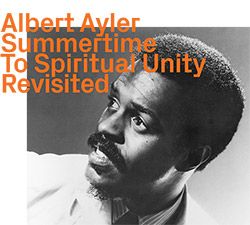 |
| Ayler, Albert Summertime To Spiritual Unity, Revisited (ezz-thetics by Hat Hut Records Ltd) |
| Remastering and reissuing two tracks--"Summertime" and "C.T"--from saxophonist Albert Ayler's 1964 Fontana album My Name Is Albert Ayler with basssist Nils-Henning Orsted Pedersen, drummer Ronnie Gardiner and pianist Nils Bronsted; and his classic and passionate 1965 ESP Disk release Spiritual Unity with double bassist Gary Peacock and drummer Sunny Murray. |
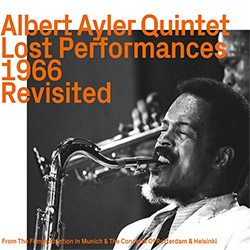 |
| Ayler, Albert Quintet Lost Performances 1966, Revisited (ezz-thetics by Hat Hut Records Ltd) |
| In 1966 tenor saxophonist Albert Ayler toured northern Europe with his ensemble of Donald Ayler on trumpet, Michel Samson on violin, William Folwell on double bass & Beaver Harris on drums, a stellar group performing some of Ayler's most substantial compositions, heard in concerts in Rotterdam and Helsinki, and in the soundtrack to a film recorded in Munich. |
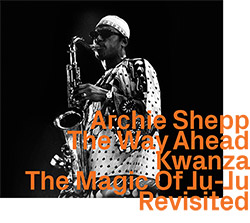 |
| Shepp, Archie The Way Ahead / Kwanza / The Magic Of Ju-Ju, Revisited (ezz-thetics by Hat Hut Records Ltd) |
| Three albums and three distinct groupings in this essential remaster & reissue of two late 60s and one 70s Impulse! albums from saxophonist and composer Archie Shepp, in configurations of septets and nonets with luminaries of the day performing Shepp's rhythm-centric jazz focused on the Afrocentric experience, drawing on blues and spirituals in free jazz settings. |
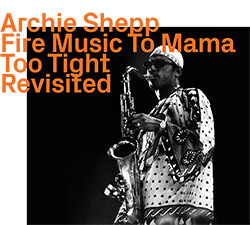 |
| Shepp, Archie Fire Music To Mama Too Tight, Revisited (ezz-thetics by Hat Hut Records Ltd) |
| Archie Shepp's second album for Impulse! merges the fire of free jazz with an incredibly eclectic set of styles, his inclusive approach to composition integrating a vast source of styles from Ellington to Ipanema; this is paired with Shepp's octet release, including an epic 20 minute work for American artist Robert Thompson reflecting his paintings in powerful thematic and abstract expression. |
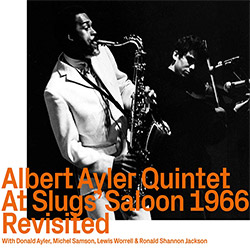 |
| Ayler, Albert Quintet At Slugs' Saloon 1966, Revisited (ezz-thetics by Hat Hut Records Ltd) |
| Combining the two Italian ESP/BASE LPs from 1982 and the 1995 ESP reissues, this spectacular concert with perhaps Ayler's most essential band--Ayler on tenor sax, Donald Ayler on trumpet, Michel Samson on violin, Lewis Worrell on double bass and Ronald Shannon Jackson on drums--is fully remastered to bring out more details from the complete, ecstatic 1966 concert. |
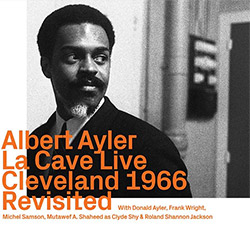 |
| Ayler, Albert La Cave Live, Cleveland 1966 Revisited [2 CDs] (ezz-thetics by Hat Hut Records Ltd) |
| Never-before released recordings of tenor saxophonist Albert Ayler's 1966 band recording in his home town of Cleveland at club La Cave, recorded over two nights in a superb sextet with brother Donald on trumpet, Frank Wright on tenor sax, Michel Samson on violin, Clyde Shy on double bass and Ronald Shannon Jackson on drums, performing Ayler's compositions and Don Cherry's "D.C.". |
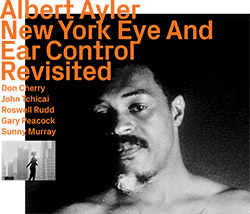 |
| Ayler, Albert Trio New York Eye And Ear Control, Revisited (ezz-thetics by Hat Hut Records Ltd) |
| After moving to NYC in the early 60s, filmmaker Michael Snow was introduced the music of saxophonist Albert Ayler's Trio with bassist Gary Peacock & drummer Sunny Murray, inviting them and trumpeter Don Cherry, trombonist Rudd and altoist John Tchicai to record these three brilliant freely improvised tracks, parts of which would be used in his art film "New York Eye and Ear Control". |
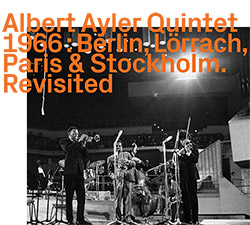 |
| Ayler, Albert Quintet 1966 Berlin, Lorrach, Paris & Stockholm, Revisited [2 CDs] (ezz-thetics by Hat Hut Records Ltd) |
| Tenor saxophonist Albert Ayler's 1966 quintet brought a unique orchestration to his music, heard in these live performances in Berlin, Lörrach, Paris & Stockholm in November of 1966, four concerts presented chronologically as performed with the exemplary playing of brother Donald Ayler on trumpet, Michel Samson on violin, William Folwell on bass, and Beaver Harris on drums. |
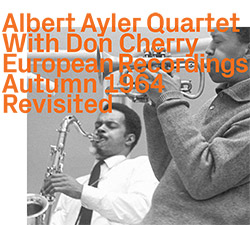 |
| Ayler, Albert Quartet With Don Cherry European Recordings Autumn 1964 (Revisited) [2 CDs] (ezz-thetics by Hat Hut Records Ltd) |
| Essential radio and live recordings from saxophonist Albert Ayler's European tour in 1964 with Don Cherry on cornet, Gary Peacock on double bass and Sunny Murray on drums, a quintessential grouping for Ayler's compositions, here in outstanding renditions of classic works including "Spirits", "Ghosts", "Vibrations", "Mothers", "Childrens", plus Don Cherry's "Infant Happiness". |
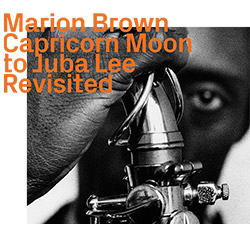 |
| Brown, Marion Capricorn Moon To Juba Lee, Revisited (ezz-thetics by Hat Hut Records Ltd) |
| Merging and remastering two essential albums from free jazz saxophonist Marion Brown: his 1966 ESP album "Marion Brown Quartet" with trumpeter Alan Shorter, bassist Reggie Johnson and percussionist Rahied Ali; and his 1967 Fontana album "Juba-Lee" in a septet with Reggie Johnson, drummer Beaver Harris, pianist Dave Burrell, trombonist Grachan Moncur III & saxophonist Bennie Maupin. |
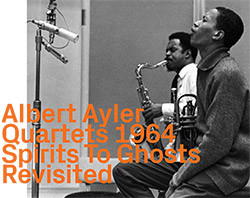 |
| Ayler, Albert Quartets Spirits To Ghosts Revisited (remastered) (ezz-thetics by Hat Hut Records Ltd) |
| Three variations of quartet settings from iconoclastic free jazz saxophonist Albert Ayler, remastering and combining two Debut Records albums, "Spirits" from 1964 with Norman Howard (trumpet), Sunny Murray (drums), and alternating bass between Henry Grimes & Earle Henderson; and 1965's "Ghosts" on Debut Records with Don Cherry (trumpet), Gary Peacock (bass), and Sunny Murray. |
Customers Who Bought This Item Also Bought:
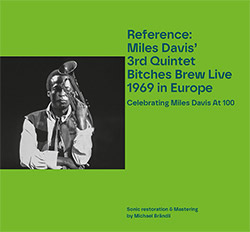 |
| Davis, Miles 3rd Quintet Reference: Bitches Brew Live 1969 In Europe [2 CDs + 2 POSTCARDS] (ALAY) |
| Documenting Miles Davis' 1969 "lost" third quintet live in Berlin, Stockholm and Rotterdam with Wayne Shorter, Chick Corea, Dave Holland and Jack DeJohnette, this 2-CD set captures the post-In a Silent Way ensemble reshaping material headed toward Bitches Brew, balancing lyricism and abstraction through open forms, electric-piano clusters, volatile rhythmic invention and Davis' fiercely exploratory trumpet. |
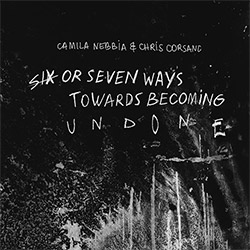 |
| Nebbia, Camila / Chris Corsano Six or Seven Ways Towards Becoming Undone (Relative Pitch) |
| A fierce, spontaneous duo of Camila Nebbia on tenor saxophone and Chris Corsano on drums, recorded in Berlin in 2025, merging Nebbia's searching lines, breath-driven textures and unstable lyricism with Corsano's explosive, highly detailed percussion language, moving between delicate abrasion, surging intensity, fragmented melody and raw improvised exchange. |
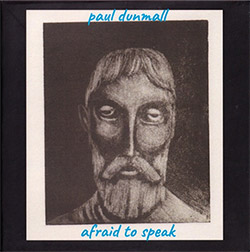 |
| Dunmall, Paul Afraid To Speak (Discus) |
| Returning to a stripped-down free-blowing setting, Paul Dunmall leads a responsive group with Corey Mwamba on vibraphone, Steven Saunders on electric guitar, Dave Kane on double bass, Miles Levin on drums and Xhosa Cole guesting on flute and piccolo, creating five incisive yet finely detailed improvisations of saxophone fire, resonant texture, electric abrasion and collective momentum. |
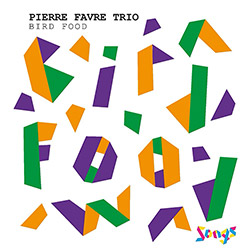 |
| Favre, Pierre Trio (Favre / Schweizer / Mraz) Bird Food (Songs) |
| Captured in 1968 in Zurich and long shelved before its recent discovery, this early trio session brings Pierre Favre, Irene Schweizer, and George Mraz together in a concise, fiery set of attentive free jazz, balancing Ornette Coleman's title piece with Schweizer's compositions, where dynamic interplay and acute listening reveal a nascent yet fully engaged collective voice. |
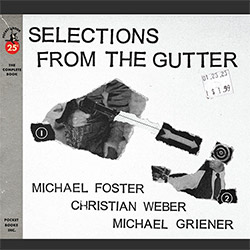 |
| Foster, Michael / Christian Weber / Michael Griener Selections From The Gutter (Relative Pitch) |
| NYC saxophonist Michael Foster joins Swiss bassist Christian Weber and Berlin drummer Michael Griener for a visceral trio session of free improv charged with noir tension, drawing on American crime novelist David Goodis-inspired titles as the group moves through fractured momentum, suspenseful restraint and explosive exchanges shaped by deep rhythmic instinct and structural awareness. |
![Airlift (Diehl / Lowery / Lawson / Levin / Lavelle / Hotep / Marquez / Dennis): Spatial Recognition [2 CDs]](https://www.teuthida.com/productImages/misc4/37874.jpg)

![Taylor, Cecil Unit: Live at the KiMo Theatre Albuquerque 1979 [VINYL 2 LPs]](https://www.teuthida.com/productImages/misc4/37966.jpg)
![Sun Ra / Merzbow: Strange City [2 CDs]](https://www.teuthida.com/productImages/misc4/37648.jpg)
![Mollestad, Hedvig Weejuns: Bitches Blues [VINYL]](https://www.teuthida.com/productImages/misc4/37656.jpg)
![Bopp, Christiane: Rever, murmurer, dire [CD + DOWNLOAD]](https://www.teuthida.com/productImages/misc4/37823.jpg)


![Perelman, Ivo / Matthew Shipp: Duologues 7: Distillation [5x5 ALBUM FACSIMILE WITH DOWNLOAD]](https://www.teuthida.com/productImages/misc4/38004.jpg)

![Mori, Ikue: Enchanted and Delighted [CD + DVD]](https://www.teuthida.com/productImages/misc4/37828.jpg)



![Corsano, Chris / Tashi Dorji: Live at Ritual Botanica [VINYL]](https://www.teuthida.com/productImages/misc4/37552.jpg)

![My Face Is Dancing (Federico Ughi / Alberto Ughi / Martino Ughi / Benjamin Ughi): My Face Is Dancing [VINYL]](https://www.teuthida.com/productImages/misc4/37836.jpg)
![Radigue, Eliane: Triptych [VINYL 2 LPs]](https://www.teuthida.com/productImages/misc4/37875.jpg)
![Money: 5 [2 CDs]](https://www.teuthida.com/productImages/misc4/37890.jpg)
![Drumm, Kevin: The Mild Temper [6 CD BOX SET]](https://www.teuthida.com/productImages/misc4/37651.jpg)
![TRAC (Teddy Ryles / Alexander Cooper): Heavy Nano Ream Aria [2 CDs]](https://www.teuthida.com/productImages/misc4/37647.jpg)
![Jerman, Jeph: For Alvin Kelly [CASSETTE + DOWNLOAD]](https://www.teuthida.com/productImages/misc4/37521.jpg)
![Mann, Oliver / Stefano Pilia: Precious Moments [CASSETTE + DOWNLOAD]](https://www.teuthida.com/productImages/misc4/37494.jpg)
![Jerman, Jeph / Ted Byrnes: Muir [CASSETTE + DOWNLOAD]](https://www.teuthida.com/productImages/misc4/37520.jpg)
![+DOG+: Angel Wings [VINYL]](https://www.teuthida.com/productImages/misc4/37513.jpg)
![Rose, Jon: Rosenberg Museum [4 CDs]](https://www.teuthida.com/productImages/misc4/37935.jpg)
![Tilbury, John: At Home [4 CDs]](https://www.teuthida.com/productImages/misc4/37729.jpg)
![Scott, Ryan: 21st-Century Canadian Snare Drum [2 CDs]](https://www.teuthida.com/productImages/misc4/37538.jpg)

![Feldman, Morton / GBSR Duo w/ Taylor MacLennan: Trios [6 CD BOX SET]](https://www.teuthida.com/productImages/misc4/37020.jpg)
![Frey, Jurg : Composer, Alone [3 CDs]](https://www.teuthida.com/productImages/misc4/36927.jpg)
![Bruce, Lenny: Comedy & Controversy: The Original Albums 1958-61 [2 CDs]](https://www.teuthida.com/productImages/misc4/37409.jpg)

![Amba, Zoh: Eyes Full [VINYL]](https://www.teuthida.com/productImages/misc4/37491.jpg)

![Henry Cow: The Henry Cow Box Redux: The Complete Henry Cow [18 CDs, DVD & 3 BOOKLETS]](https://www.teuthida.com/productImages/misc4/37272.jpg)
![MacLean, Steve: Box Of Seven [7 CD BOX]](https://www.teuthida.com/productImages/misc4/36467.jpg)
![Mehead: One Good Eye [REISSUE]](https://www.teuthida.com/productImages/misc4/37276.jpg)
![Zorn, John: The Song of Songs [CD + CD BOOK]](https://www.teuthida.com/productImages/misc4/36923.jpg)
![Coultrain: Mundus [COLORED VINYL]](https://www.teuthida.com/productImages/misc4/33056.jpg)
![Hprizm: Signs Remixed [COLORED VINYL]](https://www.teuthida.com/productImages/misc4/30635.jpg)
![Halls Of the Machine: All Tribal Dignitaries [CASSETTE w/ DOWNLOAD]](https://www.teuthida.com/productImages/misc4/36134.jpg)
![Koenjihyakkei: Live at Club Goodman [2 CDs]](https://www.teuthida.com/productImages/misc4/36111.jpg)
![Sorry For Laughing (G. Whitlow / M. Bates / Dave-Id / E. Ka-Spel): Rain Flowers [2 CDS]](https://www.teuthida.com/productImages/misc4/35985.jpg)
![Rolando, Tommaso / Andy Moor : Biscotti [CASSETTE w/ DOWNLOADS]](https://www.teuthida.com/productImages/misc4/36106.jpg)
![Electric Bird Noise / Derek Roddy: 8-10-22 [CD EP]](https://www.teuthida.com/productImages/misc4/35970.jpg)
![Coley, Byron: Dating Tips for Touring Bands [VINYL]](https://www.teuthida.com/productImages/misc4/17906.jpg)

![Lost Kisses: My Life is Sad & Funny [DVD]](https://www.teuthida.com/productImages/misc4/lostKissesDVD.jpg)