



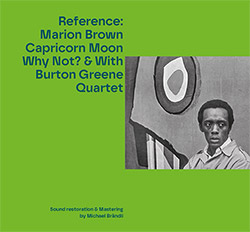
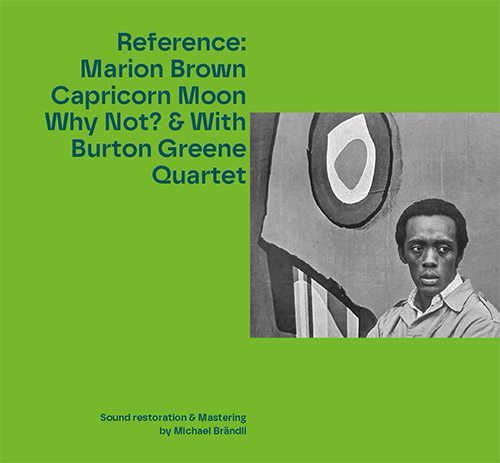
Gathering key 1965-66 New York sessions, this 2-CD set traces alto saxophonist Marion Brown's emergence in the free jazz vanguard through Capricorn Moon, Why Not? and Burton Greene quartet recordings, with Alan Shorter, Bennie Maupin, Stanley Cowell, Henry Grimes, Sirone, Rashied Ali and others shaping music of lyrical urgency, open-form momentum and evolving collective freedom.
In Stock
Quantity in Basket: None
Log In to use our Wish List
Shipping Weight: 5.00 units
EU & UK Customers:
Discogs.com can handle your VAT payments
So please order through Discogs
Sample The Album:
Marion Brown-alto saxophone
Alan Shorter-trumpet
Bennie Maupin-tenor saxophone
Frank Smith-tenor saxophone
Stanley Cowell-piano
Burton Greene-piano, Percussion
Reggie Johnson-double bass
Ronnie Boykins-double bass
Henry Grimes-double bass
Sirone-double bass
Rashied Ali-drums, percussion
Dave Grant-drums
Tom Price-drums
Click an artist name above to see in-stock items for that artist.
Includes two color postcard.
UPC: 7649988716850
Label: ALAY
Catalog ID: thingamajig 2506-2
Squidco Product Code: 37313
Format: 2 CDs
Condition: New
Released: 2026
Country: Switzerland
Packaging: Cardboard Gatefold
CD1 tracks 1-4 recorded in NYC, in 1965.
CD1 track 5 recorded in NYC, in January, 1966.
CD2 recorded in NYC, in October, 1966.
Capricorn Moon originally released in 1966 as a vinyl LP on the ESP-Disk label with catalog code ESP 1022.
Why Not originally released in 1968 as a vinyl LP on the ESP-Disk label with catalog code ESP 1040.
Burton Greene Quartet originally released in 1966 as a vinyl LP on the ESP-Disk label with catalog code ESP 1024.
"This two-CD set documents several important early recordings by alto saxophonist Marion Brown, one of the key voices to emerge from the New York avant-garde jazz scene of the mid-1960s. Having relocated to the city in 1962, Brown quickly became part of the vibrant Lower East Side community of musicians, poets and artists exploring new musical freedoms following the breakthroughs of Ornette Coleman, Cecil Taylor and John Coltrane.
The first disc centers on the powerful 1965 session Capricorn Moon, recorded in New York with a group including Alan Shorter on trumpet, Reggie Johnson and Ronnie Boykins on bass, Bennie Maupin on tenor saxophone and Rashied Ali on drums. The music combines open improvisation with memorable thematic material, revealing Brown's lyrical approach to the alto saxophone and his interest in melodic development within free jazz structures.
The set also includes recordings from pianist Burton Greene's quartet sessions of early 1966, where Brown appears as a sideman alongside Henry Grimes and drummer Dave Grant. These performances capture the fluid creative exchanges within the emerging free jazz community, blending Greene's percussive piano style with Brown's expressive and sharply articulated alto lines.
The second disc presents the complete album Why Not?, recorded later in 1966 with pianist Stanley Cowell, bassist Sirone and drummer Rashied Ali. Here Brown's compositional voice becomes more narrative and evocative, with pieces that balance exploratory improvisation and strong thematic direction. These recordings illustrate a crucial period in Brown's artistic development and the broader evolution of free jazz during one of its most innovative eras."-ALAY
"When Marion Brown relocated to New York City in 1962, following a stint in the Army where he was stationed for a time in Japan, advanced music studies with former Chick Webb multi-reedman Wayman Carver at Clark College in his hometown of Atlanta, and a brief period of law classes at Howard University, he encountered a burgeoning community of musicians determined to further expand the formal parameters and expressive content of jazz's post-bop and newly proposed freedoms as recently initiated by Ornette Coleman, Thelonious Monk, Charles Mingus, Cecil Taylor, and John Coltrane.
The neighborhood he settled into - encompassing blocks of the Lower East Side, the Bowery, and what became known as Alphabet City - may not have had the historic cachet of Greenwich Village, but nevertheless was a relatively inexpensive, if less than luxurious, haven for poets, painters, and musicians. Among his earliest contacts was another former Howard University attendee, the poet, playwright, and critic Amiri Baraka (then Leroi Jones), who lived at 27 Cooper Square, a building that also housed Archie Shepp, Norris Jones (aka Sirone), and Marzette Watts. Through these connections, Brown quickly began picking up sporadic but creative, unfortunately undocumented, gigs, in essence serving his apprenticeship, with Shepp, Bill Dixon, Paul Bley, the Jazz Composers' Guild Orchestra, and especially Sun Ra, who apparently advised Brown to stop trying to play like Charlie Parker. His breakthrough occurred in 1965 - with his first appearance on disc as sideman to Archie Shepp (Fire Music), an invitation from John Coltrane to participate in the recording of Ascension, and his own first session for ESP, succinctly titled Marion Brown Quartet.
Although active in the milieu of dramatic expressionists like Coltrane, Shepp, and Sun Ra, in a January 1967 interview with the Detroit alternative newspaper Guerrilla Brown acknowledged "The best altoists have always had this very recognizable quality of lyricism, in any case those who have influenced me: Johnny Hodges, (Benny) Carter, (Charlie) Parker, (Jackie) McLean, Cannonball (Adderley), and Ornette.... I want to make beautiful music." Certainly, Ornette stands out as a key influence on Brown's debut album - but perhaps surprisingly more as a composer than improviser. In his themes and the tunes' formal environment one may hear echoes of Coleman's "Peace," "Ramblin'," "Kaleidoscope," and "Congeniality;" while Brown's solos - with melodic episodes subdivided into motifs, structured around rhythmic shapes, andelaborating on compact phrases - sound spontaneously crafted rather than fully free-associative, with the occasional high-register excursions more for tonal contrast than emotional catharsis. The rhythm team of familiar partners Rashied Ali and Reggie Johnson (with former Sun Ra compatriot Ronnie Boykins thickening the textural flow only on "Capricorn Moon") provide a substantial foundation, and Alan Shorter's pungent trumpet is a complementary voice, as is Bennie Maupin's single, tightly-wound statement.
The inclusion here of Brown as sideman on pianist Burton Greene's own, all-but-ignored ESP album, recorded just a month later, gives a good indication of how fluid and negotiable the musical activities were within this embryonic community. This quartet, although with Rashied Ali on drums, had performed intermittently, but by the time of the recording Ali was working with John Coltrane and thus unavailable. The music, balanced on Greene's gleefully dissonant clusters and inside-the-piano diversions, allows Brown a broader range of interpretive possibilities, from the mournful tone poem "Ballade II" to the blistering rebellion of "Taking It Out Of The Ground," where in the latter Brown's alto achieves a knife-edge urgency in tandem with Frank Smith's volatile tenor sax.
Why Not, Brown's second ESP album, suggests a transitional phase in his conceptual evolution, where a shift to evocative or revelatory moods and programmatic details would eventually lead to his acclaimed 1970s Southern-based "trilogy," Afternoon of a Georgia Faun, Geechee Recollections, and Sweet Earth Flying. Though distinct, the four pieces on Why Not present Brown the composer in a storytelling mode, using references and intimations from the past as infusions of character and plot. For example, though Stanley Cowell's extended piano rhapsody and Brown's piquant alto transform the material, the full theme of "La Sorella" heard at approximately the ten-minute mark is borrowed from French composer Charles Borel-Clerc's 1905 composition of the same name, originally adapted from a Brazilian folk dance. "Fortunato" is an eloquent, yearning, traditionally conceived ballad, but one wonders if the title is a reference to the unfortunate victim of the same name in Edgar Allan Poe's story "The Cask of Amontillado."
"Homecoming" hints at several interpretations - it begins, after a drum tattoo, with a sentimental melody (in the style of "Auld Lang Syne," of Scottish origin) reminiscent of a college anthem, disrupted by a fragmented paraphrase of "Garryowen," an Irish jig adopted by ill-fated General George Armstrong Custer's 7th Calvary after the Civil War, followed by Cowell's compelling chromatic pseudo-stride piano, then Brown's alto insinuating military fanfares and "Three Blind Mice," bass and drum solos, and a return to the opening, concluding with a crash. Could the military allusions relate to Brown's life experiences? Does the title suggest a nostalgic musical hallucination? Why not?"-Art Lange, Chicago, January 2026
Includes two color postcard.
Artist Biographies
• Show Bio for Marion Brown "Marion Brown (September 8, 1931 - October 18, 2010) was an American jazz alto saxophonist and ethnomusicologist. He is most well known as a member of the 1960s avant-garde jazz scene in New York City, playing alongside musicians such as John Coltrane, Archie Shepp, and John Tchicai. He performed on Coltrane's landmark 1965 album Ascension. Brown was born in Atlanta, in 1931. He joined the Army in 1953 and in 1956 went to Clark College to study music. In 1960 Brown left Atlanta and studied pre-law at Howard University for two years. He moved in 1962 to New York, where he befriended poet Amiri Baraka and musicians including Ornette Coleman, Archie Shepp, Sun Ra, Pharoah Sanders, Paul Bley, Clifford Thornton, and Rashied Ali. He appeared on several important albums from this period, such as Shepp's Fire Music and Attica Blues, but most notably John Coltrane's Ascension. In 1967, Brown travelled to Paris, where he developed an interest in architecture, Impressionistic art, African music and the music of Erik Satie. In the late 1960s, he was an American Fellow in Music Composition and Performance at the Cité Internationale des Arts in Paris. Around 1970, he provided the soundtrack for Marcel Camus' film Le temps fou, a soundtrack featuring Steve McCall, Barre Phillips, Ambrose Jackson and Gunter Hampel. Brown returned to the US in 1970, where he felt a newfound sense of creative drive. He moved to New Haven, Connecticut, to serve as a resource teacher in a child study center in the city's public school system until 1971. He composed and performed incidental music for a Georg Büchner play, Woyzeck. In 1971, Brown was an assistant professor of music at Bowdoin College in Brunswick, Maine, a position he held until he attained his Bachelor's degree in 1974. In addition to this role, he held faculty positions at Brandeis University (1971-74), Colby College (1973-74), and Amherst College (1974-75), as well as a graduate assistant position at Wesleyan University (1974-76). Brown earned a Master's degree in ethnomusicology from Wesleyan in 1976. His master's thesis was entitled "Faces and Places: The Music and Travels of a Contemporary Jazz Musician". Throughout his tenure as an educator, Brown continued to compose, perform and record. Notable recordings during this period included Afternoon of a Georgia Faun for the ECM label in 1970 and three albums for the Impulse! label between 1973 and 1975. He played alto saxophone on the composition "Bismillahi 'Rrahman 'Rrahim" from Harold Budd's 1976 release The Pavilion of Dreams, a piece originally written by Budd for Brown's Vista LP, released the previous year. In 1972 and 1976, Brown received grants from the National Endowment for the Arts, which he used to compose and publish several pieces for solo piano, one of which was based on the poetry of Jean Toomer in his book Cane. He also transcribed some piano and organ music by Erik Satie including his Messe des pauvres and Pages mysterieuses, and arranged the composer's Le Fils des étoiles for two guitars and violin. In 1981, Brown began focusing on drawing and painting. His charcoal portrait of blues guitarist Blind Lemon Jefferson was included in a New York City Kenkeleba Gallery art show called Jus' Jass, which also included works by artists such as Romare Bearden, Charles Searles and Joe Overstreet. By the 2000s, Brown had fallen ill; due to a series of surgeries and a partial leg amputation, Brown resided for a time in a nursing home in New York. By 2005 he had moved to an assisted living facility in Hollywood, Florida, where he died in 2010, aged 79." ^ Hide Bio for Marion Brown • Show Bio for Alan Shorter "Alan Shorter (May 29, 1932 - April 5, 1988) was a free jazz trumpet and flugelhorn player, and the older brother of composer and saxophone player Wayne Shorter. Shorter was born in the Ironbound District in Newark, New Jersey. He started on alto saxophone, but switched to trumpet after graduating from high school. He attended Howard University but soon rebelled against the ultra-conservative atmosphere and dropped out. He later graduated from New York University. He played his first professional gigs with a local bebop big band called the Jackie Bland Band (other members included his brother Wayne, trombonist Grachan Moncur III, and pianist Walter Davis, Jr.). He was very much a bebop player in his early years, but soon gravitated towards free jazz, and with the exception of six months he spent in a US Army Band, continued to play in that style for the rest of his career. Shorter recorded two albums as a leader: Orgasm (1968) and Tes Esat (1971). Both were out of print for many years until re-issued by Verve Records in 2004 and 2005, respectively. He also recorded five albums with saxophonist Archie Shepp (1964-1970), including the classic Four for Trane (1964), two albums with Marion Brown (1965-1966), one album with Alan Silva (1970), and made an appearance on one of his brother's albums (The All Seeing Eye ). Several of these albums feature his unusual compositions, his most famous being "Mephistopheles". In the mid-1960s, Shorter moved to Europe, leading his own avant-garde gigs in Geneva and Paris. His style of free jazz sometimes proved to be too far-out for European audiences (his brother remembered that Shorter's gigs in Europe would often end with him responding to the crowd's boos by yelling, "You're not ready for me yet!"), but he generally found European audiences more receptive than those in the U.S. Eventually, he returned to the United States, where he taught briefly at Bennington College but otherwise faded into obscurity. He died of a ruptured aorta in Los Angeles, California in 1988, at age 56, shortly after becoming engaged to Ruth Ann Hancock, a cousin of Herbie Hancock. Shorter's playing is comparable to Don Cherry, but with a more aggressive, anarchic bent. His own albums feature his groups functioning as a unit, rather than focusing on his own virtuosity (or lack thereof). Reportedly, his musical style is much like he was personally: deep and intellectual, but intentionally strange (his childhood nickname was "Doc Strange")." ^ Hide Bio for Alan Shorter • Show Bio for Bennie Maupin "Bennie Maupin's highly personal bass clarinet sound helped define such classic jazz recordings as Miles Davis' Bitches Brew, Jack Johnson, Big Fun and On the Corner, as well as recordings by Herbie Hancock's Mwandishi band, and the Headhunters. The multi-woodwind player has also recorded with Marion Brown, Chick Corea, Horace Silver, McCoy Tyner, Lee Morgan, Freddie Hubbard, Jack DeJohnette, Andrew Hill, Eddie Henderson and Woody Shaw, to name only a few. The instrumentation of Maupin's current group, The Bennie Maupin Ensemble, harkens back to the tradition of great saxophone-bass-drum trios, such as the group led by Sonny Rollins with Wilbur Ware and Elvin Jones. Maupin's approach to his music is intentional and profound, yet alive in the interpretation of the moment." ^ Hide Bio for Bennie Maupin • Show Bio for Frank Smith Frank Smith was a tenor saxophonist associated with the mid-1960s New York free jazz scene, appearing on Burton Greene's ESP-Disk recording with Marion Brown, Henry Grimes, Dave Grant and Tom Price. Though little biographical information is widely documented, Smith was part of the same exploratory circle around ESP-Disk, Ayler, Brown and Greene, bringing an intense tenor voice to the era's expanding language of collective improvisation. ^ Hide Bio for Frank Smith • Show Bio for Stanley Cowell "Stanley Cowell (born May 5, 1941) is an American jazz pianist and co-founder of the Strata-East Records label. Cowell played with Marion Brown, Max Roach, Bobby Hutcherson, Clifford Jordan, Harold Land, Sonny Rollins and Stan Getz. Cowell played with trumpeter Charles Moore and others in the Detroit Artist's Workshop Jazz Ensemble in 1965�66. During the late 1980s Cowell was part of a regular quartet led by J.J. Johnson. Cowell taught in the Music Department of the Mason Gross School of the Arts at Rutgers, the State University of New Jersey. Cowell played with Marion Brown, Max Roach, Bobby Hutcherson, Clifford Jordan, Harold Land, Sonny Rollins and Stan Getz. Cowell played with trumpeter Charles Moore and others in the Detroit Artist's Workshop Jazz Ensemble in 1965�66. During the late 1980s Cowell was part of a regular quartet led by J.J. Johnson. Cowell taught in the Music Department of the Mason Gross School of the Arts at Rutgers, the State University of New Jersey." ^ Hide Bio for Stanley Cowell • Show Bio for Burton Greene "Burton Greene (born June 14, 1937) is a free jazz pianist born in Chicago, Illinois, though most known for his work in New York City. He has explored a variety of genres, including avant-garde jazz and the Klezmer medium. Greene rose to popularity during the 1960s on New York's free jazz scene, gigging with well-known musicians which included Alan Silva and Marion Brown, among a host of others. With Alan Silva he formed the Free Form Improvisation Ensemble in 1963. He joined Bill Dixon's and Cecil Taylor's Jazz Composers Guild in 1964, and also played with a number of other artists, including Rashied Ali, Albert Ayler, Gato Barbieri, Byard Lancaster, Sam Rivers, Patty Waters, and others. During this time, he recorded two albums under his own name for ESP-Disk. He moved to Europe in 1969, first to Paris. Since then he has been living in Amsterdam and played with such Dutch musicians as Maarten Altena and Willem Breuker. During the late 1980s he began exploring the Klezmer tradition in his groups Klezmokum (along with Perry Robinson), Klez-thetics, and a more recent group called Klez-Edge with vocalist Marek Balata. Klez-Edge has a recent recording Ancestors, Mindreles, NaGila Monsters (2008) out on John Zorn's Tzadik label. A duet with Perry Robinson, also on the Tzadik label, Two Voices in the Desert was released in January 2009. Since the mid-1990s Greene has often performed and recorded in New York and along the East Coast. Greene's recent performance and recorded groups based in New York include a duet with bassist Mark Dresser; a quartet with trumpeter Roy Campbell, Lou Grassi and Adam Lane; a trio with Ed and George Schuller on bass and drums (recorded on the CIMP label); and a quintet with the Schuller brothers, Russ Nolan on saxes and flute and Paul Smoker on trumpet. His autobiography written over 20 years, Memoirs of a Musical Pesty-Mystic, was published in 2001 (Cadence Jazz Books)." ^ Hide Bio for Burton Greene • Show Bio for Reggie Johnson "Reginald Volney Johnson (born December 13, 1940) is an American jazz double-bassist. Johnson was born in Owensboro, Kentucky. After playing trombone with school orchestras and army bands, he switched to double bass, and started working with musicians such as Bill Barron and recording with Archie Shepp in the mid-1960s, before joining Art Blakey's band for a month-long residency at the Five Spot Café in December 1965, and then going on to The Lighthouse nightclub in Hermosa Beach, California, where they recorded the live album, Buttercorn Lady, at the beginning of 1966, with a line-up, comprising Blakey, Frank Mitchell, Chuck Mangione, Keith Jarrett, and Johnson. He has also played and/or recorded with Bill Dixon, Sun Ra, and Burton Greene, Lonnie Liston Smith, Stanley Cowell, Bobby Hutcherson, Harold Land, Blue Mitchell, Walter Bishop Jr., Sonny Rollins, Sonny Stitt, Sarah Vaughan, Carmen McRae, Art Pepper, Kenny Burrell, Clark Terry, The Crusaders, Johnny Coles, and Frank Wess. In the mid-1980s he moved to Europe, where he has worked with Johnny Griffin, Horace Parlan, Monty Alexander, Kenny Barron, Tom Harrell, Phil Woods, Cedar Walton, Alvin Queen, Jesse Davis, Freddie Redd and Clark Terry." ^ Hide Bio for Reggie Johnson • Show Bio for Ronnie Boykins "Ronnie Boykins (December 17, 1935 - April 20, 1980) was a jazz bassist and is best known for his work with pianist/bandleader Sun Ra, although he had played with such disparate musicians as Muddy Waters, Johnny Griffin, and Jimmy Witherspoon prior to joining Sun Ra's Arkestra. He joined the Arkestra during the Chicago period, travelled with them to Canada and then to New York City. Boykins has been described as "the pivot around which much of Sun Ra's music revolved for 8 years". This is especially pronounced on the key recordings from 1965 (The Magic City, The Heliocentric Worlds of Sun Ra, Volume One and The Heliocentric Worlds of Sun Ra, Volume Two) where the intertwining lines of Boykins' bass and Ra's electronic keyboards provide the cohesion. He was a regular member of Sun Ra's band from 1958 until 1966, and occasionally thereafter up to 1974. Like his fellow Sun Ra bandmates, John Gilmore and Pat Patrick, Boykins attended Chicago's DuSable High School and studied under its famed music teacher "Captain" Walter Dyett. He also studied with Ernie Shepard, who would later work with Duke Ellington. Before joining Ra, Boykins had joined with a trombonist friend to open a private club-The House of Culture-with the intent of promoting black culture. Boykins' arco solo on Sun Ra's "Rocket No. 9 Take Off for Planet Venus" from 1960 may be the first recorded example of the bass being played in a horn-like manner within a relatively free context, predating similar work by Alan Silva and David Izenzon. Boykins worked with both free and straight-ahead musicians. In 1962, he recorded with the hard bop tenor saxophonist Bill Barron and, the next year, with pianist Elmo Hope. Boykins worked with tenor saxophonist Archie Shepp's New York Contemporary Five in 1964. Boykins left Ra in 1966, ostensibly to pursue more lucrative opportunities; Ra had a difficult time finding a replacement, at times settling for playing his own bass lines on keyboard. In the late '60s, he formed his own group, the Free Jazz Society, which included the pianist John Hicks. In the '70s, Boykins played with the Melodic Art-tet, a cooperative free jazz ensemble that also included drummer Roger Blank, saxophonist Charles Brackeen, and trumpeter Ahmed Abdullah. In 1975, the bassist led a session for ESP Disk that produced his sole LP as a leader, The Will Come, Is Now. In 1979 he played with Steve Lacy and Dennis Charles on New York Capers and Quirks. In the course of his career, Boykins also worked with Mary Lou Williams, Marion Brown, Sarah Vaughan, and Hajj Daoud Haroon, among others. He died of a heart attack in 1980 at the age of 44." ^ Hide Bio for Ronnie Boykins • Show Bio for Henry Grimes "As of the beginning of 2016, master jazz musician Henry Grimes (acoustic bass, violin, poetry, illustrations) had played more than 615 concerts in 31 countries (including many festivals) since 2003, when he made his astonishing return to the music world after 35 years away. He was born and raised in Philadelphia and attended the Mastbaum School (1949-52) and Juilliard (1952-54). As a youngster in the '50's and early '60's, he came up in the music playing and touring with Willis "Gator Tail" Jackson, Arnett Cobb, "Bullmoose" Jackson, "Little" Willie John, King Curtis, and a number of other great R&B / soul musicians; but drawn to jazz, he went on to play, tour, and record with many great jazz musicians of that era, including Albert Ayler, Don Cherry, Benny Goodman, Coleman Hawkins, Roy Haynes, Lee Konitz, Steve Lacy, Charles Mingus, Thelonious Monk, Gerry Mulligan, Sunny Murray, Sonny Rollins, Pharoah Sanders, Archie Shepp, Cecil Taylor, and McCoy Tyner. Sadly, a trip to the West Coast to work with Al Jarreau and Jon Hendricks went awry, leaving Henry in Los Angeles at the end of the '60's with a broken bass he couldn't pay to repair, so he sold it for a small sum and faded away from the music world. Many years passed with nothing heard from him, as he lived in his tiny rented room in an S.R.O. hotel in downtown Los Angeles, working as a manual laborer, custodian, and maintenance man, and writing many volumes of handwritten poetry. He was discovered there by a Georgia social worker in 2002 and was given a bass by William Parker, and after only a few weeks of ferocious woodshedding, Henry emerged from his room to begin playing concerts around Los Angeles and shortly afterwards made a triumphant return to New York City in May, 2003 to play in the Vision Festival. Since then, often working as a leader, he has played, toured, and / or recorded with many of this era's musical and literary heroes, such as Chris Abani, Rashied Ali, Geri Allen, Marshall Allen, Barry Altschul, Fred Anderson, Tatsu Aoki, Newman Taylor Baker, Billy Bang, Harrison Bankhead, Amiri Baraka, Joey Baron, Hamiet Bluiett, Dave Burrell, Roy Campbell Jr., Alex & Nels Cline, Cooper-Moore, Marilyn Crispell, Connie Crothers, Ted Curson, Andrew Cyrille, Thulani Davis, Toi Derricotte, Bill Dixon, Pierre Dorge, Hamid Drake, Paul Dunmall, Cornelius Eady, Kahil El'Zabar, Douglas Ewart, Bobby Few, Charles Gayle, Melvin Gibbs, Yoriyuki Harada, Craig Harris, Graham Haynes, Karma Mayet Johnson, Edward "Kidd" Jordan, Andrew Lamb, Nathaniel Mackey, Maria Mitchell, Nicole Mitchell, Roscoe Mitchell, Elaine Mitchener, Louis Moholo-Moholo, Meredith Monk [recording only], Jemeel Moondoc, Jason Moran, David Murray, Sunny Murray, Amina Claudine Myers, Zim Ngqawana, Kresten Osgood, William Parker, HPrizm (High Priest, Kyle Austin), Odean Pope, Avreeayl Ra, Tomeka Reid, Vernon Reid, Marc Ribot, Matana Roberts, Orphy Robinson, Brandon Ross, Lee Mixashawn Rozie, Mark Sanders, Rasul Siddik, Wadada Leo Smith, Warren Smith, Tyshawn Sorey, Sekou Sundiata, Tani Tabbal, Jamaaladeen Tacuma, Aldo Tambellini, Greg Tate, Cecil Taylor (reunion), Chad Taylor, John Tchicai, Pat Thomas, Henry Threadgill, Edwin Torres, Dwight Trible, Jeff "Tain" Watts, Ed Wilkerson Jr., James Zollar, John Zorn, and too many others to list here. In the past few years, Henry has also held a number of residencies and offered workshops and master classes on major campuses, including: Berklee College of Music (Boston); Buffalo Academy for Visual & Performing Arts (upstate New York); CalArts, hosted by Wadada Leo Smith (Valencia, California); the Carlucci School, with Andrew Lamb and Newman Taylor Baker (Portugal); Hamilton College of Performing Arts, with Rashied Ali (upstate New York); Humber College (Toronto); JazzInstitut Darmstadt (Germany); Mills College, hosted by Roscoe Mitchell (Oakland, California); New England Conservatory (Boston, Massachusetts); Scuole Bruscio and Scuole Poschiavo (Switzerland); the University of Gloucestershire at Cheltenham (U.K.); University of Illinois at Urbana-Champaign, Illinois; University of Michigan at Ann Arbor; and several more. Henry can be heard on about a dozen new recordings, made his professional debut on a second instrument (the violin) at the age of 70 alongside Cecil Taylor at Lincoln Center, has seen the publication of the first volume of his poetry, "Signs Along the Road," by a publisher in Cologne, and creates illustrations to accompany his new recordings and publications. He has received many honors in recent years, including four Meet the Composer grants. Mr. Grimes can be heard on 90+ recordings on various labels, including Atlantic, Ayler Records, Blue Note, Columbia, ESP-Disk, ILK Music, Impulse!, JazzNewYork Productions, Pi Recordings, Porter Records, Prestige, Riverside, and Verve. He is the subject of a new biography published in London, "Music to Silence to Music: A Biography of Henry Grimes" by Dr. Barbara Frenz, with a beautiful foreword by Sonny Rollins (http://tinyurl.com/h9f8mo4). And on July 7th, 2016, Henry received a Lifetime Achievement Award and played a full evening of concerts with groups of his own choosing in the Arts for Art / Vision Festival at Judson Memorial Church in New York City , where he had also played and recorded with Albert Ayler's group back in the '60s. Henry Grimes is now a permanent resident of New York City and welcomes students here." ^ Hide Bio for Henry Grimes • Show Bio for Sirone "Norris Jones, better known as Sirone (September 28, 1940 � October 21, 2009) was an American jazz bassist and composer. Born in Atlanta, Georgia, Sirone worked in Atlanta late in the 1950s and early in the 1960s with "The Group" alongside George Adams; he also recorded with R&B musicians such as Sam Cooke and Smokey Robinson. He moved to New York City in the middle of the 1960s, where he co-founded the "Untraditional Jazz Improvisational Team" with Dave Burrell. He also worked with Marion Brown, Gato Barbieri, Pharoah Sanders, Noah Howard, Sonny Sharrock, Sunny Murray, Albert Ayler, Archie Shepp, and Sun Ra. He co-founded the Revolutionary Ensemble with Leroy Jenkins and Frank Clayton in 1971; Jerome Cooper later replaced Clayton in the ensemble, which was active for much of the decade. In the 1970s and early 1980s Sirone recorded with Clifford Thornton, Roswell Rudd, Dewey Redman, Cecil Taylor, and Walt Dickerson. In the 1980s, he was member of Phalanx, a group with guitarist James "Blood" Ulmer, drummer Rashied Ali, and tenor saxophonist George Adams. From 1989 he lived in Berlin, Germany where he was active with his group 'Concord' (with Ben Abarbanel-Wolff and Ulli Bartel.) He was involved in theater, film, and was a practicing Buddhist. He died on October 21, 2009." ^ Hide Bio for Sirone • Show Bio for Rashied Ali "Rashied Ali, born Robert Patterson (July 1, 1933) was a progenitor and leading exponent of multidirectional rhythms and polytonal percussion. A student of Philly Joe Jones and an admirer of Art Blakey, Ali developed the style known as "free jazz" drumming, which liberates the percussionist from the role of human metronome. The drummer interfaces both rhythmically and melodically with the music, utilizing meter and sound in a unique fashion. This allows the percussionist to participate in the music in a harmonic sense, coloring both the rhythm and tonality with his personal perception. By adding his voice to the ensemble, the percussionist becomes an equal in the melodics of collective musical creation rather than a "pot banger" who keeps the others all playing at the same speed. Considered radical in the 1960s and scorned by the mediocre, multidirectional rhythms and polytonal drumming are now the landmark of the jazz percussionist. A Philadelphia native, Rashied Ali began his percussion career in the U.S. Army and started gigging with rhythm and blues and rock groups when he returned from the service. Cutting his musical teeth with local Philly R&B groups, such as Dick Hart & the Heartaches, Big Maybelle and Lin Holt, Rashied gradually moved on to play in the local jazz scene with such notables as Lee Morgan, Don Patterson and Jimmy Smith. Early in the 1960s the Big Apple beckoned, and soon Rashied Ali was a fixture of the avant-garde jazz scene, backing up the excursions of such musical free spirits as Don Cherry, Pharoah Sanders, Paul Bley, Archie Shepp, Bill Dixon and Albert Ayler. It was during this period that Rashied Ali made his first major recording ("On This Night" with Archie Shepp, on the Impulse! label) and began to sit in with John Coltrane's group at the Half Note and other clubs around Manhattan. In November 1965 John Coltrane decided to use a two-drummer format for a gig at the Village Gate; the percussionist Trane chose to complement the already legendary Elvin Jones was Rashied Ali. Thus began a musical odyssey whose reverberations are still felt in the music today--Trane probing the outer harmonic limits and changing the melodic language of jazz while Rashied Ali turned the drum kit into a multi-rhythmic, polytonal propellant, helping fuel Coltrane's flights of free jazz fancy. The rolling, emotion-piercing music generated by the Coltrane/Ali association is still being discussed, analyzed, reviewed and enjoyed as the internet and new audio technology introduces their era to a new host of the sonically aware. After Coltrane's passing in 1967, Rashied Ali headed for Europe, where he gigged in Copenhagen, Germany and Sweden before settling in for a study period with Philly Joe Jones in England. Upon his return from the continent, Rashied Ali resumed his place at the forefront of New York's music scene, working and recording with the likes of Jackie McLean, Alice Coltrane, Archie Shepp, Gary Bartz, Dewey Redman and others too numerous to mention here. In response to the decaying New York jazz scene in the early 1970s, Rashied Ali opened the loft-jazz club, Ali's Alley, in 1973 and also established a companion enterprise, Survival Records. Ali's Alley began as a musical outlet for New York avant-garde but soon became a melting pot of jazz styles. Although the Alley closed in 1979, its legacy continues in the New York jazz scene. During that time, Rashied recorded and released several albums on the Survival Records label and was busy gigging with a virtual Who's Who in jazz, refining his music and encouraging up-and-coming younger musicians. In the '80s and '90s, his presence on the scene was sporadic; he performed on occasion with bassist Jaco Pastorius, and recorded with tenor saxophonist David Murray. In 1987 he recorded and performed as a member of the group Phalanx, with guitarist James "Blood" Ulmer, tenor saxophonist George Adams, and bassist Sirone. Also in that year Rashied formed a group with multi-instrumentalist Arthur Rhames, saxophonist Antoine Roney, bassist Tyler Mitchell, and pianist Greg Murphy. In 1991, he made the critically acclaimed album "Touchin' on Trane" with bassist William Parker and tenor saxophonist Charles Gayle, a group called By Any Means that was formed in the '80s and continued to perform until 2009. In the early '90s he formed a quintet with Ravi Coltrane, Matt Garrison, Greg Murphy and guitarist Gene Ess, later releasing his 1992 recording "No One in Particular" in 2001 on Survival Records. One tour of France with this group featured Carlos Santana and Archie Shepp. The '90s also found Ali at the helm of the band, Prima Materia, an ensemble dedicated to interpreting the late works of Coltrane and Albert Ayler. This group toured extensively and in 1994, 1995, and 1996, they recorded "Peace on Earth," "Meditations," and "Bells" for the Knitting Factory Works label. He also appeared on more than half a dozen discs with guitarist Tisziji Muñoz--the majority of which were recorded in Rashied's own Survival Studios. In 2003 Rashied formed another version of The Rashied Ali Quintet. In 2005 they released two CDs--"Judgment Day Vol. 1" and "Judgment Day Vol. 2," both of which received significant national airplay and volumes of critical acclaim. In 2009 "Live In Europe" by the Rashied Ali Quintet was released, also on the Survival Records label. This group, which Jazz Times critic Bill Milkowski called "...one of the more potent working quintets in jazz today," developed a style that combined modern post-bop with Ali's trademark free jazz. This group toured frequently, with their final performances taking place at The Art of Jazz festival in Toronto in June and at the Zinc Bar in NYC in July of 2009. Rashied died August 12, 2009 in a Manhattan hospital after suffering a pulmonary embolism. He was 76. Besides his wife, Patricia, he is survived by two brothers, the jazz drummer Muhammad Ali and Umar Ali, both of Philadelphia, and nine children." ^ Hide Bio for Rashied Ali • Show Bio for Dave Grant ^ Hide Bio for Dave Grant • Show Bio for Tom Price Tom Price is a jazz drummer and percussionist, known for the group Burton Greene Quartet, Frank Wright Trio, and Henry Grimes Trio. "He was born on September 27, 1942. He is the son of the late trumpeter Barney Price and brother of bassist, Bunny Price. His uncle Billy Price, a drummer who had to stop because of ill health, first influenced him. The Summer Street building that once housed the ElksTom Price studied privately with local drummer Joe Brindizi, Alan Dawson and George Kloss. As a teenager he formed a Calypso group with Jamaican singer Kingsley McNeal. During high school, he appeared regularly at the Elks Lodge - when it was on Summer Street in Worcester - with his brother Bunny and pianist Johnny Catalozzi. He was a student at Berklee College of Music before receiving a BA from the University of North Carolina. Price was drafted into the military in 1960 and sent to the Naval School of Music in Washington, D.C. After his military stint, he spent time in New York City recording and gigging with the likes of Jaki Byard, Burton Green, Henry Grimes and Frank Wright. For more than 30 years Price had been teaching the art of drumming at the New Community School of Arts in Newark, NJ. He was recently reunited with the rediscovered bassist Henry Grimes for a series of concerts in New York." ^ Hide Bio for Tom Price
9/9/2026
Have a better biography or biography source? Please Contact Us so that we can update this biography.
9/9/2026
Have a better biography or biography source? Please Contact Us so that we can update this biography.
9/9/2026
Have a better biography or biography source? Please Contact Us so that we can update this biography.
Have a better biography or biography source? Please Contact Us so that we can update this biography.
9/9/2026
Have a better biography or biography source? Please Contact Us so that we can update this biography.
9/9/2026
Have a better biography or biography source? Please Contact Us so that we can update this biography.
9/9/2026
Have a better biography or biography source? Please Contact Us so that we can update this biography.
9/9/2026
Have a better biography or biography source? Please Contact Us so that we can update this biography.
9/9/2026
Have a better biography or biography source? Please Contact Us so that we can update this biography.
9/9/2026
Have a better biography or biography source? Please Contact Us so that we can update this biography.
9/9/2026
Have a better biography or biography source? Please Contact Us so that we can update this biography.
Have a better biography or biography source? Please Contact Us so that we can update this biography.
9/9/2026
Have a better biography or biography source? Please Contact Us so that we can update this biography.
Track Listing:
CD1
1. Capricorn Moon (22:31)
2. 27 Cooper Square (3:48)
3. Exhibition (18:01)
4. Mephistopheles (18:18)
5. Cluster Quartet (12:09)
CD2
1. Ballade II (10:36)
2. Bloom In The Commune (8:07)
3. Taking It Out Of The Ground (13:03)
4. La Sorella (11:31)
5. Fortunato (8:36)
6. Why Not? (6:59)
7. Homecoming (10:16)
June 2026
Hat Art
Improvised Music
Jazz
Free Improvisation
Jazz & Improvisation Based on Compositions
NY Downtown & Metropolitan Jazz/Improv
Quartet Recordings
Jazz Reissues
Staff Picks & Recommended Items
New in Improvised Music
Recent Releases and Best Sellers
Contemporary and Composed Modern Jazz
Search for other titles on the label:
ALAY.
 |
| Oxley, Tony Quintet Angular Apron (Corbett vs. Dempsey) |
| British percussionist Tony Oxley returned to this piece multiple times after debuting it in the early 1970s, drawing on both European improv and contemporary composed music, heard in this previously unreleased 1992 live performance with the superb quintet of legendary trumpeter & flugelhornist Manfred Schoof, UK pianist Pat Thomas, US bassist Sirone and UK saxophonist Larry Stabbins. |
 |
| Shorter, Alan Mephistopheles To Orgasm - Revisited (ezz-thetics by Hat Hut Records Ltd) |
| An exemplary set of explorative hard bop compositions from composer/trumpeter Alan Shorter, first Mephistopheles from Wayne Shorter's The All Seeing Eye in an octet with legends Wayne Shorter, James Spaulding, Freddie Hubbard, Grachan Moncur III, Herbie Hancock, Ron Carter & Joe Chambers; and then Alan Shorter's own Orgasm with Gato Barbieri, Charlie Haden, Reggie Johnson, Muhammad Ali & Rashied Ali. |
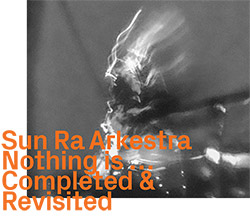 |
| Sun Ra Arkestra Nothing is ... Completed & Revisited (ezz-thetics by Hat Hut Records Ltd) |
| Reissuing and remastering Sun Ra's 1966 Arkestra album Nothing Is, the complete live recording from St. Lawrence University in NY with a classic ensemble including saxophonists Marshall Allen, Pat Patrick & John Gilmore, bassist Ronnie Boykins, drummer Cliffor Jarvis, &c., an incredible concert with an exemplary set of Sun Ra compositions and performances. |
 |
| Greene, Burton / Guillaume Gargaud Magic Intensity (Chant Record) |
| Renowned pianist and composer Burton Greene joins French composer and improvising guitarist Guillaume Gargaud performing on acoustic guitar, for four duo improvisations recorded at Tilo's Ark, in Weesp, The Netherlands in 2019, in crisp & often rapid dialog that uses space and reflective moments well, the duo joined by Tilo Baumheier on flute for three pieces. |
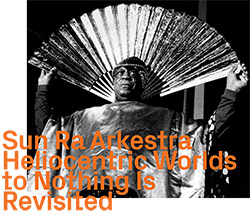 |
| Sun Ra Arkestra Heliocentric Worlds 1 and 2 (ezz-thetics by Hat Hut Records Ltd) |
| The two volumes of "Heliocentric Worlds", recorded 7 months apart in 1965, represent perhaps one of greatest chapters in Sun Ra's legacy, bringing together his immense orchestration skills with future-leaning free jazz, allowing his players expanse inside disciplined compositions that reflect on both space and the then-new freedom explored by jazz soloists. |
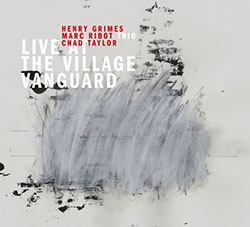 |
| Ribot, Marc Trio Live At The Village Vanguard (Pi Recordings) |
| Marc Ribot's highly anticipated debut as a leader in a band with Henry Grimes on bass and Chad Taylor on drums, performing at the iconic Village Vanguard, with material including Albert Ayler, John Coltrane, &c. |
 |
| Sun Ra Continuation [2 CDs] (Corbett vs. Dempsey) |
| A rare release of vintage Sun Ra remastered from the original tapes, featuring 14 tracks not issued anywhere else on a bonus CD, altogether totaling over 80 minutes of great music. |
 |
| Grimes, Henry / Marzette Watts (w/ Robinson / Lancaster / Sharrock / Thornton / Berger / Moses &c) The Call (ALAY) |
| Reissuing Henry Grimes' concise, darkly lyrical 1965 trio album with clarinetist Perry Robinson and drummer Tom Price alongside Marzette Watts' turbulent 1966 octet session, this remastered edition contrasts free improvisation with a dense collective of Byard Lancaster, Clifford Thornton, Sonny Sharrock, Karl Berger, Juini Booth and J. C. Moses, Grimes the link between two vital expressions of 1960s freedom |
 |
| Davis, Miles 3rd Quintet Reference: Bitches Brew Live 1969 In Europe [2 CDs + 2 POSTCARDS] (ALAY) |
| Documenting Miles Davis' 1969 "lost" third quintet live in Berlin, Stockholm and Rotterdam with Wayne Shorter, Chick Corea, Dave Holland and Jack DeJohnette, this 2-CD set captures the post-In a Silent Way ensemble reshaping material headed toward Bitches Brew, balancing lyricism and abstraction through open forms, electric-piano clusters, volatile rhythmic invention and Davis' fiercely exploratory trumpet. |
 |
| Ellington, Duke Orchestra From Fargo Live 1940 (ALAY) |
| A legendary 1940 live document of Duke Ellington's Blanton-Webster orchestra, captured in Fargo by Jack Towers and Richard Burris, with Ellington on piano, Johnny Hodges and Otto Hardwick on alto saxophones, Ben Webster on tenor, Harry Carney on baritone, Barney Bigard on clarinet, Rex Stewart, Ray Nance and Wallace Jones in the brass, Jimmy Blanton on bass, Sonny Greer on drums, and Ivie Anderson and Herb Jeffries on vocals. |
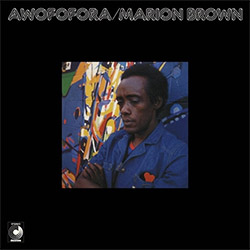 |
| Brown, Marion Awofofora [VINYL] (AGUIRRE RECORDS) |
| An overlooked 1976 session led by Marion Brown on alto sax with a rhythmically driven ensemble including Ambrose Jackson, Billy Patterson, Rene Arlain, Fred Hopkins, Ed Blackwell, Jumma Santos, and Chris Henderson, merging funk and Afro-Caribbean grooves with free jazz principles through layered rhythms, collective improvisation, and Brown's distinctive, lyrical tone. |
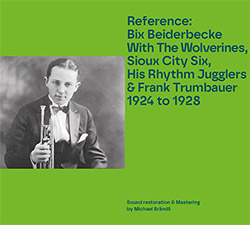 |
| Beiderbecke, Bix Reference: Bix Beiderbecke, 1924 to 1928 [2 CDs] (ALAY) |
| Gathering 45 small-group recordings from 1924-1928, this restored 2-CD reference traces Bix Beiderbecke's singular cornet and piano artistry alongside Frankie Trumbauer, Miff Mole, Don Murray, Tommy Dorsey, Eddie Lang, Joe Venuti and others, revealing a poised, lyrical and formally lucid voice whose economy, harmonic curiosity and graceful invention helped shape early jazz beyond its dance-band conventions. |
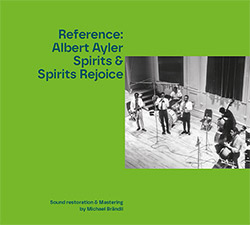 |
| Ayler, Albert Reference: Albert Ayler, Spirits & Spirits Rejoice [CD + POSTCARD] (ALAY) |
| Uniting Albert Ayler's 1964 New York sessions for Spirits (Debut) and Spirits Rejoice (ESP, with Donald Ayler, Charles Tyler, Call Cobbs, Henry Grimes, Gary Peacock, Sunny Murray, Normand Howard and Earle Henderson, this remastered edition captures Ayler's volatile balance of spiritual song, sculptural horn lines, churning bass motion, ecstatic fanfare and free jazz intensity. |
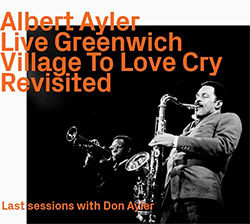 |
| Ayler, Albert Live Greenwich Village To Love Cry, Revisited (ezz-thetics by Hat Hut Records Ltd) |
| Bringing together two contrasting Impulse! albums from Aylers late 60's output: the exemplary free jazz release Live Greenwich Village in two sessions with core Ayler associates, brother Donald, Michael Sampson, Henry Grimes, Beaver Harris, &c.; then Ayler's challenging attempt to reach a more popular following in Love Cry, with Milford Graves taking the drummers chair. |
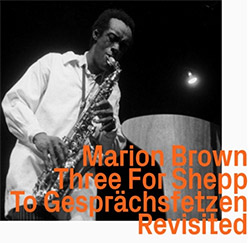 |
| Brown, Marion Three For Shepp to Gesprachsfetzen Revisited (ezz-thetics by Hat Hut Records Ltd) |
| Remastering and restoring Marion Brown's 1967 Impulse! album with Grachan Moncure III, Dave Burrel, Stanley Cowell, Sirone, Beaver Harris & Bobby Capp, and his 1968 album on the Calig label with Gunter Hampel, Steve McCall, Ambrosa Jackson & Buschi Niedergall; two albums of essential "New Thing" work through fascinating composed forms by Brown, plus Archie Shepps' "Delicado"; essential. |
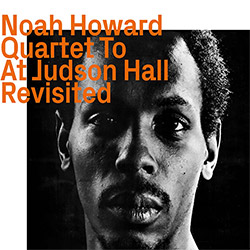 |
| Howard, Noah Quartet To At Judson Hall Revisited (ezz-thetics by Hat Hut Records Ltd) |
| Saxophonist Noah Howard's move from New Orleans to New York City brought him into the circle of early 60's free jazz players including Albert Ayler, joining Sun Ra's Arkestra, and performing at Slug's Saloon; this release reissues two ESP albums, his working band's 1966 Quartet album, and the extended and interestingly orchestrated sextet album, At Judson Hall. |
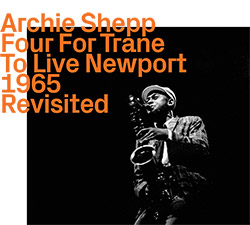 |
| Shepp, Archie Four For Trane To Live At Newport - Revisited (ezz-thetics by Hat Hut Records Ltd) |
| Influenced by and working with John Coltrane, saxophonist and composer Archie Shepp paid tribute to 'Trane with his 1965 Impulse! album Four for Trane, here remastered and joined with tracks from the live album John Coltrane/Archie Shepp: New Thing At Newport, accompanied on each by acclaimed free jazz players including Roswell Rudd, John Tchicai, Reggie Workman, Barre Phillips, Joe Chambers, &c. |
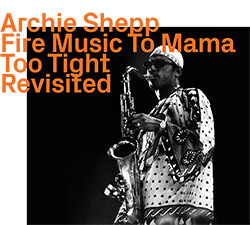 |
| Shepp, Archie Fire Music To Mama Too Tight, Revisited (ezz-thetics by Hat Hut Records Ltd) |
| Archie Shepp's second album for Impulse! merges the fire of free jazz with an incredibly eclectic set of styles, his inclusive approach to composition integrating a vast source of styles from Ellington to Ipanema; this is paired with Shepp's octet release, including an epic 20 minute work for American artist Robert Thompson reflecting his paintings in powerful thematic and abstract expression. |
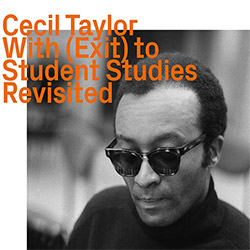 |
| Taylor, Cecil (w/ Lyons / Dixon / Grimes / Silva / Cyrille) With (Exit) To Student Studies, Revisited (ezz-thetics by Hat Hut Records Ltd) |
| Changing approaches to his music with new quartet of Jimmy Lyons on alto sax, Alan Silva on double bass and Andrew Cyrille on drums, pianist Cecil Taylor's incredible 1966 concert in Paris presented four extended compositions, here remastered and reissued with a track from a compilation LP--"With (Exit)"--extending his quartet with Bill Dixon on trumpet and Henry Grimes on double bass. |
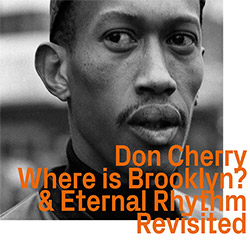 |
| Cherry, Don Where Is Brooklyn? & Eternal Rhythm Revisited (ezz-thetics by Hat Hut Records Ltd) |
| Reissuing two albums showing trumpeter Don Cherry's musical evolution through the 1960s, recorded two years apart--Where is Brooklyn from NY in 1966, and Eternal Rhythm recorded in Germany in 1968--demonstrating the development of his style from Ornette-influenced free jazz into music influenced by Northern Indian music and the percussion of Southeast Asia. |
 |
| Taylor, Cecil Mixed To Unit Structures Revisited (ezz-thetics by Hat Hut Records Ltd) |
| Bringing together two essential and impeccably remastered 1960's Cecil Taylor albums — Cecil Taylor Unit Structures and Cecil Taylor Unit Mixed — presenting both traditional influences and Taylor's unique approaches to modern jazz, featuring two septets with musicians including Jimmy Lyons, Henry Grimes, Archies Shepp, Ted Curson, Andrew Cyrille, Roswell Rudd, Sunny Murray, &c. |
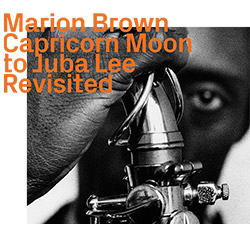 |
| Brown, Marion Capricorn Moon To Juba Lee, Revisited (ezz-thetics by Hat Hut Records Ltd) |
| Merging and remastering two essential albums from free jazz saxophonist Marion Brown: his 1966 ESP album "Marion Brown Quartet" with trumpeter Alan Shorter, bassist Reggie Johnson and percussionist Rahied Ali; and his 1967 Fontana album "Juba-Lee" in a septet with Reggie Johnson, drummer Beaver Harris, pianist Dave Burrell, trombonist Grachan Moncur III & saxophonist Bennie Maupin. |
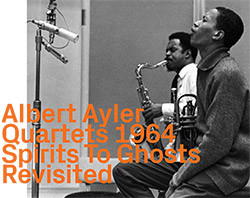 |
| Ayler, Albert Quartets Spirits To Ghosts Revisited (remastered) (ezz-thetics by Hat Hut Records Ltd) |
| Three variations of quartet settings from iconoclastic free jazz saxophonist Albert Ayler, remastering and combining two Debut Records albums, "Spirits" from 1964 with Norman Howard (trumpet), Sunny Murray (drums), and alternating bass between Henry Grimes & Earle Henderson; and 1965's "Ghosts" on Debut Records with Don Cherry (trumpet), Gary Peacock (bass), and Sunny Murray. |
 |
| Rollig, Silke / Burton Greene Space Is Still The Place (Improvising Beings) |
| New York free jazz pianist Burton Greene and free jazz vocalist Silke Rollig recorded these thirteen improvisations at The Loft in Koln, Germany in 2013, a mix of lyrical free playing with scat and freeform vocals, accompanied by flute, and by sax, on one piece each. |
 |
| Silva, Alan / Burton Greene Parallel Worlds (Long Song Records) |
| Free jazz pioneers and electronic improvisers Alan Silva and Burton Greene together playing vintage synthesizers and keyboards, exploring new sounds and pushing boundaries. |
Customers Who Bought This Item Also Bought:
 |
| Navarro, Fats Reference: Nostaligia w/ Tadd Dameron and Charlie Rouse / Dexter Gordon / Ernie Henry / Art Blakey (ALAY) |
| Restoring New York sessions from 1947 to 1949, this collection places Fats Navarro's brilliant, cleanly articulated trumpet within Tadd Dameron's harmonically refined bebop writing, joined by Charlie Rouse, Dexter Gordon, Ernie Henry, Leo Parker, Wardell Gray, Cecil Payne, Art Blakey, Kenny Clarke and others as the ensembles move between intricate modern lines, swing-rooted lyricism and early Afro-Cuban color. |
![Ehrlich, Marty: OPEN AIR: The Complete Saxophone Quartet Compositions of Julius Hemphill [2CDs]](https://www.teuthida.com/productImages/misc4/37922.jpg)
![Frith, Fred / Cornelius Claudio Kreusch / Johannes Tonio Kreusch: Pink / Neon [2 CDs]](https://www.teuthida.com/productImages/misc4/37712.jpg)
![Frith, Fred / Cornelius Claudio Kreusch / Johannes Tonio Kreusch: Pink / Neon [VINYL 2 LPs]](https://www.teuthida.com/productImages/misc4/37713.jpg)
![Miguel, Sei: Viva! O Carro de Fogo de Sei Miguel [2 CDs]](https://www.teuthida.com/productImages/misc4/37739.jpg)
![Money: 5 [2 CDs]](https://www.teuthida.com/productImages/misc4/37890.jpg)
![Drumm, Kevin: The Mild Temper [6 CD BOX SET]](https://www.teuthida.com/productImages/misc4/37651.jpg)
![Trzaska, Mikolaj / John Edwards / Mark Sanders: Because It Happens [VINYL]](https://www.teuthida.com/productImages/misc4/37551.jpg)
![Wassermann, Ute: Chimeric [VINYL]](https://www.teuthida.com/productImages/misc4/37652.jpg)


![Aranda, Irene (Malfon / Aranda / Yamasaki): May [CD + DOWNLOAD]](https://www.teuthida.com/productImages/misc4/37825.jpg)
![Bopp, Christiane: Rever, murmurer, dire [CD + DOWNLOAD]](https://www.teuthida.com/productImages/misc4/37823.jpg)
![Angles 4 (Kuchen / Haker-Flaten / Stahl / Nordeson): Angles 4 [CD + DOWNLOAD]](https://www.teuthida.com/productImages/misc4/37826.jpg)
![Glass Triangle (Parkins / Rasmussen / Sawyer): 3 X 1 [CD + DOWNLOAD]](https://www.teuthida.com/productImages/misc4/37827.jpg)
![Musicworks: #154 Summer 2026 [MAGAZINE + CD]](https://www.teuthida.com/productImages/misc4/37879.jpg)
![Dan, Lao Chicago Quartet: Klotski [VINYL]](https://www.teuthida.com/productImages/misc4/37518.jpg)
![TRAC (Teddy Ryles / Alexander Cooper): Heavy Nano Ream Aria [2 CDs]](https://www.teuthida.com/productImages/misc4/37647.jpg)
![Jerman, Jeph: For Alvin Kelly [CASSETTE + DOWNLOAD]](https://www.teuthida.com/productImages/misc4/37521.jpg)
![Mann, Oliver / Stefano Pilia: Precious Moments [CASSETTE + DOWNLOAD]](https://www.teuthida.com/productImages/misc4/37494.jpg)
![Jerman, Jeph / Ted Byrnes: Muir [CASSETTE + DOWNLOAD]](https://www.teuthida.com/productImages/misc4/37520.jpg)
![+DOG+: Angel Wings [VINYL]](https://www.teuthida.com/productImages/misc4/37513.jpg)
![Money: 4 [2 CDs]](https://www.teuthida.com/productImages/misc4/37505.jpg)
![+DOG+: The Garden [VINYL]](https://www.teuthida.com/productImages/misc4/37511.jpg)
![Le UN: 25 Pieces Sans Vide [3 CDs]](https://www.teuthida.com/productImages/misc4/37374.jpg)
![Directives: Reconsolid [CASSETTE]](https://www.teuthida.com/productImages/misc4/37418.jpg)
![Tilbury, John: At Home [4 CDs]](https://www.teuthida.com/productImages/misc4/37729.jpg)
![Scott, Ryan: 21st-Century Canadian Snare Drum [2 CDs]](https://www.teuthida.com/productImages/misc4/37538.jpg)
![Feldman, Morton / GBSR Duo w/ Taylor MacLennan: Trios [6 CD BOX SET]](https://www.teuthida.com/productImages/misc4/37020.jpg)
![Frey, Jurg : Composer, Alone [3 CDs]](https://www.teuthida.com/productImages/misc4/36927.jpg)
![Bruce, Lenny: Comedy & Controversy: The Original Albums 1958-61 [2 CDs]](https://www.teuthida.com/productImages/misc4/37409.jpg)
![Amba, Zoh: Eyes Full [VINYL]](https://www.teuthida.com/productImages/misc4/37491.jpg)
![Henry Cow: The Henry Cow Box Redux: The Complete Henry Cow [18 CDs, DVD & 3 BOOKLETS]](https://www.teuthida.com/productImages/misc4/37272.jpg)
![MacLean, Steve: Box Of Seven [7 CD BOX]](https://www.teuthida.com/productImages/misc4/36467.jpg)
![Mehead: One Good Eye [REISSUE]](https://www.teuthida.com/productImages/misc4/37276.jpg)
![Zorn, John: The Song of Songs [CD + CD BOOK]](https://www.teuthida.com/productImages/misc4/36923.jpg)
![Coultrain: Mundus [COLORED VINYL]](https://www.teuthida.com/productImages/misc4/33056.jpg)
![Hprizm: Signs Remixed [COLORED VINYL]](https://www.teuthida.com/productImages/misc4/30635.jpg)
![Halls Of the Machine: All Tribal Dignitaries [CASSETTE w/ DOWNLOAD]](https://www.teuthida.com/productImages/misc4/36134.jpg)
![Koenjihyakkei: Live at Club Goodman [2 CDs]](https://www.teuthida.com/productImages/misc4/36111.jpg)
![Sorry For Laughing (G. Whitlow / M. Bates / Dave-Id / E. Ka-Spel): Rain Flowers [2 CDS]](https://www.teuthida.com/productImages/misc4/35985.jpg)
![Rolando, Tommaso / Andy Moor : Biscotti [CASSETTE w/ DOWNLOADS]](https://www.teuthida.com/productImages/misc4/36106.jpg)
![Electric Bird Noise / Derek Roddy: 8-10-22 [CD EP]](https://www.teuthida.com/productImages/misc4/35970.jpg)
![Coley, Byron: Dating Tips for Touring Bands [VINYL]](https://www.teuthida.com/productImages/misc4/17906.jpg)
![Lost Kisses: My Life is Sad & Funny [DVD]](https://www.teuthida.com/productImages/misc4/lostKissesDVD.jpg)