


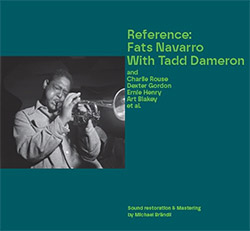
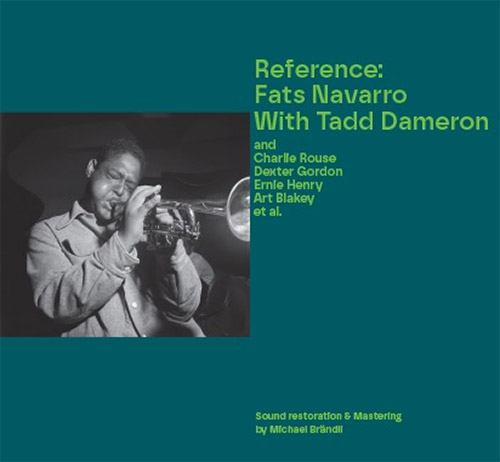
Restoring New York sessions from 1947 to 1949, this collection places Fats Navarro's brilliant, cleanly articulated trumpet within Tadd Dameron's harmonically refined bebop writing, joined by Charlie Rouse, Dexter Gordon, Ernie Henry, Leo Parker, Wardell Gray, Cecil Payne, Art Blakey, Kenny Clarke and others as the ensembles move between intricate modern lines, swing-rooted lyricism and early Afro-Cuban color.
In Stock
Quantity in Basket: None
Log In to use our Wish List
Shipping Weight: 3.00 units
Sample The Album:
Fats Navarro-trumpet
Tadd Dameron-piano
Leo Parker-baritone saxophone
Ernie Henry-alto saxophone
Charlie Rouse-tenor saxophone
Dexter Gordon-tenor saxophone
Allen Eager-tenor saxophone
Wardell Gray-tenor saxophone
Sahib Shihab-alto saxophone
Cecil Payne-baritone saxophone
Kai Winding-trombone
Gene Ramey-double bass
Nelson Boyd-double bass
Curley Russell-double bass
Denzil Best-drums
Shadow Wilson-drums
Kenny Clarke-drums
Art Blakey-drums
Art Mardigan-drums
Chino Pozo-bongos
Diego Ibarra-bongos
Vidal Bolado-congas
Rae Pearl-vocal
Click an artist name above to see in-stock items for that artist.
UPC: 7649988758324
Label: ALAY
Catalog ID: thingamajig 2512
Squidco Product Code: 37705
Format: CD
Condition: New
Released: 2026
Country: Switzerland
Packaging: Cardboard Gatefold
Tracks 1-4 recorded in New York City, New York, in January 1947
Tracks 5-8 recorded in New York City, New York, in September 1947
Tracks 9-10 recorded in New York City, New York, in October 1947
Tracks 11-14 recorded in New York City, New York, in December 1947
Tracks 15-17 recorded in New York City, New York, in December 1947
Tracks 18-20 recorded in New York City, New York, in September 1948
Tracks 21-22 recorded in New York City, New York, on January 18, 1949
Fats Navarro — Opus de Bop, containing "Fat Girl," "Ice Freezes Red," "Eb-Pob" and "Goin' to Minton's," originally released in 1957 as a vinyl LP on the Savoy label with catalog code MG-12114.
Fats Navarro Memorial Album, containing "The Chase," "The Squirrel," "Our Delight" and "Dameronia," originally released in 1952 as a 10-inch vinyl LP on the Blue Note label with catalog code BLP 5004.
New Trends of Jazz, Volume 6, containing "Be Bop Carroll," "Tadd Walk," "Nostalgia," "Barry's Bop," "Be Bop Romp" and "Fats Blows," originally released in 1952 as a 10-inch vinyl LP on the Savoy label with catalog code MG 9019.
Nostalgia, combining the December 1947 Fats Navarro quintet session with the Dexter Gordon session featuring "Dextrose," "Index" and "Dextivity," originally released in 1959 as a vinyl LP on the Savoy label with catalog code MG-12133.
The Fabulous Fats Navarro, Volume 2, containing "Jahbero," "Lady Bird" and "Symphonette," originally released in 1957 as a vinyl LP on the Blue Note label with catalog code BLP 1532.
Various Artists — Bebop Professors, containing Tadd Dameron's "Sid's Delight" and "Casbah," originally released as a vinyl LP by Capitol Records in Japan with catalog code CR-8812.
"But is it bebop? "I don't know what bop is, but of course that remark has been made a thousand times," so Tadd Dameron evasively told Leonard Feather in a 1950 Metronome Blindfold Test. Barry Ulanov's 1947 Metronome article on Fats Navarro contained the trumpeter's rational perspective, "It's just modern music. It just needs to be explained right. What they call bebop is really a series of chord progressions." In retrospect, we can describe bebop as variously as a form of social protest, a marketing tool to increase and energize the potential audience, a hipster fantasy — or an actual manifestation — of post-war cultural rebellion, and a modernist-inspired musical revolution.
Revolutions result from irreconcilable tension; a confluence of oppositional forces seeking a new system of progress amid as yet unforeseeable potential. Within the narrower, narrative confines of historical bebop, perceived as the music originated by Dizzy Gillespie, Charlie Parker, and Bud Powell, the soloist stands out as the iconoclastic figure, the heroic agent of radical change, the visionary genius. By all contemporary accounts, and the surviving recorded documents such as these, Fats Navarro deserves to be placed in that pantheon. Yet there's an alternative, analytical point of view that relates the transformational procedures of bebop to an inevitable, evolutionary process, expanding upon a firm foundation of established swing-based harmonic theory. Tadd Dameron, as composer and arranger, was among the foremost of these (for want of a better word) formalists. The often-brilliant music collected here has the advantage of benefitting from both of these resources.
Dameron never claimed to be a soloist of note, and the examples we have of him as a band pianist show him reticent and contemplative, consistently exploiting chord voicings rather than attempting spontaneous melodic variations. He began his career free-lancing, providing scores for the orchestras of Harlan Leonard, Jimmie Lunceford, Billy Eckstine, and Dizzy Gillespie among others, acknowledging his primary influences to be Duke Ellington and George Gershwin, although Gillespie was an important, lingering source of harmonic inspiration. His participation in the burgeoning experimental jam sessions at Minton's and Monroe's, and his subsequent involvement with small groups, was as much an economic as artistic expediency, and it's notable that as a leader, thinking as an arranger, he added a horn or two to the conventional quintet whenever possible to increase the harmonic potential.
Navarro, who died at the age of 26, eighteen months after the final session here, may have made the greatest impression on his fellow musicians and critics in the shortest amount of time given to any significant jazz musician. His fluency in the bebop idiom displayed complex ideas articulated cleanly, a dramatic balance of intensity and control, with high register punctuation derived from Dizzy and Roy Eldridge for excitement. He and Dameron crossed paths in the Eckstine sphere, an environment that also included future collaborators Leo Parker, Dexter Gordon, Shadow Wilson, and Art Blakey, but Navarro's ambition and adventurous appetite as a soloist quickly assured his ascent in the growing bop combo scene.
Of the six small group studio sessions collected here (the final session featured a larger ensemble), two were under Navarro's name, three from Dameron, and one for Dexter Gordon, but it's sensible that Dameron's expertise was intended in each case to handle arrangements and keep the music on track. The tunes credited to Navarro's authorship are reconfigured lines layered upon familiar tunes such as "I Got Rhythm" or "Fine and Dandy," which was common practice; quotes from pop songs and bop classics, typically exchanged and recycled, are everywhere apparent. For example, the repeated eight-bar melody of "Fats Blows," attributed to Navarro from the December 1947 session, is an ever-so-slightly ornamented version of a line first recorded as the Gershwins' "Lady Be Good" by Mary Lou Williams with Coleman Hawkins for Asch Records in 1944. A year later Hawkins used the head as his own "Rifftide," but Thelonious Monk claimed he wrote it and eventually recorded it as "Hackensack." (Ironically, Charlie Rouse solos on the theme with Navarro, fifteen years before he would record it in a studio with Monk.)
But is it bebop? Well, yes and no. Dameron's pieces, too, borrowed the same chordal structures, but he often altered the bridge (or left it open for improvisation) and constructed more sophisticated melodic contours rather than riffs or characteristically jagged themes. Frequently adapting devices from his big band charts, his strategies convey less of an aggressive bop rhythmic attack, often favoring a smoother, swing-oriented ambiance. Much of the music's flavor and variety, then, is dependent upon the soloists. Navarro, of course, was a committed bopper, as were Ernie Henry and Dexter Gordon, while the unfairly neglected Allen Eager gravitated towards the suave phrasing of Lester Young and Leo Parker indulged his pugnacious side. Rouse and Wardell Gray maneuvered between the barriers.
"Casbah," from the January 1949 session, points in the direction one suspects Dameron preferred all along, anticipating the music to be heard on Fontainebleau & The Magic Touch Revisited (ezz-thetics 1176). Nevertheless, his talents, combined with the brilliant contributions of Navarro, wrote a chapter of jazz history unlike any other."—Art Lange, Chicago, May 2025
Artist Biographies
• Show Bio for Fats Navarro • Show Bio for Tadd Dameron "Tadley Ewing Peake Dameron (February 21, 1917 - March 8, 1965) was an American jazz composer, arranger, and pianist. Born in Cleveland, Ohio, Dameron was the most influential arranger of the bebop era, but also wrote charts for swing and hard bop players. The bands he arranged for included those of Count Basie, Artie Shaw, Jimmie Lunceford, Dizzy Gillespie, Billy Eckstine, and Sarah Vaughan. In 1940-41 he was the piano player and arranger for the Kansas City band Harlan Leonard and his Rockets. He and lyricist Carl Sigman wrote "If You Could See Me Now" for Sarah Vaughan and it became one of her first signature songs. According to the composer, his greatest influences were George Gershwin and Duke Ellington. In the late 1940s, Dameron wrote arrangements for Gillespie's big band, who gave the première of his large-scale orchestral piece Soulphony in Three Hearts at Carnegie Hall in 1948. Also in 1948, Dameron led his own group in New York, which included Fats Navarro; the following year Dameron was at the Paris Jazz Festival with Miles Davis. From 1961 he scored for recordings by Milt Jackson, Sonny Stitt, and Blue Mitchell. Dameron also arranged and played for rhythm and blues musician Bull Moose Jackson. Playing for Jackson at that same time was Benny Golson, who was to become a jazz composer in his own right. Golson has said that Dameron was the most important influence on his writing. Dameron composed several bop and swing standards, including "Hot House", "If You Could See Me Now", "Our Delight", "Good Bait" (composed for Count Basie) and "Lady Bird". Dameron's bands from the late 1940s and early 1950s featured leading players such as Fats Navarro, Miles Davis, Dexter Gordon, Sonny Rollins, Wardell Gray, and Clifford Brown. In 1956 he led two sessions based on his compositions, released as the 1956 album "Fontainebleau" and the 1957 album "Mating Call". The latter featured John Coltrane. Dameron developed an addiction to narcotics toward the end of his career. He was arrested on drug charges in 1957 and 1958, and served time (1959-60) in a federal prison hospital in Lexington, Kentucky. After his release, Dameron recorded a single notable project as a leader, The Magic Touch, but was sidelined by health problems; he had several heart attacks before dying of cancer in 1965, at the age of 48. He was buried at Ferncliff Cemetery in Hartsdale, New York." ^ Hide Bio for Tadd Dameron • Show Bio for Leo Parker Leo Parker was an American baritone saxophonist who helped establish the instrument as a compelling bebop solo voice. A member of Billy Eckstine's influential orchestra during the mid-1940s, he combined modern harmonic fluency with a large, muscular tone rooted in blues, swing and rhythm and blues. Parker recorded with Dizzy Gillespie, Illinois Jacquet, Fats Navarro, Tadd Dameron and Gene Ammons, and later led two notable Blue Note albums, Let Me Tell You 'Bout It and Rollin' with Leo. His forceful attack, agility and earthy phrasing made him one of the formative baritone saxophonists of modern jazz, though his career was curtailed by his death in 1962 at age 36. ^ Hide Bio for Leo Parker • Show Bio for Ernie Henry A gifted alto saxophonist with a tragically short career, Ernie Henry (1926�1957) was known for his modern tone and lyrical phrasing, blending elements of bebop and early hard bop. He worked with luminaries like Dizzy Gillespie, Tadd Dameron, and Thelonious Monk, and recorded several albums as a leader in the 1950s for Riverside Records. Henry�s promising trajectory was cut short by his untimely death at age 31, but his work remains admired for its emotional depth and understated virtuosity. ^ Hide Bio for Ernie Henry • Show Bio for Charlie Rouse Charlie Rouse was an American tenor saxophonist and flutist best known for his decade-long association with Thelonious Monk from 1959 to 1970. Before joining Monk, he performed with the orchestras of Billy Eckstine, Dizzy Gillespie, Duke Ellington and Count Basie, recorded with Tadd Dameron and Fats Navarro, and co-led the Jazz Modes with French horn player Julius Watkins. Rouse developed a dry, compact tenor sound and angular phrasing particularly well suited to Monk's compositions, while his work as a leader and sideman extended through hard bop, post-bop and Brazilian-influenced jazz. ^ Hide Bio for Charlie Rouse • Show Bio for Dexter Gordon Dexter Gordon was an American tenor saxophonist, composer and bandleader who was among the first musicians to translate the language of bebop convincingly to the tenor saxophone. Emerging from Lionel Hampton's and Billy Eckstine's orchestras, he developed a commanding style distinguished by a broad tone, long melodic lines, relaxed rhythmic placement and witty musical quotations. Gordon recorded landmark sessions for Savoy, Dial, Blue Note, Prestige and SteepleChase, spent much of the 1960s and 1970s living and performing in Europe, and made a celebrated American return late in his career. His performance in the film Round Midnight earned him an Academy Award nomination, while his playing strongly influenced Sonny Rollins, John Coltrane and later generations of tenor saxophonists. ^ Hide Bio for Dexter Gordon • Show Bio for Allen Eager Allen Eager was an American saxophonist whose light tone and flowing melodic approach placed him among the earliest tenor players to unite Lester Young's influence with the harmonic language of bebop. A teenage member of Woody Herman's orchestra, he became active on New York's 52nd Street scene and recorded with Coleman Hawkins, Charlie Parker, Fats Navarro, Tadd Dameron, Red Rodney and Stan Getz. Although highly regarded by fellow musicians, Eager pursued an intermittent career, periodically leaving music for skiing, automobile racing and equestrian work before returning to recording during the 1980s. ^ Hide Bio for Allen Eager • Show Bio for Wardell Gray "Carl Wardell Gray was born on February 13, 1921 in Oklahoma City, the youngest of four children, to Eugene, from Georgia, and Carrie Gray (nee Maddison), from Alabama. His early childhood years were spent in Oklahoma, but the family moved to Detroit, Michigan, in 1929 as part of the great black migration to the urban centers of the northern states that promised greater economic opportunities and personal freedoms. Unfortunately, the family arrived just in time for the great depression, so no doubt the family faced some hard economic times. Census records indicate that in 1930 the Gray family was lodging at the home of James Chager on 505 E. Kirby Street in Detroit. Wardell, age 9, and older brother Harry, age 11, are the only Gray children listed as living at that address. Sisters Madeline, the oldest, and Edith are not mentioned in the census records. In early 1935, Gray began attending Northeastern High School, and then transferred to the well known Cass Technical High School in downtown Detroit, which is noted for having Donald Byrd, Lucky Thompson, Howard McGhee, Gerald Wilson and Al McKibbon as alumni. Advised by his brother-in-law Junior Warren, as a teenager he started on the clarinet, but after hearing Lester Young on record with Count Basie, he was inspired to switch to the tenor saxophone. It has also been reported that brother Harry, who played bass, encouraged his interest in music. Gray's first musical job was in Isaac Goodwin's small band, a part-time outfit that played local dances. When auditioning for another job, he was heard by Dorothy Patton, a young pianist who was forming a band at the Fraternal Club in Flint, Michigan, and she hired him. After a very happy year there, he moved to Jimmy Raschel's band. (Raschel had recorded a few sides earlier in the 1930s and is the father of Jimmy Raschel, the contemporary country western singer.) He then joined the Benny Carew band in Grand Rapids, Michigan. It was around this time that he met Jeanne Goings. They were soon married and had a daughter, Anita, who was born in January, 1941. Anita L. Gray-McClelland is still living and currently resides in Lansing, Michigan. A neighbor and friend, Patti Richards, speaks of Gray as already a wonderful musician who was fully aware of his gifts. She describes Gray as highly intelligent, good natured and friendly, and with a good but sometimes sarcastic sense of humor. He was very much aware of the barriers that his race would likely to play in his career. By then Wardell had reached the height of 6 feet 4 inches and was very thin despite having a healthy appetite. Years later trumpet great Clark Terry would jokingly refer to him as "Bones." [...]" ^ Hide Bio for Wardell Gray • Show Bio for Sahib Shihab "Sahib Shihab (born Edmund Gregory; June 23, 1925 - October 24, 1989) was an American jazz and hard bop saxophonist (baritone, alto, and soprano) and flautist. He variously worked with Luther Henderson, Thelonious Monk, Fletcher Henderson, Tadd Dameron, Dizzy Gillespie, Kenny Clarke, John Coltrane and Quincy Jones among others. He was born in Savannah, Georgia, United States. Edmund Gregory first played alto saxophone professionally for Luther Henderson aged 13, and studied at the Boston Conservatory, and to perform with trumpeter Roy Eldridge. He played lead alto with Fletcher Henderson in the mid-1940s. He was one of the first jazz musicians to convert to Islam and changed his name in 1947. He belonged to the Ahmadiyya sect of Islam. - American jazz double bassist During the late 1940s, Shihab played with Thelonious Monk, and on July 23, 1951 he recorded with Monk (later issued on the album Genius of Modern Music: Volume 2). During this period, he also appeared on recordings by Art Blakey, Kenny Dorham and Benny Golson. The invitation to play with Dizzy Gillespie's big band in the early 1950s was of particular significance, as it marked Shihab's switch to baritone. On August 12, 1958, Shihab was one of the musicians photographed by Art Kane in his photograph known as "A Great Day in Harlem". In 1959, he toured Europe with Quincy Jones, after becoming disillusioned with racial politics in United States and ultimately settled in Scandinavia, first in Stockholm, Sweden and from 1964 in Copenhagen, Denmark. He worked for Copenhagen Polytechnic and wrote scores for television, cinema and theatre. He wrote a ballet based on the Danish writer Hans Christian Andersen's fairy tale, The Red Shoes. In Denmark, Shihab performed with local musicians such as the bass player Niels-Henning Ørsted Pedersen amongst others. Together with pianist Kenny Drew, he ran a publishing firm and record company. In 1961, he joined the Kenny Clarke/Francy Boland Big Band and remained a member of the band for the 12 years it existed. He married a Danish woman and raised a family in Europe. In the Eurovision Song Contest 1966, Shihab accompanied Lill Lindfors and Svante Thuresson on stage for the Swedish entry "Nygammal Vals". In 1973, Shihab returned to the United States for a three-year hiatus, working as a session musician for rock and pop artists and undertaking work as a copyist for local musicians. He spent his remaining years between New York and Copenhagen and played in a partnership with Art Farmer. He also led his own jazz combo called Dues. From 1986, Shihab was a visiting artist at Rutgers University. Shihab died from liver cancer on October 24, 1989, in Nashville, Tennessee, United States, aged 64." ^ Hide Bio for Sahib Shihab • Show Bio for Cecil Payne Cecil Payne was an American saxophonist and composer recognized as one of the finest baritone players to emerge from the bebop era. Originally an alto saxophonist, he became prominent through Dizzy Gillespie's groundbreaking postwar orchestra, bringing a fluid, Lester Young-influenced lyricism to the heavier baritone voice. Payne subsequently worked with Tadd Dameron, Illinois Jacquet, Randy Weston, Duke Jordan and many others while leading albums under his own name across more than five decades. His playing joined agile bebop phrasing with a warm, full tone and strong blues feeling. ^ Hide Bio for Cecil Payne • Show Bio for Kai Winding "Kai Chresten Winding: May 18, 1922 - May 6, 1983) was a Danish-born American trombonist and jazz composer. He is known for his collaborations with fellow trombonist J. J. Johnson. His version of "More", the theme from the movie Mondo Cane, reached in 1963 number 8 in the Billboard Hot 100 and remained his only entry here. Winding was born in Aarhus, Denmark. His father, Ove Winding was a naturalized U.S. citizen, thus Kai, his mother and sisters, though born abroad were already U.S. citizens. In September 1934, his mother, Jenny Winding, moved Kai and his two sisters, Ann and Alice. Kai graduated in 1940 from Stuyvesant High School in New York City and that same year began his career as a professional trombonist with Shorty Allen's band. Subsequently, he played with Sonny Dunham and Alvino Rey, until he entered the United States Coast Guard during World War II. After the war, Winding was a member of Benny Goodman's orchestra, then Stan Kenton's. He participated in Birth of the Cool sessions in 1949, appearing on four of the twelve tracks, while J. J. Johnson appeared on the other eight, having participated on the other two sessions. In 1954, at the urging of producer Ozzie Cadena, Winding began a long association with Johnson, recording trombone duets for Savoy Records, then Columbia. He experimented with instruments in brass ensembles. The album Jay & Kai + 6 (1956) featured a trombone octet and the trombonium. He composed and arranged many of the works he and Johnson recorded. During the 1960s, Winding began an association with Verve Records and producer Creed Taylor. He released the first version of "Time Is On My Side" in 1963 before it was recorded by Irma Thomas and The Rolling Stones. His best selling recording from this period is "More," the theme from the movie Mondo Cane, which reached number 8 in the Billboard Hot 100 and remained his only entry here. Arranged and conducted by Claus Ogerman, "More" featured what is probably the first appearance of the French electronic music instrument the ondioline on an American recording. Although Winding was credited with playing the ondioline, guitarist Vinnie Bell, who worked on the session, claimed that it was played by Jean-Jacques Perrey, a pioneer of electronic music. Winding experimented with ensembles again, recorded solo albums, and one album of country music with the Anita Kerr Singers. He followed Creed Taylor to A&M/CTI and made more albums with J. J. Johnson. He was a member of the all-star jazz group Giants of Jazz in 1971. His son, Jai Winding, is a keyboardist who has worked as a session musician, writer and producer in Los Angeles. Kai Winding died of a brain tumor in New York City in 1983." ^ Hide Bio for Kai Winding • Show Bio for Gene Ramey Gene Ramey was an American double bassist whose career connected Kansas City swing with the emergence of bebop. After studying with Walter Page, he became a member of Jay McShann's orchestra, where he worked alongside Charlie Parker, before moving to New York in 1944. Ramey's firm walking lines and adaptable rhythmic sense made him a valued partner for Lester Young, Coleman Hawkins, Thelonious Monk, Miles Davis, Sonny Rollins, Fats Navarro and numerous others. Equally comfortable in swing and modern-jazz settings, he remained active for several decades before returning to his native Texas during the 1970s. ^ Hide Bio for Gene Ramey • Show Bio for Nelson Boyd Nelson Boyd was an American bassist active near the center of New York's formative bebop community during the late 1940s and 1950s. He recorded with Charlie Parker, Miles Davis, Fats Navarro, Tadd Dameron, Dizzy Gillespie, Coleman Hawkins and Charlie Barnet, adapting the acoustic bass's walking foundation to the faster tempos and intricate harmonies of modern jazz. Miles Davis reportedly titled the composition "Half Nelson" as a play on Boyd's name and small stature. Though rarely featured as a leader, Boyd's steady pulse and harmonic assurance supported numerous historically important sessions. ^ Hide Bio for Nelson Boyd • Show Bio for Curley Russell "Curley Russell was an important bassist in the early years of bebop for he was able to keep up as an accompanist with the rapid tempoes of the time. Never really a soloist (certainly not on the level of an Oscar Pettiford), Russell was a tireless performer who specialized in providing a swinging beat for the lead voices. After playing a bit of trombone, Russell switched to bass and he worked professionally from the age of 18. He was with Don Redman in 1941 and made his recording debut in 1943 with Benny Carter's Orchestra. In 1944 Russell joined Dizzy Gillespie's group and during the next decade he played with the who's who of bop including Charlie Parker (1945, 1948 and 1950), Tadd Dameron (1947-49), Bud Powell, Stan Getz, Buddy DeFranco (1952-53) and the Art Blakey Quintet with Clifford Brown (1954). In addition, Russell recorded with Dexter Gordon, Horace Silver, Coleman Hawkins, Miles Davis and Thelonious Monk among others, although never as a leader. During the mid-to-late 1950's Curly Russell gradually drifted away from jazz into rhythm and blues, finally dropping out of music altogether." ^ Hide Bio for Curley Russell • Show Bio for Denzil Best Denzil Best was an American drummer and composer whose subtle timekeeping and exceptional brushwork provided an alternative to the heavily accented style of many early bebop drummers. Initially trained on piano, trumpet and bass, he concentrated on drums during the 1940s and worked with Coleman Hawkins, Lennie Tristano, Lee Konitz, George Shearing, Erroll Garner and Thelonious Monk. Best composed several enduring modern-jazz pieces, including "Move," "Wee" and "Nothing but D. Best," and co-wrote "Bemsha Swing" with Monk. His smooth, legato approach influenced both cool-jazz rhythm sections and generations of small-group drummers. ^ Hide Bio for Denzil Best • Show Bio for Shadow Wilson Shadow Wilson was an American drummer admired for his light touch, buoyant swing and ability to adapt naturally to both big-band and modern-jazz settings. After working with Benny Carter, Lionel Hampton, Earl Hines, Count Basie and Woody Herman, he became a sought-after small-group drummer for Tadd Dameron, Thelonious Monk, Illinois Jacquet, Erroll Garner, Sonny Stitt and Lee Konitz. His nickname reportedly reflected the delicacy of his brushwork. Wilson never recorded as a leader, but his understated precision and responsive accompaniment made him an important presence on many recordings of the 1940s and 1950s. ^ Hide Bio for Shadow Wilson • Show Bio for Kenny Clarke "Kenny Clarke, known among musicians as "Klook" for one of his characteristic drum licks, is truly a jazz pioneer. He was a leader in the rhythmic advances that signaled the beginning of the modern jazz era, his drum style becoming the sound of bebop and influencing drummers such as Art Blakey and Max Roach. Clarke studied music broadly while in high school, including piano, trombone, drums, vibraphone, and theory. Such versatility of knowledge would later serve him well as a bandleader. Clarke moved to New York in late 1935, where he first began developing his unique approach to the drums, one with a wider rhythmic palette than that of the swing band drummers. Instead of marking the count with the top cymbal, Clarke used counter-rhythms to accent the beat, what became known as "dropping of bombs." He found a kindred spirit in Dizzy Gillespie when they hooked up in Teddy Hill's band in 1939. A key opportunity to further expand his drum language came in late 1940 when he landed a gig in the house band (with Thelonious Monk on piano, and Nick Fenton on bass) at Minton's Playhouse. It was this trio that welcomed such fellow travelers as guitarist Charlie Christian, Gillespie, and a host of others to its nightly jam sessions. These sessions became the primary laboratory for their brand of jazz, which came to be called bebop. A stint in the Army from 1943-46 introduced him to pianist John Lewis. After their discharge he and Lewis joined Gillespie's bebop big band, which gave Clarke his first taste of Paris during a European tour. After returning to New York, he joined the Milt Jackson Quartet, which metamorphosed into the Modern Jazz Quartet in 1952. Though he and Lewis remained friends, Clarke chafed at what he felt was the too-staid atmosphere of the MJQ. In 1956, he migrated to Paris, which became his home for nearly 30 years, working with Jacques Helian's band and backing up visiting U.S. jazz artists. During the years 1960-73, he co-led the major Europe-based jazz big band with Belgian pianist Francy Boland, the Clarke-Boland Big Band. The band featured the best of Europe's jazz soloists, including a number of exceptional U.S. expatriate musicians living in Europe. Among these were saxophonists Johnny Griffin and Sahib Shihab, and trumpeter Idrees Sulieman. After the disbanding of his big band, Clarke found numerous opportunities both on the bandstand and teaching in the classroom. He remained quite active as a freelancer, often working with visiting U.S. jazz musicians, until his death in 1985. In 1988, Clarke was inducted into the DownBeat Jazz Hall of Fame." ^ Hide Bio for Kenny Clarke • Show Bio for Art Blakey "Arthur Blakey (October 11, 1919 - October 16, 1990) was an American jazz drummer and bandleader. He was also known as Abdullah Ibn Buhaina after he converted to Islam for a short time in the late 1940s. Blakey made a name for himself in the 1940s in the big bands of Fletcher Henderson and Billy Eckstine. He then worked with bebop musicians Thelonious Monk, Charlie Parker, and Dizzy Gillespie. In the mid-1950s, Horace Silver and Blakey formed the Jazz Messengers, a group that the drummer was associated with for the next 35 years. The group was formed as a collective of contemporaries, but over the years the band became known as an incubator for young talent, including Freddie Hubbard, Wayne Shorter, Lee Morgan, Benny Golson, Kenny Dorham, Hank Mobley, Donald Byrd, Jackie McLean, Johnny Griffin, Curtis Fuller, Chuck Mangione, Chick Corea, Keith Jarrett, Cedar Walton, Woody Shaw, Terence Blanchard, and Wynton Marsalis. The Biographical Encyclopedia of Jazz calls the Jazz Messengers "the archetypal hard bop group of the late 50s". Blakey was inducted into the Down Beat Jazz Hall of Fame (in 1981). Posthumously, he was inducted into the Modern Drummer Hall of Fame in 1991 and the Grammy Hall of Fame (in 1998 and 2001). He was awarded the Grammy Lifetime Achievement Award in 2005." ^ Hide Bio for Art Blakey • Show Bio for Art Mardigan Art Mardigan was an American jazz drummer from Detroit whose career encompassed bebop, swing and West Coast jazz. He performed and recorded with Georgie Auld, Dexter Gordon, Charlie Parker, Fats Navarro, Stan Getz, Woody Herman, Al Cohn, Jimmy Raney and numerous others. Mardigan was also a member of the original house band at Detroit's Blue Bird Inn, an important center for modern jazz in the city. His crisp, propulsive playing suited both fast bebop sessions and more relaxed small-group settings. ^ Hide Bio for Art Mardigan • Show Bio for Chino Pozo Chino Pozo was a Cuban percussionist who helped bring Afro-Cuban rhythmic language into American jazz and popular music. After moving to the United States in 1937, he worked with Machito, José Curbelo, Noro Morales, Tito Puente, Tito Rodríguez and Pérez Prado, while also recording with jazz musicians including Fats Navarro, Tadd Dameron, Charlie Parker, Dizzy Gillespie, Illinois Jacquet and Phineas Newborn Jr. Pozo performed on bongos, congas and drum set, contributing both folkloric Cuban patterns and adaptable ensemble accompaniment to Latin jazz, bebop and mainstream popular recordings. ^ Hide Bio for Chino Pozo • Show Bio for Diego Ibarra Diego Ibarra was a Latin percussionist active in the New York recording community during the late 1940s. He is documented on the January 1949 Tadd Dameron and Fats Navarro session represented here, adding bongos to an expanded ensemble that combined bebop writing with Afro-Cuban rhythmic color. Ibarra was among the early generation of Latin percussionists heard on modern-jazz recordings before the use of bongos and congas became widespread. Reliable biographical information about his life and broader career remains scarce. ^ Hide Bio for Diego Ibarra • Show Bio for Vidal Bolado Carlos Vidal Bolado was a Cuban conga drummer and an important early figure in Afro-Cuban jazz. Active in Havana before moving to the United States, he became an original member of Machito and His Afro-Cubans and helped establish the conga drum within Latin-jazz orchestration. Bolado participated in some of the earliest commercial recordings of authentic Cuban rumba and worked with musicians exploring the intersection of Cuban rhythm, big-band arranging and modern jazz. His appearance with Tadd Dameron and Fats Navarro reflects bebop's growing engagement with Afro-Cuban percussion during the late 1940s. ^ Hide Bio for Vidal Bolado • Show Bio for Rae Pearl Rae Pearl was a vocalist associated with Tadd Dameron's late-1940s ensembles. On "Casbah," she contributes a brief wordless vocal part that functions as an instrumental color within Dameron's expanded bebop arrangement rather than as a conventional featured song performance. Published biographical information about Pearl is extremely limited, and the available documentation does not support a detailed account of her life or wider career. ^ Hide Bio for Rae Pearl
8/5/2026
Have a better biography or biography source? Please Contact Us so that we can update this biography.
Have a better biography or biography source? Please Contact Us so that we can update this biography.
Have a better biography or biography source? Please Contact Us so that we can update this biography.
Have a better biography or biography source? Please Contact Us so that we can update this biography.
Have a better biography or biography source? Please Contact Us so that we can update this biography.
Have a better biography or biography source? Please Contact Us so that we can update this biography.
8/5/2026
Have a better biography or biography source? Please Contact Us so that we can update this biography.
8/5/2026
Have a better biography or biography source? Please Contact Us so that we can update this biography.
Have a better biography or biography source? Please Contact Us so that we can update this biography.
8/5/2026
Have a better biography or biography source? Please Contact Us so that we can update this biography.
Have a better biography or biography source? Please Contact Us so that we can update this biography.
Have a better biography or biography source? Please Contact Us so that we can update this biography.
8/5/2026
Have a better biography or biography source? Please Contact Us so that we can update this biography.
Have a better biography or biography source? Please Contact Us so that we can update this biography.
Have a better biography or biography source? Please Contact Us so that we can update this biography.
8/5/2026
Have a better biography or biography source? Please Contact Us so that we can update this biography.
8/5/2026
Have a better biography or biography source? Please Contact Us so that we can update this biography.
Have a better biography or biography source? Please Contact Us so that we can update this biography.
Have a better biography or biography source? Please Contact Us so that we can update this biography.
Have a better biography or biography source? Please Contact Us so that we can update this biography.
Have a better biography or biography source? Please Contact Us so that we can update this biography.
Have a better biography or biography source? Please Contact Us so that we can update this biography.
Track Listing:
1. Fat Girl 2:21
2. Ice Freezes Red 2:42
3. Eb-Pob 2:25
4. Goin' To Mintons 2:53
5. The Chase 2:46
6. The Squirrel 3:01
7. Our Delight 3:00
8. Dameronia 3:02
9. Be Bop Carroll 3:00
10. Tadd Walk 2:53
11. Nostalgia 2:45
12. Barry's Bop 2:40
13. Be Bop Romp 2:38
14. Fats Blows 2:52
15. Dextrose 2:51
16. Index 3:05
17. Dextivity 3:01
18. Jahbero 2:56
19. Lady Bird 2:53
20. Symphonette 3:09
21. Sid's Delight 2:56
22. Casbah 3:02
August 2026
Hat Art
Improvised Music
Jazz
Jazz & Improvisation Based on Compositions
Melodic and Lyrical Jazz
NY Downtown & Metropolitan Jazz/Improv
Quintet Recordings
Large Ensembles
Jazz Reissues
New in Improvised Music
Recent Releases and Best Sellers
Search for other titles on the label:
ALAY.
 |
| Grimes, Henry / Marzette Watts (w/ Robinson / Lancaster / Sharrock / Thornton / Berger / Moses &c) The Call (ALAY) |
| Reissuing Henry Grimes' concise, darkly lyrical 1965 trio album with clarinetist Perry Robinson and drummer Tom Price alongside Marzette Watts' turbulent 1966 octet session, this remastered edition contrasts free improvisation with a dense collective of Byard Lancaster, Clifford Thornton, Sonny Sharrock, Karl Berger, Juini Booth and J. C. Moses, Grimes the link between two vital expressions of 1960s freedom |
 |
| Davis, Miles 3rd Quintet Reference: Bitches Brew Live 1969 In Europe [2 CDs + 2 POSTCARDS] (ALAY) |
| Documenting Miles Davis' 1969 "lost" third quintet live in Berlin, Stockholm and Rotterdam with Wayne Shorter, Chick Corea, Dave Holland and Jack DeJohnette, this 2-CD set captures the post-In a Silent Way ensemble reshaping material headed toward Bitches Brew, balancing lyricism and abstraction through open forms, electric-piano clusters, volatile rhythmic invention and Davis' fiercely exploratory trumpet. |
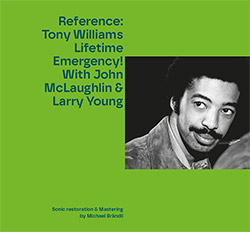 |
| Williams, The Tony Emergency w/ John McLaughlin / Larry Young Emergency! (ALAY) |
| A restored edition of Tony Williams Lifetime's incendiary 1969 trio debut with John McLaughlin on guitar and Larry Young on organ, documenting one of jazz-rock fusion's earliest and most audacious statements, where Williams' radical rhythmic designs, Young's dense harmonic force, and McLaughlin's searing electric vocabulary collide in urgent, psychedelic, genre-defying improvisation. |
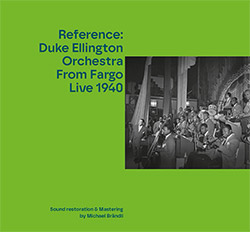 |
| Ellington, Duke Orchestra From Fargo Live 1940 (ALAY) |
| A legendary 1940 live document of Duke Ellington's Blanton-Webster orchestra, captured in Fargo by Jack Towers and Richard Burris, with Ellington on piano, Johnny Hodges and Otto Hardwick on alto saxophones, Ben Webster on tenor, Harry Carney on baritone, Barney Bigard on clarinet, Rex Stewart, Ray Nance and Wallace Jones in the brass, Jimmy Blanton on bass, Sonny Greer on drums, and Ivie Anderson and Herb Jeffries on vocals. |
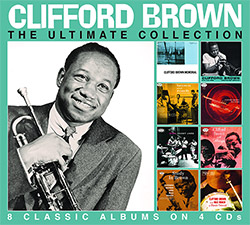 |
| Clifford Brown The Ultimate Collection [4 CDs] (Enlightenment) |
| A 4-CD survey of Clifford Brown's essential 1953-1956 Blue Note and EmArcy recordings, tracing his masterful trumpet voice through early leader dates, string settings, vocal and ensemble sessions, and the classic Max Roach quintet with Harold Land, Sonny Rollins, Richie Powell and George Morrow, capturing a foundational hard bop figure at astonishing creative strength. |
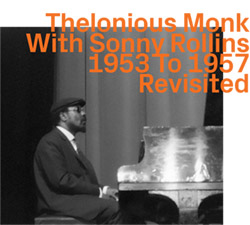 |
| Monk, Thelonious with Sonny Rollins 1953 To 1957 Revisited (ezz-thetics by Hat Hut Records Ltd) |
| Restoring and remastering three key sessions documenting the evolving creative relationship between Thelonious Monk and Sonny Rollins, alongside artists including Julius Watkins, Ernie Henry, Oscar Pettiford, and Max Roach, in a vital revisitation of formative collaborations that highlight Monk's unique brilliance and Rollins' early improvisational voice within shifting post-bop ensembles. |
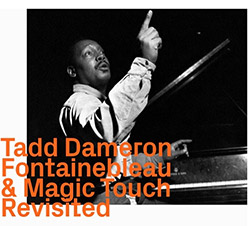 |
| Dameron, Tadd Fontainebleau & Magic Touch, Revisited (ezz-thetics by Hat Hut Records Ltd) |
| Composer, pianist, and bandleader Tadd Dameron's first album, Fontainebleau (1956), and his final work, The Magic Touch (1962), are remastered to highlight his sophisticated hard bop compositions for large ensembles, featuring influential players like Bill Evans, Philly Joe Jones, and Ron Carter, and showcasing Dameron's lasting impact on jazz before his untimely passing. |
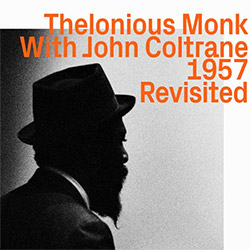 |
| Monk, Thelonious with John Coltrane 1957, Revisited (ezz-thetics by Hat Hut Records Ltd) |
| A transformative experience for John Coltrane, whose 1957 studio sessions with pianist Thelonious Monk, recorded after Monk's residency at the Five Spot, came at a transitional point for the iconic tenor saxophonist, expanding his knowledge of harmonic structure and refining his approach to soloing; with Coleman Hawkins, Art Blakey, Gigi Gryce, Ray Copeland, Wilbur Ware and Shadow Wilson. |
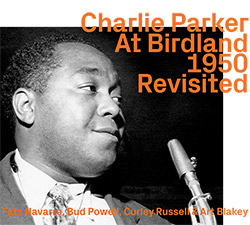 |
| Parker, Charlie At Birdland 1950 "Revisited" (ezz-thetics by Hat Hut Records Ltd) |
| A remarkable feat of remastering, sound restoration and pitch correction from the tapes of this June 1950 radio broadcast at Birdland in NYC, finding the exceptional quintet of jazz pioneers led by alto saxophonist Charlie Parker in superb form, with Fats Navarro on trumpet, Bud Powell on piano, Curley Russell on double bass and Art Blakey on drums. |
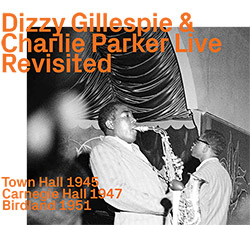 |
| Gillespie, Dizzy & Charlie Parker Live, Revisited (ezz-thetics by Hat Hut Records Ltd) |
| Three essential concerts remastered, from the legacy of be-bop trailblazers, trumpeter Dizzy Gillespie and alto saxophonist Charlie Parker, with Don Byas, Al Haig piano, Curley Russell, Max Roach & Sidney Catlett at Town Hall 1945; with John Lewis, Al McKibbon & Joe Harris at Carnegie Hall 1947; and with Bud Powell, Tommy Potter & Roy Haynes at Birdland 1951. |
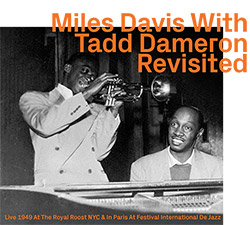 |
| Davis, Miles w/ Tadd Dameron Revisited (ezz-thetics by Hat Hut Records Ltd) |
| Between his work with Charlie Parker and before his own personal success, trumpeter Miles Davis joined the influential ensemble of pianist, composer and arranger Tadd Dameron, heard in six large ensemble pieces at New York's Royal Roost in 1949, and then in a quintet at the Paris Festival International De Jazz the same year, in both hearing a unique and confident facet to Miles' playing. |
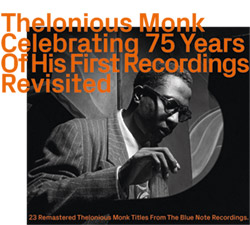 |
| Monk, Thelonious Celebrating 75 Years Of His First Recordings (ezz-thetics by Hat Hut Records Ltd) |
| The foundational work of composer and pianist Thelonious Monk is heard in these six remastered studio sessions for Blue Note Records recorded between 1947 to 1952, performing twenty three original compositions in bands from trios to sextets with a who's who of emerging jazz leaders including Art Blakey, Max Roach, Lou Donaldson, Kenny Dorham, and Milt Jackson. |
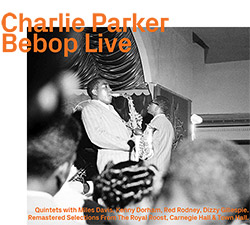 |
| Parker, Charlie Bebop Live [2 CDs] (ezz-thetics by Hat Hut Records Ltd) |
| Remarkably remastered recordings of Charlie Parker's quintets from 1945-49, performing live at Carnegie Hall, Royal Roost, & Town Hall with configurations of Miles Davis, Dizzy Gillespie, Kenny Dorham, Red Rodney, Don Byas, Al Haig, Max Roach, Roy Haynes, Kenny Clarke, Tommy Potter & Curley Russell, allowing us to re-live the consistent brilliance of the leader and his sidemen. |
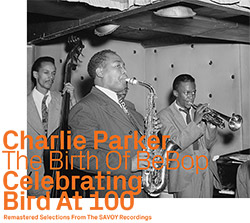 |
| Parker, Charlie Selections From The SAVOY Recordings (ezz-thetics by Hat Hut Records Ltd) |
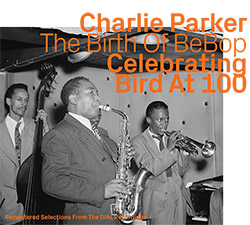
| The second of two volumes in celebration of legendary saxophonist Charlie Parker's 100th birthday, here remastering his landmark recordings for the Savoy label in New York City between 1945-48, performing with jazz greats including Bud Powell, Dizzy Gillespie, Miles Davis, John Lewis, Curley Russel, Max Roach, &c. for some of be-bop's finest and best known compositions. |
 |
| Parker, Charlie Selections From The DIAL Recordings (ezz-thetics by Hat Hut Records Ltd) |
| The first of two volumes in celebration of legendary saxophonist Charlie Parker's 100th birthday, here remastering his landmark recordings for the Dial label on the US West Coast between 1946-47, performing with jazz greats including Miles Davis, Lucky Thompson, Erroll Garner, Barney Kessel, Red Calender, JJ Johson, Max Roach, &c. for some of Parker's best known and essential compositions. |
Customers Who Bought This Item Also Bought:
 |
| Tilbury, John At Home [4 CDs] (Another Timbre) |
| Spanning home recordings from 2018 to 2026 with selected archival material, this four-CD set closes John Tilbury's recording career through piano, clavichord, organ and voice, joined by Keith Rowe, Klaus Filip and six pianists in music ranging from Elizabethan songbooks and contemporary compositions to quiet improvisation and reflection. |
 |
| Merivale, Finola / Catherine Sikora Abhaile (Relative Pitch) |
| Composer Finola Merivale surrounds Catherine Sikora's layered tenor saxophone, breath tones and multiphonics with electronics and field recordings gathered in County Cork, New York and other changing environments, creating three immersive electroacoustic works that move from stark detail to surging masses of sound while exploring landscape, displacement, memory and the unsettled meaning of home. |
 |
| Mattrey, Joanna / Camila Nebbia / Camilo �ngeles / Violeta Garcia Heavy Handed (Relative Pitch) |
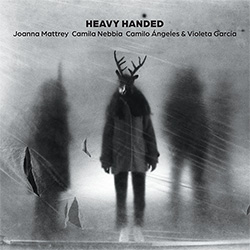
| An international quartet of Joanna Mattrey on viola, Camila Nebbia on tenor saxophone, Camilo Angeles on flute and effects, and Violeta Garcia on cello and effects, developing seven volatile collective improvisations where breath, bowed resonance, abrasive attacks and subtle electronics move between fragile chamber textures, urgent counterpoint and dense, rhythmically charged eruptions. |
 |
| Michaeli, Milton / Asaf Shchori / Hamid Drake Universal Butterfly (577 Records) |
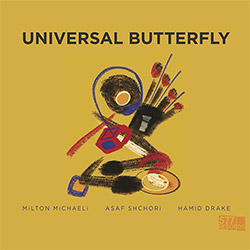
| Bridging generations of creative music, pianist Milton Michaeli, double bassist Asaf Shchori, and drummer Hamid Drake form a vividly responsive trio, blending original compositions and improvisation into music shaped by jazz and Latin traditions, deep grooves, bowed textures, lyrical bass movement, spiritual rhythm, and inspirations from Sun Ra and Ras Michael. |

![Byard, Jaki: The Classic 1960s Albums [4 CDs]](https://www.teuthida.com/productImages/misc4/37394.jpg)
![Bruce, Lenny: Comedy & Controversy: The Original Albums 1958-61 [2 CDs]](https://www.teuthida.com/productImages/misc4/37409.jpg)
![Quebec, Ike: The Classic Blue Note Collection [4 CDs]](https://www.teuthida.com/productImages/misc4/37410.jpg)

![Gregg, J.J. / Ravi Albright: Minto & Elsewhere [CD + DOWNLOAD]](https://www.teuthida.com/productImages/misc4/37700.jpg)

![Turbulence Orchestra and Sub-Units: In The Path Of Typhoons [2CDs]](https://www.teuthida.com/productImages/misc4/37627.jpg)
![Dionee (Beriault / Normand / Servant): Mille-feuilles [VINYL]](https://www.teuthida.com/productImages/misc4/37569.jpg)
![Leandre, Joelle / Remy Belanger de Beauport: Jeux De Mains [VINYL]](https://www.teuthida.com/productImages/misc4/37575.jpg)

![Blaser, Samuel Quartet: Rosina [CASSETTE + DOWNLOAD]](https://www.teuthida.com/productImages/misc4/37638.jpg)
![TRAC (Teddy Ryles / Alexander Cooper): Heavy Nano Ream Aria [2 CDs]](https://www.teuthida.com/productImages/misc4/37647.jpg)
![Jerman, Jeph: For Alvin Kelly [CASSETTE + DOWNLOAD]](https://www.teuthida.com/productImages/misc4/37521.jpg)
![Mann, Oliver / Stefano Pilia: Precious Moments [CASSETTE + DOWNLOAD]](https://www.teuthida.com/productImages/misc4/37494.jpg)
![Jerman, Jeph / Ted Byrnes: Muir [CASSETTE + DOWNLOAD]](https://www.teuthida.com/productImages/misc4/37520.jpg)
![+DOG+: Angel Wings [VINYL]](https://www.teuthida.com/productImages/misc4/37513.jpg)
![Money: 4 [2 CDs]](https://www.teuthida.com/productImages/misc4/37505.jpg)
![+DOG+: The Garden [VINYL]](https://www.teuthida.com/productImages/misc4/37511.jpg)
![Le UN: 25 Pieces Sans Vide [3 CDs]](https://www.teuthida.com/productImages/misc4/37374.jpg)
![Directives: Reconsolid [CASSETTE]](https://www.teuthida.com/productImages/misc4/37418.jpg)

![La Casa, Eric / Francisco Lopez: Collection Supranaturelle: Induction / Mutation [2 CDs]](https://www.teuthida.com/productImages/misc4/37287.jpg)
![Aries House Zaes: Network Friction [VINYL]](https://www.teuthida.com/productImages/misc4/37242.jpg)
![Scott, Ryan: 21st-Century Canadian Snare Drum [2 CDs]](https://www.teuthida.com/productImages/misc4/37538.jpg)
![Feldman, Morton / GBSR Duo w/ Taylor MacLennan: Trios [6 CD BOX SET]](https://www.teuthida.com/productImages/misc4/37020.jpg)
![Frey, Jurg : Composer, Alone [3 CDs]](https://www.teuthida.com/productImages/misc4/36927.jpg)
![Amba, Zoh: Eyes Full [VINYL]](https://www.teuthida.com/productImages/misc4/37491.jpg)

![Henry Cow: The Henry Cow Box Redux: The Complete Henry Cow [18 CDs, DVD & 3 BOOKLETS]](https://www.teuthida.com/productImages/misc4/37272.jpg)
![MacLean, Steve: Box Of Seven [7 CD BOX]](https://www.teuthida.com/productImages/misc4/36467.jpg)
![Mehead: One Good Eye [REISSUE]](https://www.teuthida.com/productImages/misc4/37276.jpg)
![Zorn, John: The Song of Songs [CD + CD BOOK]](https://www.teuthida.com/productImages/misc4/36923.jpg)
![Coultrain: Mundus [COLORED VINYL]](https://www.teuthida.com/productImages/misc4/33056.jpg)
![Hprizm: Signs Remixed [COLORED VINYL]](https://www.teuthida.com/productImages/misc4/30635.jpg)
![Halls Of the Machine: All Tribal Dignitaries [CASSETTE w/ DOWNLOAD]](https://www.teuthida.com/productImages/misc4/36134.jpg)
![Koenjihyakkei: Live at Club Goodman [2 CDs]](https://www.teuthida.com/productImages/misc4/36111.jpg)
![Sorry For Laughing (G. Whitlow / M. Bates / Dave-Id / E. Ka-Spel): Rain Flowers [2 CDS]](https://www.teuthida.com/productImages/misc4/35985.jpg)
![Rolando, Tommaso / Andy Moor : Biscotti [CASSETTE w/ DOWNLOADS]](https://www.teuthida.com/productImages/misc4/36106.jpg)
![Electric Bird Noise / Derek Roddy: 8-10-22 [CD EP]](https://www.teuthida.com/productImages/misc4/35970.jpg)
![Coley, Byron: Dating Tips for Touring Bands [VINYL]](https://www.teuthida.com/productImages/misc4/17906.jpg)
![Lost Kisses: My Life is Sad & Funny [DVD]](https://www.teuthida.com/productImages/misc4/lostKissesDVD.jpg)