


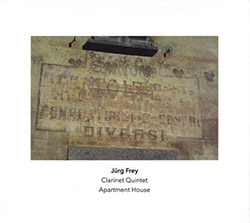
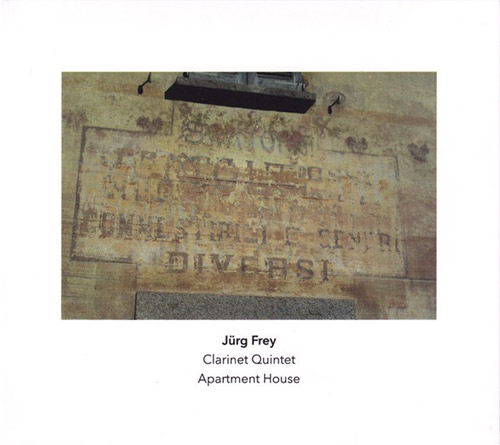
Composed between 2023 and 2025 after Jurg Frey withdrew from clarinet performance, this 54-minute chamber work places Heather Roche's clarinet within the string quartet of Mira Benjamin, Chihiro Ono, Bridget Carey and Anton Lukoszevieze, as Apartment House reveal a quietly extraordinary balance of stillness and motion, warm tonal color, intimate dialogue and a slow, organic passage toward unexpected transformation.
In Stock
Quantity in Basket: None
Log In to use our Wish List
Shipping Weight: 3.00 units
EU & UK Customers:
Discogs.com can handle your VAT payments
So please order through Discogs
Sample The Album:
Jurg Frey-composer
Heather Roche-clarinet
Mira Benjamin-violin
Chihiro Ono-violin
Bridget Carey-viola
Anton Lukoszevieze-cello
Click an artist name above to see in-stock items for that artist.
Label: Another Timbre
Catalog ID: at256
Squidco Product Code: 37453
Format: CD
Condition: New
Released: 2026
Country: UK
Packaging: Cardboard Gatefold
Recorded at City University London, in July, 2025, by Simon Reynell.
Interview with Jürg Frey by Marat Ingeldeev
First off, could you tell us about Clarinet Quintet? I believe it's a relatively recent piece. How did it come about? I also love that the title is purely descriptive, keeping the work open rather than framing it in advance.
It all began with a commission from Simon Reynell, though this is only superficially a mere external detail. It is not the first time I have received a commission from him, and each time he has sparked something that has led me to new horizons. And so it was this time too: perhaps Simon spotted or sensed a gap in my catalogue of works, or perhaps he simply wanted to hear a piece by me for this instrumentation; whatever the case, it came at exactly the right time, and his idea and my work were able to form a perfect symbiosis.That said, the commission gave me a great deal of freedom: it simply called for 'something for clarinet and strings'. I began with clarinet and string trio; clarinet and string quintet, or even an ensemble of six strings with clarinet were also ideas on my desk. I initially avoided the clarinet and string quartet line-up, partly because of the well-known pieces for these instruments by Mozart, Brahms or Feldman, all of which I have played frequently.
But then I realised that the quintet best matched my vision of depth and breadth in the piece-and I decided to take up the challenge.
The music is teeming with moments of wonder: dense clouds of harmony that seem to strain towards release or shift colour without warning, passages of clarity giving way to brooding haziness, intimate confessional duets, unexpected rests, lonely pizzicato. The finale alone is worth the journey-I'll spare the reader any spoilers. What strikes me most is a sense of stasis that retroactively reveals itself as movement, which feels very lifelike. How did you piece the form together?
I can say a few words about the term 'lifelike', because your comment matches my own feeling. Though I must say straight away that I never had any plan to write a 'lifelike' composition. Thinking that way would hinder my work, even make it impossible; plans of that sort are like evil spirits that must be driven away, as they seek to destroy the piece.
But Clarinet Quintet isn't without a plan either, not at all. It's a web of associations, constructions, sketches, decisions, durations, marvelling at ideas, rejecting efficiency, desires, memories-if there is a plan, then the creation of the piece and the plan are one and the same. That means my aim is to develop a feel for the piece whilst working, to get a sense of what's possible. And that's probably how this 'lifelike' quality emerges.For a while, the piece was also titled Ce lent rythme humain (This slow human rhythm), a short phrase I discovered in a text by Gustave Roud whilst working on it. In the end, it remained Clarinet Quintet, and that's just as well.
I rarely ask questions like this, but I'm curious about the harmony and its shifts in colour. How did you devise them and what's your approach to harmony more generally?
I'm not sure whether I really think in terms of the category of 'harmony', or at most only marginally, as an afterthought. The category of 'sound' as an abstract phenomenon is just as important. I work somewhere on the threshold, or in no-man's-land between harmony on the one hand, and sound and colour on the other.These are questions of the presence and absence of harmony, and related to this is also what you mentioned earlier, 'a sense of stasis that retroactively reveals itself as movement'. I want to bring a clear architecture and, at the same time, an organic form into balance. Harmony and colour stand in a subtle relationship to one another: allowing things to move forward, but also allowing them to stand still. Actually, it's mostly stillness. It's simply time passing, but in the end you've arrived at a different place.
Do you have a compositional routine, and how strictly do you keep to it? What tends to serve as the entry point into a new piece? Do you compose in short bursts or longer spans?
There is already a consistent compositional process that I stick to. The paradox, perhaps, is that this routine often consists of 'hanging around and not doing much'. And that's why I can never really say what the entry point into a new piece is. It's more a case of it looming on the horizon, and then I try to stick with it. A lot of material is produced that just lies around in my sketchbooks, and through composition I try to transform it into something meaningful. Or as William Carlos Williams puts it: 'The same thing exists, but in a different condition when energized by imagination'.
Review by Dominic Hartley at Music Web International
For most of his career, Jürg Frey has been a clarinettist as well as a composer. Over fifty years he played across Europe and taught in Swiss schools, carrying the instrument's character in both body and mind. As Philip Thomas memorably put it, to understand Frey's music 'is to know that underlying each event, each phrase, each rest, each relationship, is the beating heart of a performing musician.' Around 2022, illness forced Frey to stop playing. He has spoken of this without regret, noting that while someone else can always pick up a clarinet, nobody else can write his music. The Clarinet Quintet, composed between 2023 and 2025, is the first major work for his own instrument that he has completed since that withdrawal. Whether it amounts to a farewell, a distillation of his performing experience, or simply the next piece he needed to write is a question best left open. What matters is the music itself.
And the music is quietly extraordinary. Over fifty-four minutes, five instruments pursue a conversation of such gentle purpose and unforced warmth that the effect is less like listening to a performance than overhearing one. The clarinet is not a soloist here. It is an equal participant, woven into the string texture, breathing with it. Frey knows exactly how to place a clarinet inside a quartet of strings so that it belongs there completely. The result is a work of deep, unshowy beauty.
When I reviewed Frey's Je laisse à la nuit son poids d'ombre earlier this year I was struck by his ability to sustain a 52-minute span with an apparent effortlessness that disguised considerable craft. That piece deployed a large and colourful ensemble: strings, brass, woodwind, percussion, analogue synthesiser, two soprano voices. The Clarinet Quintet could hardly be more different in its means. Five acoustic instruments. No voices, no electronics, no percussion. The most familiar chamber instrumentation imaginable, the same combination that Mozart and Brahms chose. Where Je laisse achieved its atmosphere through timbral variety, the Quintet works with concentration: a narrow palette demanding close attention.
Frey has written about the piece in terms worth hearing directly. He describes the listener encountering a 'paradoxical situation: it is music that seems to stand still, yet continues to move forward, and after 50 minutes we arrive at a place we could not have imagined at the beginning.' This is an accurate account of how the Quintet feels. The harmonic world is tonal. The opening minutes possess a settled, sympathetic territory that seems to promise very little drama. And yet, listened to across its full span, the piece covers a remarkable amount of ground. The harmonies shift so gradually that the ear cannot quite locate the moment of change, but by the final pages the music has arrived somewhere altogether different from where it began.
The large-scale shape is worth describing. The first half builds slowly from spare, quiet phrases towards the most assertive passage in the entire work, around the ten-minute mark. From there it subsides, the textures thinning, the dynamic level dropping, until it reaches a passage of extraordinary delicacy around twenty-three minutes in. This is not silence, exactly, but something very close: a repeated, faint, single-instrument pizzicato. From this threshold the second half emerges with a different character. It is fuller, more sustained, the instruments more continuously present. The music ends with a long, unhurried withdrawal.
The sound world is distinctive. The strings play almost entirely in their middle and lower registers. The clarinet sits in its warmest range for much of the first half, rising higher and with more mobility thereafter. The overall effect is intimate and blended, without rhetoric or virtuoso display. The writing has an apparent simplicity: open strings, gentle dialogues between individual instruments, and passages where the clarinet drops out entirely and the strings converse alone. The clarinet's subsequent return has a particular quality of arrival, each time slightly changed.
The tonal language avoids strong directional harmony, inhabiting a space that is settled without being static or predictable. The ear can rest inside each sound rather than being pushed forward to the next. In the second half there is an enrichment, the harmonic language broadening, admitting more colour. And the rhythmic profile shifts too. The strings move to shorter, more animated figures. The clarinet begins to play what sounds like fragments of melody, phrases that hint at a song we are never quite given in full. It is deeply affecting, partly because of how much restraint has preceded it.
What comparison helps here? The endorsements that accompany the album invoke Brahms and Schubert, and I understand why. But listening repeatedly I found myself drawn to an older sound-world. The strings, in their colour and the intervals they favour, reminded me at times of a viol consort. The clarinet became a complementary voice, not unlike a singer. Think of a Dowland song at its most tender and bittersweet. I don't want to push the analogy too far, but there is something in the pace of the writing, the sense of each note being placed with care, and the melancholy that never quite declares itself, that made the connection feel real.
This is music for repeated listening, not because it is difficult to grasp but because each listening seems to open another layer. A phrase that seemed incidental on first hearing turns out to carry weight. A harmonic shift that passed unnoticed reveals itself as the pivot of an entire passage. And Apartment House are the ideal performers. Every detail of Frey's quiet, apparently spontaneous conversation is rendered with care and naturalness. Heather Roche deserves particular praise. Her clarinet playing is beautifully integrated, sensitive to the strings around her, never imposing, always present. The recorded sound, captured by Simon Reynell at City University London, is superb. The balance places the listener close to the ensemble without any sense of clinical proximity.
This is a very fine addition to Another Timbre's substantial Frey discography. I should note that I've been working from an advance copy without supplementary material. Another Timbre plan to publish an interview with Frey on their website in time for the CD release, and it will be worth seeking out. But the music truly speaks for itself with an eloquence that needs no commentary.
Dominic HartleyArtist Biographies
• Show Bio for Jurg Frey "Jürg Frey was born in 1953 in Aarau, Switzerland. Following his musical education at the Concervatoire de Musique de Genève, he turned to a career as a clarinetist, but his activities as composer soon came to the foreground. Frey developed his own language as a composer and sound artist with the creation of wide, quiet sound spaces. His work is marked by an elementary non-extravagence of sound, a sensibilty for the qualities of the material, and precision of compositional approach. His compositions sometimes bypass instrumentation and duration altogether and touch on aspects of sound art. He has worked with compositional series, as well as with language and text. Some of these activities appear in small editions or as artist's books as individual items and small editions (Edition Howeg, Zurich; weiss kunstbewegung, Berlin; complice, Berlin). His music and recordings are published by Edition Wandelweiser. Frey has been invited to workshops as visiting composer and for composer portraits at the Universität der Künste Berlin, the Universität Dortmund and several times at Northwestern University and CalArts. Some of the other places his work has developed are the concerts at the Kunstraum Düsseldorf, the Wandelweiser-in-Residence-Veranstaltungen in Vienna, the Ny music concerts in Boras (Sweden), the cooperation with Cologne pianist John McAlpine, the Bozzini Quartet (Montréal), QO-2 (Bruxelles), Die Maulwerker, incidental music, as well as the regular stays in Berlin (where during the last years many of his compositions were premiered). Frey is a member of the Wandelweiser Komponisten Ensemble which has presented concerts for more than 15 years in Europe, North America and Japan. Frey also organizes the concert series moments musicaux aarau as a forum for contemporary music." ^ Hide Bio for Jurg Frey • Show Bio for Heather Roche "Born in Canada, clarinetist Heather Roche trained in England, lived in Germany for 7 years and now lives in London. She has performed at some of the major European festivals, including musikFest (Berlin), BachFest (Leipzig), Musica Nova (Helsinki), Acht Brücken (Cologne), the International Computer Music Conference (Huddersfield, Ljubljana), the Dias de Música Electroacústica (Seia, Portugal) and the Agora Festival (Ircam, Paris). She has also performed solo programmes at the Zagreb Music Biennale, the Huddersfield Contemporary Music Festival, the New York Electroacoustic Symposium, at CIRMMT (Montreal), Unerhörte Musik (Berlin), Eavesdropping (London), and with the Birmingham Electroacoustic Sound Theatre (BEAST). She has performed with ensembles and orchestras including Musik Fabrik (Cologne), the WDR Orchestra (Cologne), mimitabu (Gothenburg), the London Symphony Orchestra (London), ensemble Garage (Cologne), ensemble interface (Berlin), the Riot Ensemble (London), the Alisios Camerata (Zagreb), and ensemble proton (Bern). She also plays across the UK in a trio with Carla Rees (flutes) and Xenia Pestova (piano) and in 2015 formed an duo with the accordionist Eva Zöllner, with whom she has played across Germany, the UK and in Portugal. She is a founding member of hand werk, a 6-person chamber music ensemble based in Cologne, and worked with the group from 2010-2017. She has solo CDs out on the HCR/NMC and Métier labels. Please see the Discography for further details. In 2014 she was awarded a DIVA (Danish International Visiting Artists Fellowship), and lived in Copenhagen for two months. Since 2016 she has acted as the Reviews Editor for TEMPO, a quarterly journal for contemporary music published by Cambridge University Press. Her website is host to one of the most widely read new music blogs on the Internet. In 2017 it had 75,000 hits from around the world. She successfully crowdfunded in 2014 in order to host her first composition competition. Six young composers were chosen out of 270 applicants to write new pieces, which were premiered in 2016. She is a fervent advocate of collaboration, and her PhD research at the University of Huddersfield (under the supervision of Dr. Philip Thomas) explored the nature of dialogue within performer-composer relationships. She has given workshops in instrumental technique and/or iPad use in performance all over Europe, for example in London, Munich and Copenhagen. Heather completed her Masters of Music (Orchestral Training) in 2006 at the Guildhall School of Music and Drama in London, studying under Joy Farrall and Laurent Ben Slimane, in addition to conducting with Sian Edwards. Following her degree she completed residencies with the International Ensemble Modern Academy, at IMPULS in Graz and with ensemble recherche in Freiburg, the Darmstadt Summer Courses 2008 and 2010 and the International Ensemble Modern Academy in Innsbruck, Austria. She has performed in masterclasses with Michael Collins, Ernesto Molinari and Shizuyo Oka, to name a few. She completed her BMus in 2005 at the University of Victoria, Canada, studying under Patricia Kostek." ^ Hide Bio for Heather Roche • Show Bio for Mira Benjamin "Mira Benjamin is a Canadian violinist, researcher and new-music instigator. She performs new and experimental music, with a special interest in microtonality & tuning practice. She actively commissions music from composers at all stages of their careers, and develops each new work through multiple performances. Current collaborations include new works by Anna Höstman, Scott McLaughlin, Amber Priestley, Taylor Brook and James Weeks. Since 2011, Mira has co-directed NU:NORD - a project-based music and performance network which instigates artistic exchanges and encourages community building between music creators from Canada, Norway & the UK. To date NU:NORD has engaged 79 artists and commissioned 62 new works. Through this initiative, Mira hopes to offer a foundation from which Canadian artists can reach out to artistic communities overseas, and provide a conduit through which UK & Norwegian artists can access Canada's rich art culture. Originally from Vancouver, British Columbia, Mira lived for ten years in Montréal, where she was a member of Quatuor Bozzini. Since 2014 she has resided in London (UK), where she regularly performs with ensembles such as Apartment House, Decibel, and the London Contemporary Orchestra Soloists, and is currently the Duncan Druce Scholar in Music Performance at the University of Huddersfield. Mira is the recipient of the 2016 Virginia Parker Prize from the Canada Council for the Arts. The prize is awarded annually to a Canadian musician in recognition of their contribution to the artistic life in Canada and internationally." ^ Hide Bio for Mira Benjamin • Show Bio for Chihiro Ono "Japanese-born violinist Chihiro Ono use music as a tool to explore human abilities, link people and places, and open human beings' minds." ^ Hide Bio for Chihiro Ono • Show Bio for Bridget Carey "Bridget Carey studied jointly at the Royal Academy of Music and London University and has pursued a varied freelance career based in London, and has developed a particular reputation in the field of new music. For 15 years she premiered new chamber opera for the Almeida, whilst working in dance scores with Siobhan Davies and Rambert companies, classical contemporary with Opus 20 and Music Projects/London and new complexity with Ensemble Expose. From 1995-2005 she was viola player with the Kreutzer string quartet. More recently, her chamber music interests include Okeanos and the RPS award-winning experimental music group Apartment House, with whom she continues to add to her chamber music discography. She has been a member of Britten Sinfonia for the last 20 years, and is a regular guest with London Sinfonietta and BCMG, among others." ^ Hide Bio for Bridget Carey • Show Bio for Anton Lukoszevieze "Cellist Anton Lukoszevieze (born 1965 in the UK) is one of the most diverse performers of his generation and is notable for his performances of avant-garde, experimental and improvised music. Anton has given many performances at numerous international festivals throughout Europe and the USA (Maerzmusik, Donaueschingen, Wien Modern, GAS, Transart, Ultima, etc.etc.). He has also made frequent programmes and broadcasts for BBC Radio 3, Danish Radio, SR2, Sweden, Deutschland Rundfunk, WDR, Germany and ORT, Austria. Deutschlandfunk, Berlin produced a radio portrait of him in September, 2003. Anton has also performed concerti with the City of Birmingham Symphony Orchestra at the 2001 Aldeburgh festival and the Netherlands Radio Symphony Orchestra. He has collaborated with many composers and performers including David Behrman, Alvin Lucier, Amnon Wolman, Pierre Strauch, Rytis Mazulis, Karlheinz Essl, Helmut Oehring, Christopher Fox, Philip Corner, Alvin Curran, Phill Niblock and Laurence Crane, He is unique in the UK through his use of the curved bow (BACH-Bogen), which he is using to develop new repertoire for the cello. From 2005-7 he was New Music Fellow at Kings College, Cambridge and Kettles Yard Gallery. Anton is the subject of four films (FoxFire Eins) by the renowned artist-filmmaker Jayne Parker. A new film Trilogy with compositions by Sylvano Bussotti, George Aperghis and Laurence Crane premieres at The London Film Festival, October 2008. In November will premiere a new hour long work by Christopher Fox for cello and the vocal ensemble Exaudi commissioned by the Huddersfield Contemporary Music Festival and will also present new solo works for cello and live electronics. Anton is also active as an artist, his work has been shown in Holland (Lux Nijmegen), CAC, Vilnius, Duisburg (EarPort), Austria, (Sammlung Essl), Wien Modern, The Slade School of Art, Kettles Yard Gallery, Cambridge Film Festival and Rational Rec. London. His work has been published in Musiktexte, Cologne, design Magazine and the book SoundVisions (Pfau-Verlag, Saarbrucken, 2005). Anton Lukoszevieze is founder and director of the ensemble Apartment House, a member of the radical noise group Zeitkratzer and recently made his contemporary dance debut with the Vincent Dance Company in Broken Chords, Dusseldorf." ^ Hide Bio for Anton Lukoszevieze
6/5/2026
Have a better biography or biography source? Please Contact Us so that we can update this biography.
6/5/2026
Have a better biography or biography source? Please Contact Us so that we can update this biography.
6/5/2026
Have a better biography or biography source? Please Contact Us so that we can update this biography.
6/5/2026
Have a better biography or biography source? Please Contact Us so that we can update this biography.
6/5/2026
Have a better biography or biography source? Please Contact Us so that we can update this biography.
6/5/2026
Have a better biography or biography source? Please Contact Us so that we can update this biography.
Track Listing:
1. Clarinet Quintet 54:13
June 2026
Compositional Forms
Chamber Rock
London & UK Improv & Related Scenes
Quintet Recordings
Ambient, Minimal, Reductionist, Onky Sound, &c.
Staff Picks & Recommended Items
New in Compositional Music
Recent Releases and Best Sellers
Search for other titles on the label:
Another Timbre.
 |
| Lim, Sylvia Flare (Another Timbre) |
| Composer Sylvia Lim's quietly individualistic chamber works explore fragility, decay and timbral richness across solo, duo, trio and small ensemble settings, using prepared cello, resonant piano, clarinets, percussion and guitars to let intimate gestures, unstable sounds and microscopic details slowly unfold into hushed, tactile sound worlds. |
 |
| Lang, Klaus / Apartment House Geschrieben In Wasser (Another Timbre) |
| Klaus Lang's chamber works for Apartment House trace a patient, inwardly focused music of sustained tones, structural clarity and lyrical restraint, drawing from Pre-Raphaelite poetry, Basho's autumnal imagery and Keats' epitaph as clarinets, strings, piano and electric organ reveal slowly shifting architectures where beauty, stillness and sound become forms of quiet protest. |
 |
| Frey, Jurg with ensemble]h[iatus Je Laisse A La Nuit Son Poids D'ombre (Another Timbre) |
| A brooding work for ten musicians, Jürg Frey's crepuscular score intertwines Japanese haiku and poems by Anne Perrier through hushed voices, fragile instrumental colors, and suspended textures, inviting ensemble]h[iatus, led by Le Quan Ninh and Martine Altenburger, into a slowly unfolding landscape where uncertainty, breath, and quiet tension shape a haunting world on the edge of darkness. |
 |
| Priest, Eldritch Dead-Wall Reveries (Another Timbre) |
| Three chamber works from Canadian composer Eldritch Priest trace his distinctive blend of lyric drifting and restless detail, from a fragile, noise-tinged string quartet to a reflective solo piano piece and a shifting, daydream-like ensemble work, each drawing on his interest in improvisation, ambiguity, and melodies that wander with deliberate aimlessness. |
 |
| Reeder, Kory Homestead (Another Timbre) |
| A deeply personal meditation rooted in the composer's time as artist-in-residence at Homestead National Historical Park, this four-movement string quartet performed by Chihiro Ono, Amalia Young, Bridget Carey, and Anton Lukoszevieze weaves archival fragments, traditional forms, and minimalist textures into a contemplative, resonant work of memory, place, and lineage. |
 |
| Cage, John Chamber Works 1943-1951 (Another Timbre) |
| A superb interpretation of John Cage's early chamber works, performed by members of Apartment House and pianist Kerry Yong, recorded at The Old School, in Starston, UK, highlighting Cage's intricate balance of rhythm and resonance through prepared piano, strings, and percussion, captured in detailed and intimate recordings by Simon Reynell at The Old School in Starston, UK. |
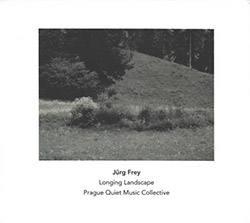 |
| Frey, Jurg Longing Landscape (Another Timbre) |
| Swiss composer Jürg Frey joins with the Prague Quiet Music Collective for three recent works exploring delicate tonal shifts, structural lists, and slow, evolving forms, balancing between consonance and dissonance, the ensemble — featuring clarinets, strings, guitars, double bass, and percussion — interprets Frey's subtly shifting frameworks with a deep sensitivity. |
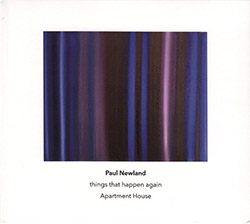 |
| Newland, Paul Things That Happen Again (Another Timbre) |
| A portrait of UK interdisciplinary composer Paul Newland's music through five pieces dating from 2009 to 2023 performed by members of London's Apartment House ensemble, including a string quartet, two different trio combinations, a short work for solo piano, and a score for open instrumentation, realised in this recording by a septet. |
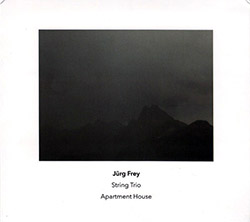 |
| Frey, Jurg / Apartment House String Trio (Another Timbre) |
| Reworking a piece for string trio originally commissioned by the Concertgebouw Brugge and premiered by the Goeyvaerts Trio as part of the 2019 SLOW Festival, this new version expands on the original composition to bring elegant calmness and clarity to the work, performed by UK's Apartment House members Mira Benjamin on violin, Bridget Carey on viola and Anton Lukoszevieze on cello. |
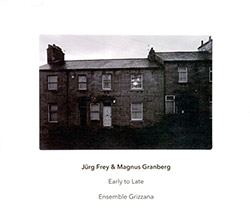 |
| Frey, Jurg / Magnus Granberg Early to Late (Another Timbre) |
| New ensemble pieces by Jurg Frey and Magnus Granberg played by Ensemble Grizzana, commissioned by Another Timbre with the request that both start from the same two fragments of early music, one by Johannes Ockeghem, the other by William Byrd, each composer producing fascinatingly different pieces that both contain echoes of the source material. |
 |
| Frey, Jurg Collection Gustave Roud [2 CDs] (Another Timbre) |
| A double CD with five beautiful pieces that engage with the work of the extraordinary French-Swiss poet Gustave Roud, with performers including Dante Boon, Stefan Thut, Andrew McIntosh and Jurg Frey himself, 10 compositions that Frey wrote in the manner that Roud would, roaming with a sketchbook and developing the pieces based on impressions of his surroundings. |
 |
| Zimmerlin, Alfred Dunki . Frey . Aeschbacher . Capt . Hefti . Moster (Edition Wandelweiser Records) |
| German composer Alfred Zimmerlin presents 3 pieces that balance compositional and improvisational approaches, with a 7-part work for strings, a large Klavierstruck work for microtonal piano, and an improvised chamber work, "Klarinettenquintett," with Jurg Frey on clarinet. |
 |
| Frey, Beuger / Duo Contour Duos (Edition Wandelweiser Records) |
| The duo Contour of Stephen Altoff (trumpet) & Lee Forrest Ferguson (percussion) perform Antoine Beuger's "dedekind duos" dedicated to mathematician Julius Wilhelm Richard Dedekind; and Jurg Frey's "22 Sachelchen" or "small things", 22 focused miniature compositions. |
 |
| Wolff, Christian / Wandelweiser Komponisten Ensemble Stones (Edition Wandelweiser Records) |
| Antoine Beuger, Burkhard Schlothauer, Chico Mello, Jurg Frey, Kunsu Shim, Michael Pisaro-Liu, and Thomas Stiegler participate in this realization of Christian Wolff's compositions to make sounds or draw sounds out of stones, alone or with other surfaces, acoustically or amplified. |
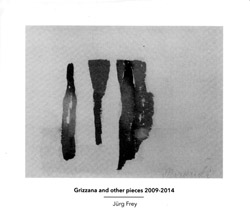 |
| Frey, Jurg Grizzana and other pieces 2009-2014 [2 CDs] (Another Timbre) |
| The Ensemble Grizzana (Ryoko Akama, Mira Benjamin, Richard Craig, Emma Richards, Philip Thomas and Seth Woods) performs a series of delicate and beautiful chamber pieces by Swiss composer and clarinetist Jurg Frey, who also performs on clarinet. |

![Money: 4 [2 CDs]](https://www.teuthida.com/productImages/misc4/37505.jpg)
![[ahmed] (Thomas / Grip / Gerbal / Wright): Play Monk [2 CDs]](https://www.teuthida.com/productImages/misc4/37428.jpg)
![+DOG+: The Garden [VINYL]](https://www.teuthida.com/productImages/misc4/37511.jpg)
![Clifford Brown: The Ultimate Collection [4 CDs]](https://www.teuthida.com/productImages/misc4/37290.jpg)
![Flojter (Mats Gustafsson / Delphine Joussein): Brest Blow [VINYL]](https://www.teuthida.com/productImages/misc4/37321.jpg)

![Westbrook, Mike Orchestra: The Cortege Live At The BBC 1980 [2CDs]](https://www.teuthida.com/productImages/misc4/37001.jpg)
![Le UN: 25 Pieces Sans Vide [3 CDs]](https://www.teuthida.com/productImages/misc4/37374.jpg)
![Directives: Reconsolid [CASSETTE]](https://www.teuthida.com/productImages/misc4/37418.jpg)
![La Casa, Eric / Francisco Lopez: Collection Supranaturelle: Induction / Mutation [2 CDs]](https://www.teuthida.com/productImages/misc4/37287.jpg)
![Aries House Zaes: Network Friction [VINYL]](https://www.teuthida.com/productImages/misc4/37242.jpg)
![Lindorff-Ellery, Evan: Light Sound Falling [CASSETTE w/ DOWNLOAD]](https://www.teuthida.com/productImages/misc4/37043.jpg)
![Lindorff-Ellery, Evan / Naomi Juniper: Studio, Creek [CASSETTE W/ DOWNLOAD]](https://www.teuthida.com/productImages/misc4/37044.jpg)

![Coleman, Rodger: Journey to Brno [CASSETTE + DOWNLOAD]](https://www.teuthida.com/productImages/misc4/37175.jpg)
![Allbee, Liz: Breath Vessels [VINYL]](https://www.teuthida.com/productImages/misc4/37012.jpg)
![Feldman, Morton / GBSR Duo w/ Taylor MacLennan: Trios [6 CD BOX SET]](https://www.teuthida.com/productImages/misc4/37020.jpg)
![Frey, Jurg : Composer, Alone [3 CDs]](https://www.teuthida.com/productImages/misc4/36927.jpg)
![Henry Cow: The Henry Cow Box Redux: The Complete Henry Cow [18 CDs, DVD & 3 BOOKLETS]](https://www.teuthida.com/productImages/misc4/37272.jpg)
![MacLean, Steve: Box Of Seven [7 CD BOX]](https://www.teuthida.com/productImages/misc4/36467.jpg)
![Mehead: One Good Eye [REISSUE]](https://www.teuthida.com/productImages/misc4/37276.jpg)
![Zorn, John: The Song of Songs [CD + CD BOOK]](https://www.teuthida.com/productImages/misc4/36923.jpg)
![Coultrain: Mundus [COLORED VINYL]](https://www.teuthida.com/productImages/misc4/33056.jpg)
![Hprizm: Signs Remixed [COLORED VINYL]](https://www.teuthida.com/productImages/misc4/30635.jpg)
![Halls Of the Machine: All Tribal Dignitaries [CASSETTE w/ DOWNLOAD]](https://www.teuthida.com/productImages/misc4/36134.jpg)
![Koenjihyakkei: Live at Club Goodman [2 CDs]](https://www.teuthida.com/productImages/misc4/36111.jpg)
![Sorry For Laughing (G. Whitlow / M. Bates / Dave-Id / E. Ka-Spel): Rain Flowers [2 CDS]](https://www.teuthida.com/productImages/misc4/35985.jpg)
![Rolando, Tommaso / Andy Moor : Biscotti [CASSETTE w/ DOWNLOADS]](https://www.teuthida.com/productImages/misc4/36106.jpg)
![Electric Bird Noise / Derek Roddy: 8-10-22 [CD EP]](https://www.teuthida.com/productImages/misc4/35970.jpg)

![Coley, Byron: Dating Tips for Touring Bands [VINYL]](https://www.teuthida.com/productImages/misc4/17906.jpg)

![Lost Kisses: My Life is Sad & Funny [DVD]](https://www.teuthida.com/productImages/misc4/lostKissesDVD.jpg)