



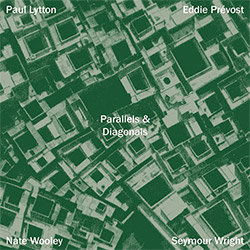
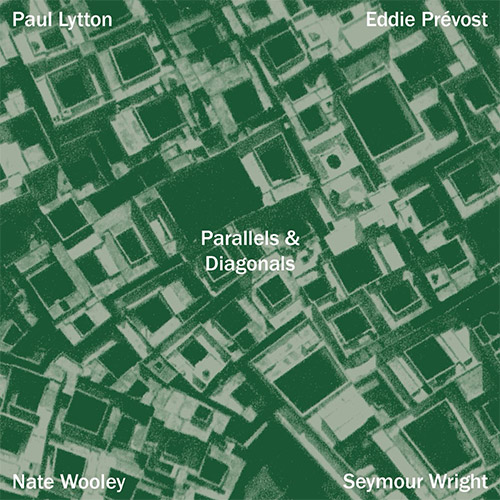
Recorded live at Cafe Oto, this first-time quartet of percussionists Paul Lytton and Eddie Prevost, trumpeter Nate Wooley and saxophonist Seymour Wright brings together overlapping histories of long-standing, renewed and entirely new collaborations, using those contrasting degrees of familiarity to shape a freely improvised performance of shifting alliances, layered interaction and distinct individual voices.
In Stock
Quantity in Basket: None
Log In to use our Wish List
Shipping Weight: 3.00 units
EU & UK Customers:
Discogs.com can handle your VAT payments
So please order through Discogs
Sample The Album:
Paul Lytton-percussion
Eddie Prevost-percussion
Nate Wooley-trumpet
Seymour Wright-saxophone
Click an artist name above to see in-stock items for that artist.
Label: Fataka
Catalog ID: Fataka 17
Squidco Product Code: 37927
Format: CD
Condition: New
Released: 2026
Country: UK
Packaging: Cardboard Gatefold
Recorded live at Cafe Oto, in London, UK, on July 14th, 2014, by James Dunn.
"Which is the more productive situation for improvisation: the shock of the first time encounter, unhindered by history or habit, or the long-term association and the evolution of more complex interactions? It's an unresolved, perhaps even undecidable, question. This recording brings together four improvisers together in a multi-layered situation which combines multiple permutations of the untried and the familiar. The four had never all played together before but the quartet contains various histories between individuals, with associations ranging from the established and ongoing (Lytton/Wooley, Prevost/Wright) and the emerging (Wooley/Wright) to the long dormant (Lytton/Prevost) and the completely fresh (Lytton/Wright, Prevost/Wooley).
It's undoubtedly an interesting situation, but one that is made even more so by the people involved: this is not just a theoretical experiment but a meeting of four individuals with distinct musical personalities and attitudes."-Fataka
Artist Biographies
• Show Bio for Paul Lytton "Paul Lytton (born 8 March 1947, London) is an English free jazz percussionist. Lytton began on drums at age 16. He played jazz in London in the late 1960s while taking lessons on the tabla from P.R. Desai. In 1969 he began experimenting with free improvisational music, working in a duo with saxophonist Evan Parker. After adding bassist Barry Guy, the ensemble became the Evan Parker Trio. He and Parker continued to work together into the 2000s; more recent releases include trio releases with Marilyn Crispell in 1996 (Natives and Aliens) and 1999 (After Appleby). A founding member of the London Musicians Collective, Lytton worked extensively on the London free improvisation scene in the 1970s, and aided Paul Lovens in the foundation of the Aachen Musicians' Cooperative in 1976. Lytton has toured North America and Japan both solo and with improvisational ensembles. In 1999, he toured with Ken Vandermark and Kent Kessler, and recorded with Vandermark on English Suites. Lytton also collaborated with Jeffrey Morgan (alto & tenor saxophone), with whom he recorded the CD "Terra Incognita" Live in Cologne, Germany. He played also on White Noise's pioneer electronic pop music album An Electric Storm in 1969." ^ Hide Bio for Paul Lytton • Show Bio for Eddie Prevost "Eddie Prévost (Edwin John) (born Hitchin, Hertfordshire, England, 22 June 1942) is an English percussionist noted for founding and participating in the AMM free improvisation group. Of Huguenot heritage, Prévost's silk weaving ancestors moved to Spitalfields in the late 17th century. Brought up by single parent mother (Lilian Elizabeth) in war-damaged London Borough of Bermondsey. He won a state scholarship to Addey and Stanhope Grammar School, Deptford, London, where to-be drummers Trevor Tomkins and Jon Hiseman also studied. Music tuition, however, was limited to singing and general classical music appreciation. Enrolled in the Boy Scouts Association (19th Bermondsey Troop) to join marching band. As a teenager began to get involved with the emerging youth culture music; skiffle, before being introduced to a big jazz record collection of a school friend with rich parents. With a bonus from the florist, for whom Prévost worked part-time after school, purchased his first snare drum from the famed Len Hunt drum shop in Archer Street (part of London's theatre land). After leaving school at sixteen Prévost was employed in various clerical positions whilst continuing his musical interests. Although, by now immersed in the music of bebop, his playing technique was insufficient for purpose. New Orleans style jazz ('trad') offered scope for his growing musical prowess. He played in various bands mostly in the East End of London. It was during a tenure with one of these bands he met trumpeter David Ware, who also shared a passion for the hard-bop jazz music. In their early twenties they later formed a modern jazz quintet which ultimately included Lou Gare, who had recently moved to London from Rugby and was a student at Ealing College of Art and a member of the Mike Westbrook Jazz Orchestra. AMM was co-founded in 1965 by Lou Gare, Eddie Prévost and Keith Rowe. They were shortly joined by Lawrence Sheaff. All had a jazz background. They were, however, soon augmented by composer Cornelius Cardew. Thereafter, Cardew, Gare, Prévost and Rowe remained as basis of the ensemble until the group fractured in 1972. Other more formally trained musicians were to enter the ranks of AMM after Cardew's departure. Those to make significant contributions were cellist Rohan de Saram and, in particular, pianist John Tilbury. The latter was a friend and early associate of Cardew and later became his biographer. In contrast to many other improvising ensembles, the core aesthetic of the ensemble is one of enquiry. There was no attempt to create a spontaneous music reflecting, or emulating, other forms. The AMM sound-world emerged from what Cardew referred to as "searching for sounds". For Prévost, the following would become the core formulation which he would explore during his subsequent musical career and explain and develop in various writings (see bibliography) and workshop activities. We are "searching" for sounds and for the responses that attach to them, rather than thinking them up, preparing them and producing them. In the 1980s, in response to various workshops and lectures, Prévost first formulated the twin analytical propositions of heurism and dialogue as defining concepts for an emergent musical philosophy, whilst acknowledging Cardew's construction (above). This line was explored and constantly redefined much through the London workshop experience, as his articles and his books show. (see below: The London Workshop). His 2011 book - The First Concert: an Adaptive Appraisal of a Meta Music - is described as a view "mediated through the developing critical discourse of adaptionism; a perspective grounded in Darwinian conceptions of human nature. Music herein is examined for its cognitive and generative qualities to see how our evolved biological and emergent cultural legacy reflects our needs and dreams. This survey visits ethnomusicology, folk music, jazz, contemporary music and "world music" as well as focusing upon various forms of improvisation - observing their effect upon human relations and aspirations. However, there are also analytical and ultimately positive suggestions towards future metamusical practices. These mirror and potentially meet the aspirations of a growing community who wish to engage with the world - with all its history and chance conditionals - by applying a free-will in making music that is creative and collegiate." (back cover of First Concert)History with AMM When, in the early 1970s, Cardew and Rowe began to devote their time and energy to espousing the political doctrine of an English Maoist party a fracture occurred in the ensemble leaving the rump of Lou Gare and Eddie Prévost, who continued in a duo form making various concerts and festival appearances and leaving a legacy of two recordings. At the end of the decade a rapprochement was attempted and for a short while the quartet began playing together again. It did not last. Lou Gare departed and moved from London to Devon. While Cardew's commitment to politics made his complete withdrawal inevitable. It was during this period Prévost took an Honours Degree at Hatfield Polytechnic, exploring and developing his interests in history(especially East Asian) and philosophy. Musically, this left Rowe and Prévost playing together. Their recording for German ECM label "It had been an ordinary enough day in Pueblo, Colorado" is the single example of their duet period. By the late 1970s a reawakened association with John Tilbury was cemented into his permanent place in AMM. He is featured on all subsequent AMM performances and recordings (as is Prévost). In 2002 a more lasting schism occurred leading to Rowe departing from AMM and leaving Tilbury to continue with Prévost.Percussion The investigative dynamic of AMM leads a musician to seek out new material. It is the fabric and constitution of stuff that is considered as more important than any historical or cultural heritage. It is Prévost's constant exploration's that has produced the range of sounds associated with his work, particularly within AMM and its extension to the many workshop ensembles. This philosophy leads to what Seymour Wright has so aptly described as the "awkward wealth" of investigation.(citation) It is a position of constant examination and artistic redress.Drumming Drumming with AMM was principally replaced by discreet percussion work which by and large relied on sound and texture rather than rhythm. At the time of the Gare/Prévost period this position was reviewed. However, it was plain the AMM aesthetic, characteristic of the early formative period, was to have its effect. The "searching" method prevailed. And, whereas a saxophone and drums duet led to a more jazz-like expectation (amplified by Gare's reversion to a more rolling and modal post-Rollins kind of approach). Prévost's playing was noted to have acquired some unusual qualities. This lead one reviewer (Melody Maker) to remark in 1972: "His free drumming flows superbly making use of his formidable technique. It's as though there has never been an Elvin Jones or Max Roach." Drumming however, was to take a back seat in Prévost's musical output as AMM developed and began to acquire and enhance its innovative reputation. And, apart from rare musical outings he did not commit himself, more fully, to the jazz drum kit again until 2007/08. Although, continuing to play percussion, a jazz-inflected project with Seymour Wright and Ross Lambert in an ensemble called SUM was the precursor of a period more devoted to drumming. Apart from various ad hoc ensembles, this led to various recordings including a series a CDs entitled Meetings with Remarkable Saxophonists. At date this consists of four volumes featuring Evan Parker, John Butcher, Jason Yarde and Bertrand Denzler respectively.The London workshop Over the years Prévost has conducted many improvised music workshops. However, as a result of a seminar he conducted at The Guelph Jazz Festival, Canada in 1999, Prévost began to formulate a framework for a workshop based upon a more thorough working of AMM principles and practice. He wrote: "I had, of course, already had long previous experience of improvisation and experimental music mostly through my participation in AMM and working closely with the composers Cornelius Cardew and Christian Wolff. From this experience I had begun a working hypothesis in my book 'No Sound is Innocent'. However, there is always more to discover. On my long flight across the Atlantic, I intuited more could be found out. Not through introspective, if rational, thought alone but, through discovery or experimentation: praxis. It can, of course, be very discomforting to watch a proposition die in practise. No theory is worth its salt unless it is fully tested. The best ideas - this experience suggests - emerge through activity. Hence, the working premise of the improvisation workshop had to be based upon an emergent set of criteria constantly tested within the cauldron of experience. In November 1999 I made it known that a free improvisation workshop would start weekly in a room at London's Community Music Centre, near London Bridge. Originally, under the auspices of the London Musicians' Collective, [...] these premises were found and minimal lines of communication to possible interested parties were opened. The first Friday evening (not thought to be an auspicious evening of the week because people 'went out' to have a good time) duly arrived. The room was available precisely because no one ever hired it on a Friday! I waited. Edwin Prévost, The First Concert: an Adaptive Appraisal of a Meta Music, (2011) p.115/6 Since then the workshop has continued weekly. It has a strong collegiate atmosphere. Those who participate are themselves formulating and refining a programme of enquiry and empathy. The working premise is one of 'searching for sounds' (Cardew). The emphasis is upon discovery and not on presentation. It is a place to risk failure and develop an open and continuing processive relationship with the materials at hand and other people. As hoped and anticipated, Prévost's continual presence is no longer required. In his occasional absences senior colleagues (in particular Seymour Wright and Ross Lambert) more than adequately move the project along. To date there have been over five hundred people who have attended the weekly workshop in London, representing over twenty different nationalities. This activity is further augmented by occasional forums for discussion and London's Cafe OTO programmes ensembles drawn from the London workshop every month. There have also been occasional extended periods of collective workshop musical experimentation. And, in 2010 there was a residential workshop held in Mwnci Studios on the Dolwillym Estate, west Wales. (see various other texts: including Philip Clark's Wire piece)] There are now workshops based upon this general premise functioning in Hungary, Greece, Slovenia, Japan, Brazil and Mexico. Mostly started by alumni of the original workshop in London.Intermediate and experimental compositions Cardew's 'Treatise' etc. Cardew's introduction to AMM in 1966 owes something to his search for musicians to perform his (then unfinished)193 pages long graphic score, 'Treatise'. The AMM musicians (at the time Lou Gare, Eddie Prévost, Keith Rowe and Lawrence Sheaff) seemed perfect candidates to embrace this bold work of imagination. And, with others (including later AMM member John Tilbury) all participated in the premier performance at the Commonwealth Institute on 8 April 1966 (check year!). But the initial impact of Cardew's induction into AMM was to bring a halt to his compositional aspirations. However, over the years since, AMM has had a long relationship with particular indeterminate and experimental works particularly those of Cardew - especially after his death in 1983. Most prominently 'Treatise'. Other favourites were 'Solo with Accompaniment', 'Autumn '60', Schooltime Compositions' and the text piece Cardew wrote particularly for AMM, 'The Tiger's Mind.' These pieces (which for a long time had been neglected within 'new' musical schedules), and occasionally others by Christian Wolff and John Cage, were sometimes played in conjunction with an AMM improvisation. Some concert promoters were, it seems, more interested in these pieces being played than the principal musical output of AMM. Hence, Prévost's ambivalence about the inclusion of such material in concert programmes. The creative search for primary performance material was diverted, in such works, in keeping with the demands of the notation or compositional scheme. This inevitably prevented the musician from (to use Cardew's own words) "being at the heart of the experiment". (Cardew, 'Towards an Ethic of Improvisation; CC R p. 127).Matchless Recordings and Publishing In 1979 Prévost began the recording imprint of Matchless Recordings and Publishing. Although there had been some interest by commercial labels to take on the new improvising music of the late 1960s onwards, it proved not to be satisfactory or long-lasting. Together with a number of similar initiatives, e.g. Incus Records in Britain and ICP (?) in the Netherlands, Prévost sought to take control of their own work. In the early years this was slow and painstaking work. Some years little was produced and few small sales accrued. Gradually however, Matchless recordings began to be the documenting and disseminating base for a developing body of work. Most of the AMM output is featured on Matchless and this has diversified (more so in recent years) to include other associated artists and ensembles.[see matchlessrecordings.com] In 1995, following the same principal for internal control over the output, production and dissemination of material, the publishing imprint Copula was inaugurated. The first publication was Prevost's No Sound is Innocent. Later followed by Minute Particulars in 2004. 2006 saw the publication of Cornelius Cardew: A Reader (edited by Prévost) which was a collection of Cardew's published writings accompanied by commentaries by a number of musicians associated and inspired by Cardew. This volume was an essential companion to John Tilbury's comprehensive biography Cornelius Cardew: a life unfinished which was also published by Copula in 2008. The most recent book to appear on this imprint is Prévost's The First Concert: An Adaptive Appraisal of a Meta Music (2011). Eddie Prévost is the cousin of the ex-docker shop-steward and left-wing political activist also named Eddie Prevost." ^ Hide Bio for Eddie Prevost • Show Bio for Nate Wooley "Nate Wooley was born in 1974 in Clatskanie, Oregon, a town of 2,000 people in the timber country of the Pacific Northwestern corner of the U.S. He began playing trumpet professionally with his father, a big band saxophonist, at the age of 13. His time in Oregon, a place of relative quiet and slow time reference, instilled in Nate a musical aesthetic that has informed all of his music making for the past 20 years, but in no situation more than his solo trumpet performances. Nate moved to New York in 2001, and has since become one of the most in-demand trumpet players in the burgeoning Brooklyn jazz, improv, noise, and new music scenes. He has performed regularly with such icons as John Zorn, Anthony Braxton, Eliane Radigue, Ken Vandermark, Fred Frith, Evan Parker, and Yoshi Wada, as well as being a collaborator with some of the brightest lights of his generation like Chris Corsano, C. Spencer Yeh, Peter Evans, and Mary Halvorson. Wooley's solo playing has often been cited as being a part of an international revolution in improvised trumpet. Along with Peter Evans and Greg Kelley, Wooley is considered one of the leading lights of the American movement to redefine the physical boundaries of the horn, as well as demolishing the way trumpet is perceived in a historical context still overshadowed by Louis Armstrong. A combination of vocalization, extreme extended technique, noise and drone aesthetics, amplification and feedback, and compositional rigor has led one reviewer to call his solo recordings "exquisitely hostile". In the past three years, Wooley has been gathering international acclaim for his idiosyncratic trumpet language. Time Out New York has called him "an iconoclastic trumpeter", and Downbeat's Jazz Musician of the Year, Dave Douglas has said, "Nate Wooley is one of the most interesting and unusual trumpet players living today, and that is without hyperbole". His work has been featured at the SWR JazzNow stage at Donaueschingen, the WRO Media Arts Biennial in Poland, Kongsberg, North Sea, Music Unlimited, and Copenhagen Jazz Festivals, and the New York New Darmstadt Festivals. In 2011 he was an artist in residence at Issue Project Room in Brooklyn, NY and Cafe Oto in London, England. In 2013 he performed at the Walker Art Center as a featured solo artist. Nate is the curator of the Database of Recorded American Music (www.dramonline.org) and the editor-in-chief of their online quarterly journal Sound American (www.soundamerican.org) both of which are dedicated to broadening the definition of American music through their online presence and the physical distribution of music through Sound American Records. He also runs Pleasure of the Text which releases music by composers of experimental music at the beginnings of their careers in rough and ready mediums." ^ Hide Bio for Nate Wooley • Show Bio for Seymour Wright "Seymour Wright - saxophonist, investigator, artist - lives in London. His practice is about the saxophone - music, history and technique - actual and potential; an on-going, rigorous and exhaustive exploration of the instrument. The energy of this learning is applied to various collaborations and contexts to access/share what he has called the 'awkward wealth of investigation'. His work is documented on two widely acclaimed self-released collections Seymour Wright of Derby (2008) and Seymour Writes Back (2015). As well as STEPS, his current collaborations include lll人 (with Daichi Yoshikawa and Paul Abbott), GUO (with Daniel Blumberg) and XT (with Paul Abbott)." ^ Hide Bio for Seymour Wright
9/29/2026
Have a better biography or biography source? Please Contact Us so that we can update this biography.
9/29/2026
Have a better biography or biography source? Please Contact Us so that we can update this biography.
9/29/2026
Have a better biography or biography source? Please Contact Us so that we can update this biography.
9/29/2026
Have a better biography or biography source? Please Contact Us so that we can update this biography.
Track Listing:
1. Parallel A 23:38
2. Parallel B 18:38
3. Diagonal A 11:39
4. Diagonal B 13:06
September 2026
Improvised Music
Jazz
Free Improvisation
NY Downtown & Metropolitan Jazz/Improv
London & UK Improv & Related Scenes
Quartet Recordings
Nate Wooley
Matchless
Staff Picks & Recommended Items
New in Improvised Music
Recent Releases and Best Sellers
Search for other titles on the label:
Fataka.
 |
| Golding / Brice / Prevost High Laver Levitations Vol 4: Sound-Out - jazz is dead, long live jazz (Matchless) |
| Binker Golding, Olie Brice and Eddie Prévost reduce their earlier Secret Handshake with Danger collaboration to an elemental saxophone, bass and drums trio, bringing contemporary London jazz into Prévost's High Laver Levitations series through vigorous free improvisation where pulse, melody, resonance and abstraction continually test and renew the boundaries of jazz. |
 |
| [ahmed] (Thomas / Grip / Gerbal / Wright) Play Monk [2 CDs] (Otoroku) |
| After six albums reimagining Ahmed Abdul-Malik, Pat Thomas, Joel Grip, Antonin Gerbal and Seymour Wright turn their transformative [Ahmed] project toward Thelonious Monk, atomising his compositions across two CDs into volatile, time-bending forms where piano, bass, drums and alto saxophone fracture and reassemble melody, rhythm and space through free jazz intensity, pulse and radical collective invention. |
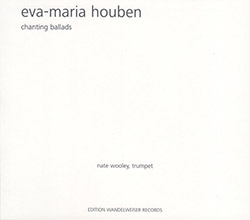 |
| Houben, Eva-Maria (Nate Wooley) Chanting Ballads (Edition Wandelweiser Records) |
| Commissioned for the for/with series, Eva-Maria Houben presents a long-form work for Nate Wooley's trumpet, voice, and whistling, where sparse, precisely placed tones unfold in a meditative arc, expanding from an early performance into a deeply considered exploration of pure timbre, attentive listening, and the subtle interplay between composition and free improv. |
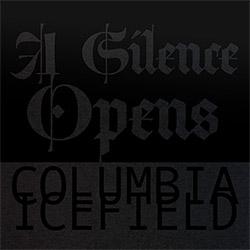 |
| Columbia Icefield (Wooley / Alcorn / Mendoza / Sawyer) A Silence Opens (Out Of Your Head Records) |
| A deeply elegiac final statement from Nate Wooley's Columbia Icefield, with Susan Alcorn's pedal steel, Ava Mendoza's guitar and voice, and Ryan Sawyer's drums joining Wooley's trumpet, amplifier, voice, whistling and footwork in music shaped by grief, memory and gratitude, responding to the deaths of Ron Miles and Alcorn through expansive, emotionally weighted improvisation. |
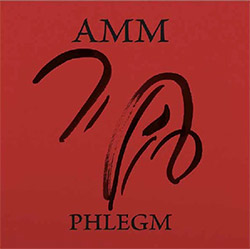 |
| AMM (Prevost / Rowe / Tilbury) Phlegm (Matchless) |
| A late-period live recording from AMM — Eddie Prévost, Keith Rowe, and John Tilbury — capturing their refined electroacoustic free improv language of near-silence, where percussion, electronics, and piano dissolve into a shared sonic field shaped by extreme restraint, microscopic detail, and a collective focus on texture, duration, and deep listening. |
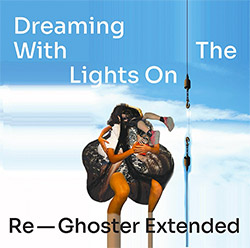 |
| Re-Ghoster Extended Dreaming With The Lights On [VINYL] (Konnekt) |
| Recorded live at the Archipel Festival, this quintet of Nicolas Field, Thomas Florin, Jerome Noetinger, Fritz Welch, and Nate Wooley delivers an intense electroacoustic performance where composed frameworks erupt into explosive, immersive interactions, as voice, trumpet, piano, percussion, and electronics collide in dense, mutating textures that are disorienting, consuming, often volatile, yet consistently exhilarating. |
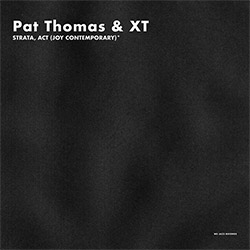 |
| Thomas, Pat & XT (Wright / Abbott) Strata, Act (Joy Contemporary)* London [VINYL + DOWNLOAD] (We Jazz) |
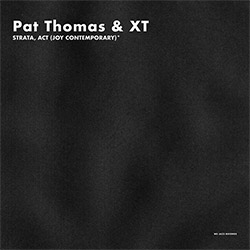 |
| Thomas, Pat & XT (Wright / Abbott) Strata, Act (Joy Contemporary)* Zurich [2 CDs] (We Jazz) |
| Recorded live at Rote Fabrik, in Zurich, this 2-CD set from Pat Thomas with XT — Seymour Wright and Paul Abbott — reimagines free improv through a fluid integration of acoustic and electronic sound, where real and "imaginary" instruments dissolve boundaries of form and timbre, unfolding as a complex, evolving suite that draws on ea traditions while pushing toward a synthetic, genre-defying future. |
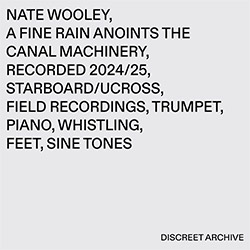 |
| Wooley, Nate A Fine Rain Anoints The Canal Machinery (Discreet Archive) |
| In a subtly detailed journey, Nate Wooley layers field recordings, trumpet, piano, sine tones, whistling, and bodily sound into a stark, reflective work that probes the uneasy coexistence of nature, machinery, and human presence, shaping a quietly political soundscape in which environmental detail, isolation, and mechanical intrusion collide in fragile, contrapuntal tension. |
 |
| Perelman, Ivo / Nate Wooley Polarity 4 (Burning Ambulance Music) |
| Continuing their ever-evolving duo series, tenor saxophonist Ivo Perelman and trumpeter Nate Wooley expand their intuitive, exploratory language with a bold new dimension, including the duo's first-ever use of overdubbing to create layered, prismatic improvisations that push their Polarity collaboration into strikingly multidirectional terrain. |
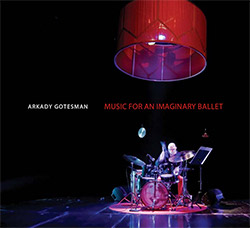 |
| Gotesman, Arkady (w/ Nate Wooley / Charles Gayle / Mark Sanders / Liudas Mockunas / Martin Kuchen / Ned Rothenberg) Music For An Imaginary Ballet (NoBusiness) |
| Drawing from recordings made between 2000 and 2025 across Lithuania and Latvia, percussionist Arkady Gotesman assembles collaborators including Nate Wooley, Charles Gayle, Mark Sanders, Liudas Mockūnas, Martin Küchen and Ned Rothenberg for a focused set of duos, trios and solo works that trace three decades of chamber-improvised music shaped by fascinating structurs and a deep connection to Vilnius. |
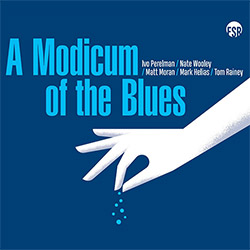 |
| Pereleman, Ivo / Nate Wooley / Matt Moran / Mark Helias / Tom Rainey A Modicum Of the Blues (Listen! Foundation (Fundacja Sluchaj!)) |
| Tenor saxophonist Ivo Perelman joins Nate Wooley (trumpet), Matt Moran (vibes), Mark Helias (bass) and Tom Rainey (drums) in a tempered yet highly active quintet that nods to the blues, moving through free, melody-rich dialog; vibes replace piano to color the space as the group shifts from playful exchanges to surging peaks, their seemingly telepathic interplay balancing warmth and power. |
 |
| Prevost, Eddie Material Consequences (Matchless) |
| An engrossing solo statement from AMM percussionist Eddie Prévost, recorded in 2001, using bowed cymbals, found objects, resonant drums, and extended techniques to explore a wide sonic palette, transforming his percussion into a nuanced instrument of texture, tone, and timbral abstraction in a focused, contemplative, and remarkably expressive improvisation. |
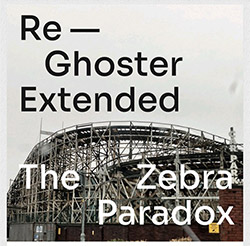 |
| Re-Ghoster Extended The Zebra Paradox [VINYL] (Konnekt) |
| Expanding the Re-Ghoster trio of Nicolas Field on drums, Thomas Florin on piano, and Valerio Tricoli on revox and electronics with the addition of Nate Wooley on acoustic and amplified trumpet and Fritz Welch's visceral vocal work, the group explores surreal electroacoustic improvisation through dense, transdimensional soundscapes, fractured time, deranged textures, and ritualistic intensity; incredible! |
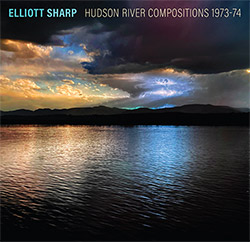 |
| Sharp, Elliott (w/ Coleman / Dulberger / Green II / Insell / Jiang / McKenzie / Salomon / Wooley) Hudson River Compositions 1973-74 (zOaR Records) |
| Inspired by fireflies, birds, and the flow of the Hudson River while living in Germantown, NY, Elliott Sharp developed these compositions using traditional, graphic, & conceptual scores, presented here in a collage of sessions featuring Sharp on reeds & strings with Anthony Coleman, Nate Wooley, Shayna Dulberger, Hao Jiang, Terry L. Greene, Don McKenzie, Terry L. Green II, Sara Salomon, and Judith Insell. |
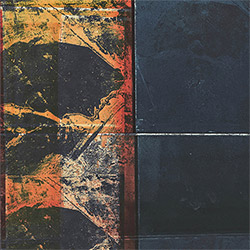 |
| Perelman, Ivo / Nate Wooley Polarity 2 (Burning Ambulance Music) |
| The second installment from New York saxophonist Ivo Perelman and trumpeter Nate Wooley demonstrates the strong affinity between the two players, highlighting their impressive mastery of their instruments with a creative drive and quick responsiveness that sparks unique dialogs, full of powerful and sometimes unconventional technique and expression; a truly gratifying and remarkable set of improvisations. |
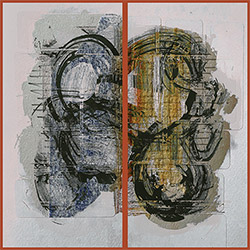 |
| Perelman, Ivo / Nate Wooley Polarity 3 (Burning Ambulance Music) |
| Ten improvisations in the 3rd release of New York trumpeter Nate Wooley and tenor saxophonist Ivo Perelman's Polarity series, their dialogs an incredible weaving of creative ideas and technical prowess that started in 2020 after recording a series of larger group albums, their affinity and cooperative approach to instrumental dialog exceptional and exemplary. |
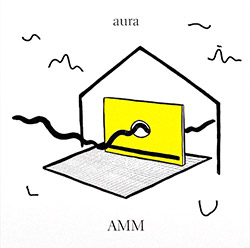 |
| AMM (Prevost / Tilbury) Aura (Matchless) |
| Recorded in Finland in 2016, this extended improvisation features a core duo from later AMM configurations — percussionist Eddie Prévost and pianist John Tilbury, who also performs on harpsichord — captured in the exceptional acoustics of The Sibelius Museum concert hall where the intimate setting elicits profound, beautifully recorded dialogue between these two masterful performers. |
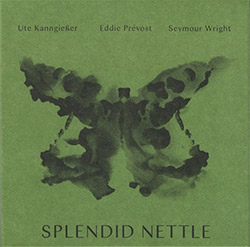 |
| Kanngiesser / Prevost / Wright Splendid Nettle (High Laver Levitations Volume 3) (Matchless) |
| The third volume in the High Laver Levitations series that started with the duo of John Butcher and Eddie Prévost, continued with Silvan Schmid, Tom Wheatley & Prévost, now presents Ute Kanngiesser on cello, Seymour Wright on alto sax, and Eddie Prévost on drum kit, recording two extended improvisations that explore the resonant acoustics of All Saints Church in High Laver, Essex. |
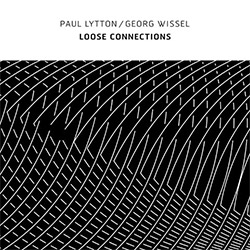 |
| Lytton, Paul / Georg Wissel Loose Connections (Confront) |
| An unusual and engrossing concert of free dialog using tightly controlled technique between two legendary free jazz improvisers: percussionist Paul Lytton performing on tabletop percussion and "bits and pieces", and saxophonist Georg Wissel performing on augmented alto saxophone and tenor saxophone, from reserved intricate detail to forcefully passionate expression. |
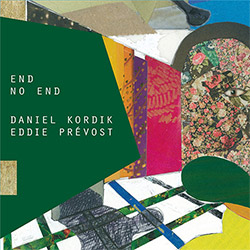 |
| Kordik, Daniel / Eddie Prevost End No End (Earshots) |
| Legendary AMM drummer/percussionist and Matchless label leader Eddie Prévost meets with Earshots co-label leader and improvising synthesist Daniel Kordik for five remarkable dialogs, both using a full range of creative techniques that complement through alternating percussive and sonic approaches to their instruments, taking listeners into unforseen territories. |
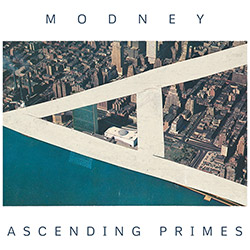 |
| Modney (Modney / Wooley / Gentile / Roberts / Pluta / Symthe / ...) Ascending Primes [2 CDs] (Pyroclastic Records) |
| Exploring tuning systems and the extremes of harmonicity and dissonance through compositions that employ prime numbers of players in solo, trio, quintet, septet, and undectet (11) configurations, violinist Modney takes listeners into transcendent and turbulent spaces spanning improvisation and composition, detailed in a 24-page booklet with collages from Ellsworth Kelly. |
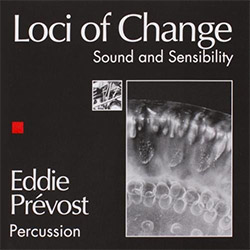 |
| Prevost, Eddie Loci Of Change (Matchless) |
| Breaking from the AMM collective, British percussionist Eddie Prévost's 1996 solo debut showcases six studio-recorded works highlighting expressive momentum and textural nuance through innovative drumming and cymbal techniques, crafting layered and intense sonic landscapes with extraordinary skill and the inventive application of external objects. |
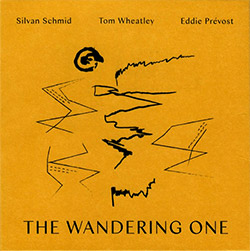 |
| Schmid, Silvan / Tom Wheatley / Eddie Prevost The Wandering One - High Laver Levitation Volume 2 (Matchless) |
| A live recording of freely improvised improv captured at All Hallows Church in High Laver, Essex in 2023 from the trio of AMM drummer and Matchless label-leader Eddie Prévost, Zürich and Maastricht trumpeter Silvan Shmid, and London double bassist Tom Wheatley of the group Widdershins, heard in three investigative conversations of great creative drive. |
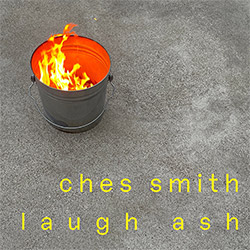 |
| Smith, Ches Laugh Ash (Pyroclastic Records) |
| A stunning album that effortlessly blends styles from jazz, electronics, minimalism and contemporary forms, rendered by an eclectic group of primarily NY artists including Nate Wooley, Jennifer Choi, James Brandin Lews, Oscar Noriega, Anna Webber, Shahzad Ismaily and Smith himself, in an exhilarating and well-balanced set of Smith compositions that inform and groove spectacularly! |
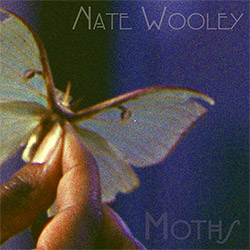 |
| Wooley, Nate Moths (Editions Verde) |
| Nate Wooley's exquisite improvised composition begins with a musical gesture and four parameters of change from each player--harmonic motion, articulation, extension, & physicality--which directs their "flight" in its slowly evolving pace, creating a varying mosaic of sound, as beautifully rendered by Laura Cocks (flute), Madison Greenstone (clarinet) and Eric Wubbels (keys & voice). |

![Rose, Jon: Rosenberg Museum [5 CDs]](https://www.teuthida.com/productImages/misc4/37935.jpg)
![Corsano, Chris / Tashi Dorji: Live at Ritual Botanica [VINYL]](https://www.teuthida.com/productImages/misc4/37552.jpg)
![My Face Is Dancing (Federico Ughi / Alberto Ughi / Martino Ughi / Benjamin Ughi): My Face Is Dancing [VINYL]](https://www.teuthida.com/productImages/misc4/37836.jpg)
![Kim, Doyeon (w/ Sorey / Maneri / Fraser): Wellspring [VINYL]](https://www.teuthida.com/productImages/misc4/37338.jpg)
![Radigue, Eliane: Triptych [VINYL 2 LPs]](https://www.teuthida.com/productImages/misc4/37875.jpg)
![Orchestre National De Jazz: With Carla [2 CDs]](https://www.teuthida.com/productImages/misc4/37714.jpg)
![Rollins, Sonny : The Early Years [4 CDs]](https://www.teuthida.com/productImages/misc4/37711.jpg)
![Vasseur, Christian / Steve Gibbs / Nicolo Vivi : FWWU+ Duos Trios [2 CDs]](https://www.teuthida.com/productImages/misc4/37891.jpg)
![Ehrlich, Marty: OPEN AIR: The Complete Saxophone Quartet Compositions of Julius Hemphill [2 CDs]](https://www.teuthida.com/productImages/misc4/37922.jpg)
![Frith, Fred / Cornelius Claudio Kreusch / Johannes Tonio Kreusch: Pink / Neon [2 CDs]](https://www.teuthida.com/productImages/misc4/37712.jpg)
![Frith, Fred / Cornelius Claudio Kreusch / Johannes Tonio Kreusch: Pink / Neon [VINYL 2 LPs]](https://www.teuthida.com/productImages/misc4/37713.jpg)
![Money: 5 [2 CDs]](https://www.teuthida.com/productImages/misc4/37890.jpg)
![Drumm, Kevin: The Mild Temper [6 CD BOX SET]](https://www.teuthida.com/productImages/misc4/37651.jpg)
![TRAC (Teddy Ryles / Alexander Cooper): Heavy Nano Ream Aria [2 CDs]](https://www.teuthida.com/productImages/misc4/37647.jpg)
![Jerman, Jeph: For Alvin Kelly [CASSETTE + DOWNLOAD]](https://www.teuthida.com/productImages/misc4/37521.jpg)
![Mann, Oliver / Stefano Pilia: Precious Moments [CASSETTE + DOWNLOAD]](https://www.teuthida.com/productImages/misc4/37494.jpg)
![Jerman, Jeph / Ted Byrnes: Muir [CASSETTE + DOWNLOAD]](https://www.teuthida.com/productImages/misc4/37520.jpg)
![+DOG+: Angel Wings [VINYL]](https://www.teuthida.com/productImages/misc4/37513.jpg)
![Money: 4 [2 CDs]](https://www.teuthida.com/productImages/misc4/37505.jpg)
![Tilbury, John: At Home [4 CDs]](https://www.teuthida.com/productImages/misc4/37729.jpg)
![Scott, Ryan: 21st-Century Canadian Snare Drum [2 CDs]](https://www.teuthida.com/productImages/misc4/37538.jpg)
![Feldman, Morton / GBSR Duo w/ Taylor MacLennan: Trios [6 CD BOX SET]](https://www.teuthida.com/productImages/misc4/37020.jpg)
![Frey, Jurg : Composer, Alone [3 CDs]](https://www.teuthida.com/productImages/misc4/36927.jpg)
![Bruce, Lenny: Comedy & Controversy: The Original Albums 1958-61 [2 CDs]](https://www.teuthida.com/productImages/misc4/37409.jpg)

![Amba, Zoh: Eyes Full [VINYL]](https://www.teuthida.com/productImages/misc4/37491.jpg)
![Henry Cow: The Henry Cow Box Redux: The Complete Henry Cow [18 CDs, DVD & 3 BOOKLETS]](https://www.teuthida.com/productImages/misc4/37272.jpg)
![MacLean, Steve: Box Of Seven [7 CD BOX]](https://www.teuthida.com/productImages/misc4/36467.jpg)
![Mehead: One Good Eye [REISSUE]](https://www.teuthida.com/productImages/misc4/37276.jpg)
![Zorn, John: The Song of Songs [CD + CD BOOK]](https://www.teuthida.com/productImages/misc4/36923.jpg)
![Coultrain: Mundus [COLORED VINYL]](https://www.teuthida.com/productImages/misc4/33056.jpg)
![Hprizm: Signs Remixed [COLORED VINYL]](https://www.teuthida.com/productImages/misc4/30635.jpg)
![Halls Of the Machine: All Tribal Dignitaries [CASSETTE w/ DOWNLOAD]](https://www.teuthida.com/productImages/misc4/36134.jpg)
![Koenjihyakkei: Live at Club Goodman [2 CDs]](https://www.teuthida.com/productImages/misc4/36111.jpg)
![Sorry For Laughing (G. Whitlow / M. Bates / Dave-Id / E. Ka-Spel): Rain Flowers [2 CDS]](https://www.teuthida.com/productImages/misc4/35985.jpg)
![Rolando, Tommaso / Andy Moor : Biscotti [CASSETTE w/ DOWNLOADS]](https://www.teuthida.com/productImages/misc4/36106.jpg)
![Electric Bird Noise / Derek Roddy: 8-10-22 [CD EP]](https://www.teuthida.com/productImages/misc4/35970.jpg)
![Coley, Byron: Dating Tips for Touring Bands [VINYL]](https://www.teuthida.com/productImages/misc4/17906.jpg)

![Lost Kisses: My Life is Sad & Funny [DVD]](https://www.teuthida.com/productImages/misc4/lostKissesDVD.jpg)