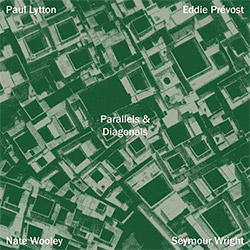
The Fataka label returns after a three-year break, quietly but with incredible intent, releasing a recording from London's Cafe Oto twelve years earlier, in a quartet that recalls the spirit of AMM while embracing the more contemplative approaches of contemporary improvisation. Meeting on stage on July 14, 2014, percussionists Paul Lytton and Eddie Prévost joined a younger generation of improvisers, trumpeter Nate Wooley and saxophonist Seymour Wright, for four freely improvised performances, two "Parallels" and two "Diagonals."
Lytton and Prévost were both instrumental in the development of British free improvisation during the late 1960s and early 1970s, Lytton through his associations with Evan Parker and Barry Guy, and Prévost as a founding member of AMM. Wooley and Wright represent a younger generation who inherited those experiments and developed their own distinctive approaches, particularly Wooley, whose work embraces both contemporary jazz traditions and more radical, outsider approaches. All four bring superb technical mastery to their instruments, but equally important are their patience, pacing, and capacity for intense listening and interaction.
The musicians also share a rich history of collaborations, particularly Lytton and Wooley, who released the excellent psi album Creak Above 33 in 2010, employing microscopic percussion events, amplified trumpet sounds, electronics, and abrupt, unpredictable exchanges. They can also be heard on the 2012 Clean Feed album The Nows, in trio configurations with Ikue Mori and Ken Vandermark. Wooley and Wright released About Trumpet and Saxophone on Fataka in 2013, exploring extended techniques and unconventional sounds with a clear musical purpose. Prévost and Wright recorded the 2008 duo album Gamut for Matchless, taking percussion and wind instruments into unexpected territory. They also formed two-thirds of the trio heard on the 2009 Matchless album Invenio Ergo Sum with guitarist Ross Lambert, and collaborated again in 2012 with pianist Sebastian Lexer on Impossibility in Its Purest Form.
Those shared histories inform Parallels & Diagonals, balancing unconventional approaches to the horns with seemingly inexplicable percussive sounds. No player dominates the foreground; instead, they share a dialogue at a deceptively easy pace, belying the furious activity of each musician. There is no bellowing, no grandstanding, and plenty of space between interactions. Those interactions are the fascination, drawing the ear toward the percussive and harmonic blending of unusual sounds and sudden moments of excitation. Lytton focuses on an assortment of sound-producing devices, complemented by Prévost's metallic percussion and bowed sounds. The horns contribute vocalized textures, scrabbling gestures, and wonderful swells that build force within the conversation. And as quickly as the sound grows, it recedes, relieving the listener and preparing them for the next foray.
Comments and Feedback:

More Recent Reviews, Articles, and Interviews @ The Squid's Ear...
|





 Sunny Murray and Sabu Toyozumi:
 Eva-Maria Houben (Nate Wooley):
 Masayo Koketsu / Nava Dunkelman:
 Nicolas Gombert / James Weeks:
 Reuben / Hanslip / Lash / Hession:
 Ivo Perelman / Matthew Shipp:
 Ishmael Ali (Ishmael / Wilkerson / Wilkes / Baker / Tong / Harris):
 Marta Warelis (w/ LaMar Gay / Baars / Ng / Haker Flaten / Rosaly):
 Maya Bennardo / Erik Blennow Calalv / Kristofer Svensson: