



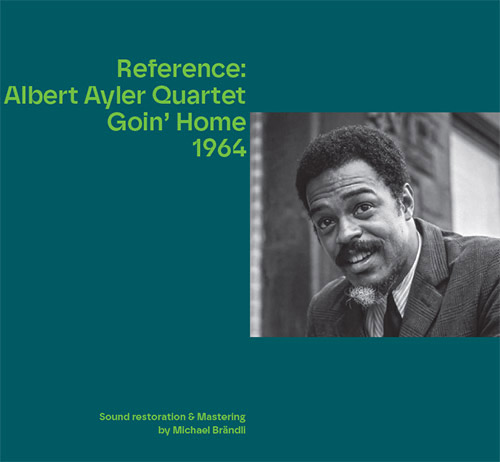
A strikingly restrained side of Albert Ayler emerges on this 1964 session of spirituals and devotional songs, with his tenor and soprano saxophones joined by Call Cobbs Jr. on piano, Henry Grimes on double bass and Sunny Murray on drums, emphasizing melody, blues-inflected tone and deep vibrato while revealing the gospel and New Orleans roots underlying his more radical later language.
In Stock
Quantity in Basket: None
Log In to use our Wish List
Shipping Weight: 3.00 units
Sample The Album:
Albert Ayler-tenor saxophone, soprano saxophone
Call Cobbs-piano
Henry Grimes-double bass
Sunny Murray-drums
Click an artist name above to see in-stock items for that artist.
UPC: 7649988758355
Label: ALAY
Catalog ID: thingamajig 2515
Squidco Product Code: 37878
Format: CD
Condition: New
Released: 2026
Country: Switzerland
Packaging: Cardboard Gatefold
Recorded in New York City, on February 24, 1964.
Swing Low, Sweet Spiritual originally issued in 1981 as a vinyl LP on the Osmosis label with catalog code 4001.
Goin' Home subsequently issued as an expanded reissue on the Black Lion label, adding alternate takes from the same February 24, 1964 session.
"[...] Ayler's roots in the music of the church has been well documented — mentored by his father on alto saxophone and performing for religious services, primarily in Cleveland's Liberty Hill Baptist Church, before he was a teenager, learning a repertoire and a style of articulation that spoke to the assembled worshippers. But by age 15 he had started working with local r&b bands, eventually leading to his employment with professional artists like Chicago bluesman Little Walter and vocalist Lloyd Price, which likely reinforced an awareness of the similar visceral feelings stimulated by gospel and blues-based music. Further, Ayler's appreciation of the colorful sounds and vital spirit coming from New Orleans ensembles — such as those that included one of his idols, Sidney Bechet, who recorded both blues and spirituals with equal zeal, but possibly other groups led by popular practitioners like clarinetist George Lewis and alto saxophonist "Captain" John Handy (not to be confused with the modern altoist of the same name) who celebrated spirituals and blues interchangeably — was to prove inspirational throughout his career.
How, then, can we measure sincerity? In performing these standards, familiar songs with a message of suffering and salvation, Ayler adopted a strategy of internalized piety in place of the flamboyant formal distortions of his earlier Stockholm and Copenhagen recordings of jazz standards — to distance this representation of his faith from the abstracted, existential initiatives unveiled in the second session recorded that same day, released separately as Spirits in 1964 [now available on Reference: Albert Ayler, Spirits & Spirits Rejoice, thingamajig 2504], or, even moreso, the tonal glossolalia (the transformative "speaking in tongues") he was continuing to develop — as if to here engage the listener's spirit and lessen the effect of his music's otherwise potentially alienating surface.
His more extreme gestures were replaced by fidelity to the song's melody — serving to focus attention on the well-known lyrics — intensified in feeling by a blues-inflected tonal coloration and pitch-affecting thick vibrato [...]. In this light, it's understandable that Ayler hired pianist Call Cobbs to, initially, accompany and support this more traditional orientation. Cobbs was a versatile veteran of the r&b scene, among his credits having appeared on four sides in 1946, all with the then-trendy "boogie" in the title, fronted by the boisterous tenor saxist Jack McVea; his playing here employs a sophisticated touch and florid ornamentation that softens the frequently somber mood.
Unlike any other document in Ayler's discography, Goin' Home could be compared to a chapter in a novel that does not add significantly to the plot, but explains something about the main character's motivation. Though never returning specifically to this repertoire, echoes and motifs reoccur in future original compositions and pastiches, song titles throughout the years illustrate the extent of his spiritual vision, and the emotional catharsis released by Ayler's passion confirms his conviction in the complex impressions of reality that inspire the most personal modes of creativity.'-Art Lange, Chicago, June 2026
Artist Biographies
• Show Bio for Albert Ayler "Albert Ayler (born July 13, 1936 - November 25, 1970) was an American avant-garde jazz saxophonist, singer and composer. After early experience playing R&B and bebop, Ayler began recording music during the free jazz era of the 1960s. However, some critics argue that while Ayler's style is undeniably original and unorthodox, it does not adhere to the generally accepted critical understanding of free jazz. In fact, Ayler's style is difficult to categorize in any way, and it evoked incredibly strong and disparate reactions from critics and fans alike. His innovations have inspired subsequent jazz musicians. His trio and quartet records of 1964, such as Spiritual Unity and The Hilversum Session, show him advancing the improvisational notions of John Coltrane and Ornette Coleman into abstract realms where whole timbre, and not just mainly harmony with melody, is the music's backbone. His ecstatic music of 1965 and 1966, such as "Spirits Rejoice" and "Truth Is Marching In", has been compared by critics to the sound of a brass band, and involved simple, march-like themes which alternated with wild group improvisations and were regarded as retrieving jazz's pre-Louis Armstrong roots. Early life and career Born in Cleveland, Ohio, Ayler was first taught alto saxophone by his father Edward, who was a semiprofessional saxophonist and violinist. Edward and Albert played alto saxophone duets in church and often listened to jazz records together, including swing era jazz and then-new bop albums. Ayler's upbringing in the church had a great impact on his life and music, and much of his music can be understood as an attempt to express his spirituality, including the aptly titled Spiritual Unity, and his album of spirituals, Goin' Home, which features "meandering" solos that are meant to be treated as meditations on sacred texts, and at some points as "speaking in tongues" with his saxophone. Ayler's experience in the church and exposure to swing jazz artists also impacted his sound: his wide vibrato was similar to that of gospel saxophonists, who sought a more vocal-like sound with their instruments, and to that of brass players in New Orleans swing bands. Ayler attended John Adams High School on Cleveland's East Side, and graduated in 1954 at the age of 18. He later studied at the Academy of Music in Cleveland with jazz saxophonist Benny Miller. Ayler also played the oboe in high school. As a teenager, Ayler's understanding of bebop style and mastery of standard repertoire earned him the nickname of "Little Bird", after Charlie "Bird" Parker, in the small Cleveland jazz scene. In 1952, at the age of 16, Ayler began playing bar-walking, honking, R&B-style tenor with blues singer and harmonica player Little Walter, spending two summer vacations with Walter's band. In 1958, after graduating from high school, Ayler joined the United States Army, where he switched from alto to tenor sax and jammed with other enlisted musicians, including tenor saxophonist Stanley Turrentine. Ayler also played in the regiment band, along with future composer Harold Budd. In 1959 he was stationed in France, where he was further exposed to the martial music that would be a core influence on his later work. After his discharge from the army, Ayler tried to find work in Los Angeles and Cleveland, but his increasingly iconoclastic playing, which had moved away from traditional harmony, was not welcomed by traditionalists. Ayler relocated to Sweden in 1962, where his recording career began, leading Swedish and Danish groups on radio sessions, and jamming as an unpaid member of Cecil Taylor's band in the winter of 1962-63. (Long-rumored tapes of Ayler performing with Taylor's group were released by Revenant Records in 2004, as part of a 10-CD set.) The album My Name Is Albert Ayler is a session of standards recorded for a Copenhagen radio station with local musicians including Niels-Henning Ørsted Pedersen and drummer Ronnie Gardiner, with Ayler playing tenor and soprano on tracks such as "Summertime".Early recording career In 1963, Ayler returned to the US and settled in New York City, where he continued to develop his personal style and occasionally played alongside free jazz pianist Cecil Taylor. 1964 was the most well-documented year of Ayler's career, during which he recorded many albums, the first of which was Witches and Devils in March of that year. Ayler also began his rich relationship with ESP-Disk Records in 1964, recording his breakthrough album (and ESP's very first jazz album) Spiritual Unity for the then-fledgling record label. ESP-Disk came to play an integral role in recording and disseminating free jazz. Spiritual Unity featured the trio that Ayler had just assembled that summer, including bassist Gary Peacock and drummer Sunny Murray. The liner notes of Spiritual Unity include a brief description of the musicians on that day, July 10, 1964, in the Variety Arts Recording Studio. Just before 1 PM, Sunny Murray arrived, a large, genial walrus....Gary Peacock was next, tall, thin, ascetic looking, and soft spoken....Albert Ayler was last, small, wary, and laconic. On July 17, 1964 the members of this trio, along with trumpet player Don Cherry, alto saxophonist John Tchicai, and trombonist Roswell Rudd, collaborated in recording New York Eye and Ear Control, a freely improvised soundtrack to Canadian artist and filmmaker Michael Snow's film of the same name. During this time, Ayler began to garner some attention from critics, although he was not able to foster much of a fan following. However, later in 1964, Ayler, Peacock, Murray, and Cherry were invited to travel to Europe for a brief Scandinavian tour, which too yielded some new recordings, including The Copenhagen Tapes, Vibrations, and The Hilversum Session. Ayler recorded Bells on May 1, 1965. It is a ferociously-paced 20-minute improvisation featuring his signature military-march influenced melodies. Spirits Rejoice was recorded on September 23, 1965 at Judson Hall in New York City, and features a much larger band than the sparse trio of his earlier album Spiritual Unity. The Encyclopedia of Popular Music describes Spirits Rejoice as a "riotous, hugely emotional and astonishingly creative celebration of the urge to make noise." Both albums feature Albert's brother, trumpet player Donald Ayler, who translated his brother's expansive approach to improvisation to the trumpet. Donald played with Albert until he experienced a debilitating nervous breakdown in 1967. In 1966 Ayler was signed to Impulse Records at the urging of Coltrane, the label's star attraction at that time. But even on Impulse, Ayler's radically different music never found a sizable audience. Ayler's first set for Impulse was recorded a few weeks before Christmas in 1966, entitled Albert Ayler in Greenwich Village. Ayler performed with his brother, Michel Samson, Beaver Harris, Henry Grimes, and Bill Folwell, and his Coltrane was in attendance. For a tune titled "For John Coltrane," Ayler returned to the alto saxophone for the first time in years. Ayler first sang on a recording in a version of "Ghosts" performed in Paris in 1966, in which his vocal style was similar that of his saxophone, with an eerie disregard for pitch. Ayler continued to experiment with vocals for the rest of his career. In 1967, John Coltrane died of liver cancer, and Ayler was asked to perform at his iconic funeral. It is said that during his performance, Ayler ripped his saxophone from his mouth at two points: once, to emit a cry of anguish, the other a cry of joy to symbolize his friend and mentor's ascension into heaven.Final years For the next two and half years Ayler began to move from a mostly improvisatory style to one that focused more closely on compositions. This was largely a result of pressures from Impulse who, unlike ESP-Disk, placed heavier emphasis on accessibility than artistic expression. In 1967 and 1968, Ayler recorded three LPs that featured the lyrics and vocals of his girlfriend Mary Maria Parks and introduced regular chord changes, funky beats, and electronic instruments. Ayler himself sang on his album New Grass, which hearkened back to his roots in R&B as a teenager. However, this album was remarkably unsuccessful, scorned by Ayler fans and critics alike. Ayler staunchly asserted that he wanted to move in this R&B and rock-and-roll direction, and that he was not simply succumbing to the pressures of Impulse and the popular music of that day, and it is true that Ayler heavily emphasizes the spirituality that seems to define the bulk of his work. New Grass begins with the track "Message from Albert," in which Ayler speaks directly to his listener, explaining that this album was nothing like his ones before it, that was of "a different dimension in [his] life." He claims that, "through meditation, dreams, and visions, [he has] been made a Universal Man, through the power of the Creator..." In 1968, Ayler submitted an impassioned, rambling open letter to Cricket magazine entitled "To Mr. Jones-I Had a Vision," in which he describes startling apocalyptic spiritual visions. He "saw in a vision the new Earth built by God coming out of Heaven," and implores the readers to share the message of Revelations, insisting that "This is very important. The time is now." His final album, Music Is the Healing Force of the Universe, featured rock musicians such as Henry Vestine of Canned Heat alongside jazz musicians like pianist Bobby Few. This was a return to his blues-roots with very heavy rock influences, but did feature more of Ayler's signature timbre variations and energetic solos than the unsuccessful New Grass. In July 1970 Ayler returned to the free jazz idiom for a group of shows in France (including at the Fondation Maeght), but the band he was able to assemble (Call Cobbs, bassist Steve Tintweiss and drummer Allen Blairman) was not regarded as being of the caliber of his earlier groups. Ayler disappeared on November 5, 1970, and he was found dead in New York City's East River on November 25, a presumed suicide. For some time afterwards, rumors circulated that Ayler had been murdered, with a long standing urban legend that the Mafia tied him to a jukebox. Later, however, Parks would say that Ayler had been depressed and feeling guilty, blaming himself for his brother's problems. She stated that, just before his death, he had several times threatened to kill himself, smashed one of his saxophones over their television set after she tried to dissuade him, then took the Statue of Liberty ferry and jumped off as it neared Liberty Island. He is buried in Highland Park Cemetery in Beachwood, Ohio." ^ Hide Bio for Albert Ayler • Show Bio for Call Cobbs "Harvey Call Cobbs Jr. (January 30, 1911 - September 21, 1971), was an American jazz pianist, electric harpsichordist, and organist. He is remembered for his work with saxophonist Albert Ayler in the mid- and late-1960s. Cobbs was born in Urbana, Ohio, to Harvey Call Cobbs Sr. and Ethel Hill Cobbs. His father, known as Harry Cobbs, was a church janitor. In his youth, Cobbs served as companion and guide to the pianist Art Tatum and later accompanied Billie Holiday and replaced Hampton Hawes in the band of Wardell Gray. Cobbs worked and recorded with the alto saxophonist Johnny Hodges in 1954, when Hodges' band included John Coltrane. He studied the Schillinger System of musical composition. He is best remembered for his work with the free jazz saxophonist Albert Ayler from 1964 through 1970, playing piano, rocksichord, and electronic organ in live performances and recordings. He also acted as Ayler's copyist and musical director. When Ayler's body was found floating in the East River in New York City on November 25, 1970, Cobbs was called upon to identify the body. Cobbs was killed in a hit and run collision on September 21, 1971. He died at Jacobi Medical Center in The Bronx at the age of 60." ^ Hide Bio for Call Cobbs • Show Bio for Henry Grimes "As of the beginning of 2016, master jazz musician Henry Grimes (acoustic bass, violin, poetry, illustrations) had played more than 615 concerts in 31 countries (including many festivals) since 2003, when he made his astonishing return to the music world after 35 years away. He was born and raised in Philadelphia and attended the Mastbaum School (1949-52) and Juilliard (1952-54). As a youngster in the '50's and early '60's, he came up in the music playing and touring with Willis "Gator Tail" Jackson, Arnett Cobb, "Bullmoose" Jackson, "Little" Willie John, King Curtis, and a number of other great R&B / soul musicians; but drawn to jazz, he went on to play, tour, and record with many great jazz musicians of that era, including Albert Ayler, Don Cherry, Benny Goodman, Coleman Hawkins, Roy Haynes, Lee Konitz, Steve Lacy, Charles Mingus, Thelonious Monk, Gerry Mulligan, Sunny Murray, Sonny Rollins, Pharoah Sanders, Archie Shepp, Cecil Taylor, and McCoy Tyner. Sadly, a trip to the West Coast to work with Al Jarreau and Jon Hendricks went awry, leaving Henry in Los Angeles at the end of the '60's with a broken bass he couldn't pay to repair, so he sold it for a small sum and faded away from the music world. Many years passed with nothing heard from him, as he lived in his tiny rented room in an S.R.O. hotel in downtown Los Angeles, working as a manual laborer, custodian, and maintenance man, and writing many volumes of handwritten poetry. He was discovered there by a Georgia social worker in 2002 and was given a bass by William Parker, and after only a few weeks of ferocious woodshedding, Henry emerged from his room to begin playing concerts around Los Angeles and shortly afterwards made a triumphant return to New York City in May, 2003 to play in the Vision Festival. Since then, often working as a leader, he has played, toured, and / or recorded with many of this era's musical and literary heroes, such as Chris Abani, Rashied Ali, Geri Allen, Marshall Allen, Barry Altschul, Fred Anderson, Tatsu Aoki, Newman Taylor Baker, Billy Bang, Harrison Bankhead, Amiri Baraka, Joey Baron, Hamiet Bluiett, Dave Burrell, Roy Campbell Jr., Alex & Nels Cline, Cooper-Moore, Marilyn Crispell, Connie Crothers, Ted Curson, Andrew Cyrille, Thulani Davis, Toi Derricotte, Bill Dixon, Pierre Dorge, Hamid Drake, Paul Dunmall, Cornelius Eady, Kahil El'Zabar, Douglas Ewart, Bobby Few, Charles Gayle, Melvin Gibbs, Yoriyuki Harada, Craig Harris, Graham Haynes, Karma Mayet Johnson, Edward "Kidd" Jordan, Andrew Lamb, Nathaniel Mackey, Maria Mitchell, Nicole Mitchell, Roscoe Mitchell, Elaine Mitchener, Louis Moholo-Moholo, Meredith Monk [recording only], Jemeel Moondoc, Jason Moran, David Murray, Sunny Murray, Amina Claudine Myers, Zim Ngqawana, Kresten Osgood, William Parker, HPrizm (High Priest, Kyle Austin), Odean Pope, Avreeayl Ra, Tomeka Reid, Vernon Reid, Marc Ribot, Matana Roberts, Orphy Robinson, Brandon Ross, Lee Mixashawn Rozie, Mark Sanders, Rasul Siddik, Wadada Leo Smith, Warren Smith, Tyshawn Sorey, Sekou Sundiata, Tani Tabbal, Jamaaladeen Tacuma, Aldo Tambellini, Greg Tate, Cecil Taylor (reunion), Chad Taylor, John Tchicai, Pat Thomas, Henry Threadgill, Edwin Torres, Dwight Trible, Jeff "Tain" Watts, Ed Wilkerson Jr., James Zollar, John Zorn, and too many others to list here. In the past few years, Henry has also held a number of residencies and offered workshops and master classes on major campuses, including: Berklee College of Music (Boston); Buffalo Academy for Visual & Performing Arts (upstate New York); CalArts, hosted by Wadada Leo Smith (Valencia, California); the Carlucci School, with Andrew Lamb and Newman Taylor Baker (Portugal); Hamilton College of Performing Arts, with Rashied Ali (upstate New York); Humber College (Toronto); JazzInstitut Darmstadt (Germany); Mills College, hosted by Roscoe Mitchell (Oakland, California); New England Conservatory (Boston, Massachusetts); Scuole Bruscio and Scuole Poschiavo (Switzerland); the University of Gloucestershire at Cheltenham (U.K.); University of Illinois at Urbana-Champaign, Illinois; University of Michigan at Ann Arbor; and several more. Henry can be heard on about a dozen new recordings, made his professional debut on a second instrument (the violin) at the age of 70 alongside Cecil Taylor at Lincoln Center, has seen the publication of the first volume of his poetry, "Signs Along the Road," by a publisher in Cologne, and creates illustrations to accompany his new recordings and publications. He has received many honors in recent years, including four Meet the Composer grants. Mr. Grimes can be heard on 90+ recordings on various labels, including Atlantic, Ayler Records, Blue Note, Columbia, ESP-Disk, ILK Music, Impulse!, JazzNewYork Productions, Pi Recordings, Porter Records, Prestige, Riverside, and Verve. He is the subject of a new biography published in London, "Music to Silence to Music: A Biography of Henry Grimes" by Dr. Barbara Frenz, with a beautiful foreword by Sonny Rollins (http://tinyurl.com/h9f8mo4). And on July 7th, 2016, Henry received a Lifetime Achievement Award and played a full evening of concerts with groups of his own choosing in the Arts for Art / Vision Festival at Judson Memorial Church in New York City , where he had also played and recorded with Albert Ayler's group back in the '60s. Henry Grimes is now a permanent resident of New York City and welcomes students here." ^ Hide Bio for Henry Grimes • Show Bio for Sunny Murray "James Marcellus Arthur "Sunny" Murray (born September 21, 1936 in Idabel, Oklahoma) is one of the pioneers of the free jazz style of drumming. Murray spent his youth in Philadelphia before moving to New York City where he began playing with Cecil Taylor: "We played for about a year, just practicing, studying - we went to workshops with Varèse, did a lot of creative things, just experimenting, without a job" He was featured on the influential 1962 concerts in Denmark released as Nefertiti the Beautiful One Has Come. Murray was among the first to forgo the drummer's traditional role as timekeeper in favor of purely textural playing. "Murray's aim was to free the soloist completely from the restrictions of time, and to do this he set up a continual hailstorm of percussion ... continuous ringing stickwork on the edge of the cymbals, an irregular staccato barrage on the snare, spasmodic bass drum punctuation and constant, but not metronomic, use of the sock-cymbal" After his period with Taylor's group, Murray's influence continued as a core part of Albert Ayler's trio who recorded Spiritual Unity: "Sunny Murray and Albert Ayler did not merely break through bar lines, they abolished them altogether." He later recorded under his own name for ESP-Disk and then when he moved to Europe for BYG Actuel." ^ Hide Bio for Sunny Murray
9/14/2026
Have a better biography or biography source? Please Contact Us so that we can update this biography.
9/14/2026
Have a better biography or biography source? Please Contact Us so that we can update this biography.
9/14/2026
Have a better biography or biography source? Please Contact Us so that we can update this biography.
9/14/2026
Have a better biography or biography source? Please Contact Us so that we can update this biography.
Track Listing:
1. Goin' Home 4:27
2. Ol' Man River 5:30
3. Down By The Riverside 4:46
4. Swing Low, Sweet Chariot 4:34
5. Deep River 4:20
6. When The Saints Go Marchin' In 4:18
7. Nobody Knows The Trouble I've Seen 4:53
8. Ol' Man River (Take 1) 4:02
9. Swing Low, Sweet Chariot (Take 1) 4:45
10. Down By The Riverside (Take 5) 4:24
September 2026
Hat Art
Improvised Music
Jazz
Jazz & Improvisation Based on Compositions
Melodic and Lyrical Jazz
NY Downtown & Metropolitan Jazz/Improv
Quartet Recordings
New in Improvised Music
Recent Releases and Best Sellers
Search for other titles on the label:
ALAY.
 |
| Grimes, Henry / Marzette Watts (w/ Robinson / Lancaster / Sharrock / Thornton / Berger / Moses &c) The Call (ALAY) |
| Reissuing Henry Grimes' concise, darkly lyrical 1965 trio album with clarinetist Perry Robinson and drummer Tom Price alongside Marzette Watts' turbulent 1966 octet session, this remastered edition contrasts free improvisation with a dense collective of Byard Lancaster, Clifford Thornton, Sonny Sharrock, Karl Berger, Juini Booth and J. C. Moses, Grimes the link between two vital expressions of 1960s freedom |
 |
| Brown, Marion / Burton Greene Quartet Reference: Capricorn Moon, Why Not & With Burton Greene Quartet [2 CDs + POSTCARD] (ALAY) |
| Gathering key 1965-66 New York sessions, this 2-CD set traces alto saxophonist Marion Brown's emergence in the free jazz vanguard through Capricorn Moon, Why Not? and Burton Greene quartet recordings, with Alan Shorter, Bennie Maupin, Stanley Cowell, Henry Grimes, Sirone, Rashied Ali and others shaping music of lyrical urgency, open-form momentum and evolving collective freedom. |
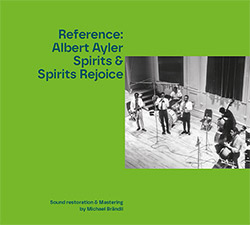 |
| Ayler, Albert Reference: Albert Ayler, Spirits & Spirits Rejoice [CD + POSTCARD] (ALAY) |
| Uniting Albert Ayler's 1964 New York sessions for Spirits (Debut) and Spirits Rejoice (ESP, with Donald Ayler, Charles Tyler, Call Cobbs, Henry Grimes, Gary Peacock, Sunny Murray, Normand Howard and Earle Henderson, this remastered edition captures Ayler's volatile balance of spiritual song, sculptural horn lines, churning bass motion, ecstatic fanfare and free jazz intensity. |
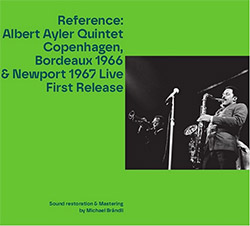 |
| Ayler, Albert Quintet Copenhagen, Bordeaux 1966 & Newport 1967 Live First Release (ALAY) |
| Previously unreleased recordings from the Albert Ayler Quintet — captured in Copenhagen and Bordeaux during the 1966 Newport in Europe tour and at the Newport Jazz Festival in 1967 — present Ayler with Donald Ayler, Michel Samson, Bill Folwell, and Beaver Harris/Milford Graves in fiercely expressive performances, newly restored and mastered from rediscovered tapes. |
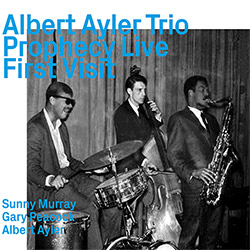 |
| Ayler, Albert Trio Prophecy Live, First Visit (ezz-thetics by Hat Hut Records Ltd) |
| Recorded live at New York City's Cellar Café in June 1964, this essential document captures Albert Ayler, bassist Gary Peacock, and drummer Sunny Murray in a pivotal moment of spiritual free jazz, expressing motifs like 'Ghosts' and 'Spirits' into an ecstatic, ever-evolving language, with this remastered edition offering a refined perspective on a landmark session that shaped Ayler's uncompromising vision. |
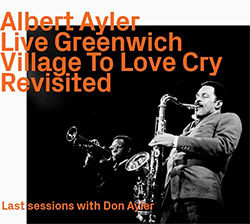 |
| Ayler, Albert Live Greenwich Village To Love Cry, Revisited (ezz-thetics by Hat Hut Records Ltd) |
| Bringing together two contrasting Impulse! albums from Aylers late 60's output: the exemplary free jazz release Live Greenwich Village in two sessions with core Ayler associates, brother Donald, Michael Sampson, Henry Grimes, Beaver Harris, &c.; then Ayler's challenging attempt to reach a more popular following in Love Cry, with Milford Graves taking the drummers chair. |
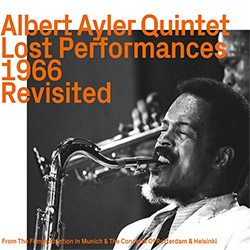 |
| Ayler, Albert Quintet Lost Performances 1966, Revisited (ezz-thetics by Hat Hut Records Ltd) |
| In 1966 tenor saxophonist Albert Ayler toured northern Europe with his ensemble of Donald Ayler on trumpet, Michel Samson on violin, William Folwell on double bass & Beaver Harris on drums, a stellar group performing some of Ayler's most substantial compositions, heard in concerts in Rotterdam and Helsinki, and in the soundtrack to a film recorded in Munich. |
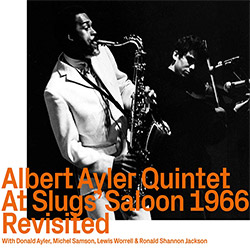 |
| Ayler, Albert Quintet At Slugs' Saloon 1966, Revisited (ezz-thetics by Hat Hut Records Ltd) |
| Combining the two Italian ESP/BASE LPs from 1982 and the 1995 ESP reissues, this spectacular concert with perhaps Ayler's most essential band--Ayler on tenor sax, Donald Ayler on trumpet, Michel Samson on violin, Lewis Worrell on double bass and Ronald Shannon Jackson on drums--is fully remastered to bring out more details from the complete, ecstatic 1966 concert. |
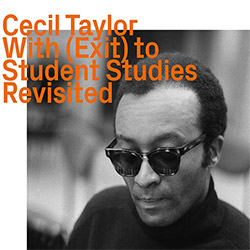 |
| Taylor, Cecil (w/ Lyons / Dixon / Grimes / Silva / Cyrille) With (Exit) To Student Studies, Revisited (ezz-thetics by Hat Hut Records Ltd) |
| Changing approaches to his music with new quartet of Jimmy Lyons on alto sax, Alan Silva on double bass and Andrew Cyrille on drums, pianist Cecil Taylor's incredible 1966 concert in Paris presented four extended compositions, here remastered and reissued with a track from a compilation LP--"With (Exit)"--extending his quartet with Bill Dixon on trumpet and Henry Grimes on double bass. |
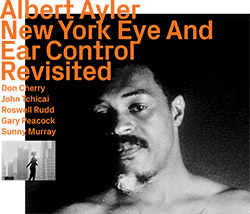 |
| Ayler, Albert Trio New York Eye And Ear Control, Revisited (ezz-thetics by Hat Hut Records Ltd) |
| After moving to NYC in the early 60s, filmmaker Michael Snow was introduced the music of saxophonist Albert Ayler's Trio with bassist Gary Peacock & drummer Sunny Murray, inviting them and trumpeter Don Cherry, trombonist Rudd and altoist John Tchicai to record these three brilliant freely improvised tracks, parts of which would be used in his art film "New York Eye and Ear Control". |
 |
| Taylor, Cecil Mixed To Unit Structures Revisited (ezz-thetics by Hat Hut Records Ltd) |
| Bringing together two essential and impeccably remastered 1960's Cecil Taylor albums — Cecil Taylor Unit Structures and Cecil Taylor Unit Mixed — presenting both traditional influences and Taylor's unique approaches to modern jazz, featuring two septets with musicians including Jimmy Lyons, Henry Grimes, Archies Shepp, Ted Curson, Andrew Cyrille, Roswell Rudd, Sunny Murray, &c. |
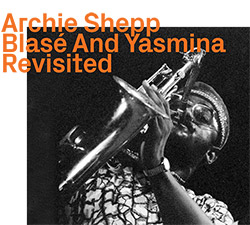 |
| Shepp, Archie Blase And Yasmina, Revisited (ezz-thetics by Hat Hut Records Ltd) |
| Revisiting two of Archie Shepp's 1969 recordings released on the BYG label as Blasé, and title track to Yasmina, three tracks featuring the vocals of Jeanne Lee, with four band configurations including Dave Burrell, Malachi Favors, Lester Bowie, Roscoe Mitchell, Sunny Murray, Philly Joe Jones, &c., beautifully remastered to bring to light Shepp's pan-stylistic impulses. |
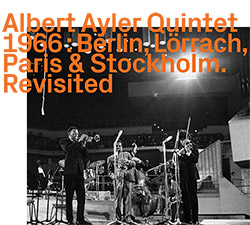 |
| Ayler, Albert Quintet 1966 Berlin, Lorrach, Paris & Stockholm, Revisited [2 CDs] (ezz-thetics by Hat Hut Records Ltd) |
| Tenor saxophonist Albert Ayler's 1966 quintet brought a unique orchestration to his music, heard in these live performances in Berlin, Lörrach, Paris & Stockholm in November of 1966, four concerts presented chronologically as performed with the exemplary playing of brother Donald Ayler on trumpet, Michel Samson on violin, William Folwell on bass, and Beaver Harris on drums. |
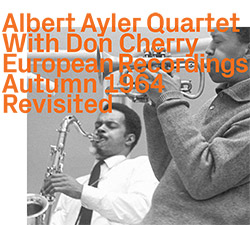 |
| Ayler, Albert Quartet With Don Cherry European Recordings Autumn 1964 (Revisited) [2 CDs] (ezz-thetics by Hat Hut Records Ltd) |
| Essential radio and live recordings from saxophonist Albert Ayler's European tour in 1964 with Don Cherry on cornet, Gary Peacock on double bass and Sunny Murray on drums, a quintessential grouping for Ayler's compositions, here in outstanding renditions of classic works including "Spirits", "Ghosts", "Vibrations", "Mothers", "Childrens", plus Don Cherry's "Infant Happiness". |
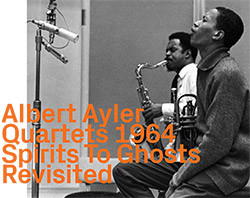 |
| Ayler, Albert Quartets Spirits To Ghosts Revisited (remastered) (ezz-thetics by Hat Hut Records Ltd) |
| Three variations of quartet settings from iconoclastic free jazz saxophonist Albert Ayler, remastering and combining two Debut Records albums, "Spirits" from 1964 with Norman Howard (trumpet), Sunny Murray (drums), and alternating bass between Henry Grimes & Earle Henderson; and 1965's "Ghosts" on Debut Records with Don Cherry (trumpet), Gary Peacock (bass), and Sunny Murray. |
![Rollins, Sonny : The Early Years [4 CDs]](https://www.teuthida.com/productImages/misc4/37711.jpg)
![Orchestre National De Jazz: With Carla [2 CDs]](https://www.teuthida.com/productImages/misc4/37714.jpg)
![Vasseur, Christian / Steve Gibbs / Nicolo Vivi : FWWU+ Duos Trios [2 CDs]](https://www.teuthida.com/productImages/misc4/37891.jpg)
![Ehrlich, Marty: OPEN AIR: The Complete Saxophone Quartet Compositions of Julius Hemphill [2 CDs]](https://www.teuthida.com/productImages/misc4/37922.jpg)
![Frith, Fred / Cornelius Claudio Kreusch / Johannes Tonio Kreusch: Pink / Neon [2 CDs]](https://www.teuthida.com/productImages/misc4/37712.jpg)
![Frith, Fred / Cornelius Claudio Kreusch / Johannes Tonio Kreusch: Pink / Neon [VINYL 2 LPs]](https://www.teuthida.com/productImages/misc4/37713.jpg)
![Miguel, Sei: Viva! O Carro de Fogo de Sei Miguel [2 CDs]](https://www.teuthida.com/productImages/misc4/37739.jpg)
![Money: 5 [2 CDs]](https://www.teuthida.com/productImages/misc4/37890.jpg)
![Drumm, Kevin: The Mild Temper [6 CD BOX SET]](https://www.teuthida.com/productImages/misc4/37651.jpg)
![Trzaska, Mikolaj / John Edwards / Mark Sanders: Because It Happens [VINYL]](https://www.teuthida.com/productImages/misc4/37551.jpg)
![Wassermann, Ute: Chimeric [VINYL]](https://www.teuthida.com/productImages/misc4/37652.jpg)

![Aranda, Irene (Malfon / Aranda / Yamasaki): May [CD + DOWNLOAD]](https://www.teuthida.com/productImages/misc4/37825.jpg)


![Bopp, Christiane: Rever, murmurer, dire [CD + DOWNLOAD]](https://www.teuthida.com/productImages/misc4/37823.jpg)
![Angles 4 (Kuchen / Haker-Flaten / Stahl / Nordeson): Angles 4 [CD + DOWNLOAD]](https://www.teuthida.com/productImages/misc4/37826.jpg)
![Glass Triangle (Parkins / Rasmussen / Sawyer): 3 X 1 [CD + DOWNLOAD]](https://www.teuthida.com/productImages/misc4/37827.jpg)
![Musicworks: #154 Summer 2026 [MAGAZINE + CD]](https://www.teuthida.com/productImages/misc4/37879.jpg)

![TRAC (Teddy Ryles / Alexander Cooper): Heavy Nano Ream Aria [2 CDs]](https://www.teuthida.com/productImages/misc4/37647.jpg)
![Jerman, Jeph: For Alvin Kelly [CASSETTE + DOWNLOAD]](https://www.teuthida.com/productImages/misc4/37521.jpg)
![Mann, Oliver / Stefano Pilia: Precious Moments [CASSETTE + DOWNLOAD]](https://www.teuthida.com/productImages/misc4/37494.jpg)
![Jerman, Jeph / Ted Byrnes: Muir [CASSETTE + DOWNLOAD]](https://www.teuthida.com/productImages/misc4/37520.jpg)
![+DOG+: Angel Wings [VINYL]](https://www.teuthida.com/productImages/misc4/37513.jpg)
![Money: 4 [2 CDs]](https://www.teuthida.com/productImages/misc4/37505.jpg)
![+DOG+: The Garden [VINYL]](https://www.teuthida.com/productImages/misc4/37511.jpg)
![Le UN: 25 Pieces Sans Vide [3 CDs]](https://www.teuthida.com/productImages/misc4/37374.jpg)
![Directives: Reconsolid [CASSETTE]](https://www.teuthida.com/productImages/misc4/37418.jpg)

![Tilbury, John: At Home [4 CDs]](https://www.teuthida.com/productImages/misc4/37729.jpg)
![Scott, Ryan: 21st-Century Canadian Snare Drum [2 CDs]](https://www.teuthida.com/productImages/misc4/37538.jpg)

![Feldman, Morton / GBSR Duo w/ Taylor MacLennan: Trios [6 CD BOX SET]](https://www.teuthida.com/productImages/misc4/37020.jpg)
![Frey, Jurg : Composer, Alone [3 CDs]](https://www.teuthida.com/productImages/misc4/36927.jpg)

![Bruce, Lenny: Comedy & Controversy: The Original Albums 1958-61 [2 CDs]](https://www.teuthida.com/productImages/misc4/37409.jpg)

![Amba, Zoh: Eyes Full [VINYL]](https://www.teuthida.com/productImages/misc4/37491.jpg)

![Henry Cow: The Henry Cow Box Redux: The Complete Henry Cow [18 CDs, DVD & 3 BOOKLETS]](https://www.teuthida.com/productImages/misc4/37272.jpg)
![MacLean, Steve: Box Of Seven [7 CD BOX]](https://www.teuthida.com/productImages/misc4/36467.jpg)
![Mehead: One Good Eye [REISSUE]](https://www.teuthida.com/productImages/misc4/37276.jpg)
![Zorn, John: The Song of Songs [CD + CD BOOK]](https://www.teuthida.com/productImages/misc4/36923.jpg)
![Coultrain: Mundus [COLORED VINYL]](https://www.teuthida.com/productImages/misc4/33056.jpg)
![Hprizm: Signs Remixed [COLORED VINYL]](https://www.teuthida.com/productImages/misc4/30635.jpg)
![Halls Of the Machine: All Tribal Dignitaries [CASSETTE w/ DOWNLOAD]](https://www.teuthida.com/productImages/misc4/36134.jpg)
![Koenjihyakkei: Live at Club Goodman [2 CDs]](https://www.teuthida.com/productImages/misc4/36111.jpg)
![Sorry For Laughing (G. Whitlow / M. Bates / Dave-Id / E. Ka-Spel): Rain Flowers [2 CDS]](https://www.teuthida.com/productImages/misc4/35985.jpg)
![Rolando, Tommaso / Andy Moor : Biscotti [CASSETTE w/ DOWNLOADS]](https://www.teuthida.com/productImages/misc4/36106.jpg)
![Electric Bird Noise / Derek Roddy: 8-10-22 [CD EP]](https://www.teuthida.com/productImages/misc4/35970.jpg)
![Coley, Byron: Dating Tips for Touring Bands [VINYL]](https://www.teuthida.com/productImages/misc4/17906.jpg)

![Lost Kisses: My Life is Sad & Funny [DVD]](https://www.teuthida.com/productImages/misc4/lostKissesDVD.jpg)