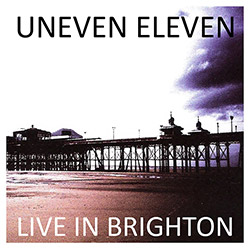
The cover image is of a bridge stretching across the strand. Is this the parapet in Brighton, England, that Uneven Eleven — really a trio — might have passed twelve years ago on their way to Sticky Mike's Frog Bar, where this album was recorded? Does it point to more abstract concepts of connection across spaces and styles? Is it a metaphor for this intercontinental supergroup of Makoto Kawabata (Japan), Guy Segers (Belgium), and Charles Hayward (UK)? Whatever its meaning, it is a simple and colloquial image, and the shading and pixelated quality make something of a memory scrap or ephemera, a hazy snapshot from a prior time, bright sky with an ominously looming swathe of storm clouds, and all.
I focus on the image because Live in Brighton is something of a throwback. It is hard to shake a patchwork of influences decades arear. Almost any rock-infused guitar-bass-drum trio invites comparisons to the Jimi Hendrix Experience. Especially with Segers and Hayward's (relatively) barebones scaffolding and Kawabata's love for multihued and feedback-laden sonic eruption, the Hendrix influence is effusive. However, the parallels that stick out most lie in 1980s postpunk experimentalism. Segers, of Univers Zero and Eclectic Maybe Band fame, leans away from the grander gestures of his proggier projects and, instead, settles into a series of raw and gummy grooves that sometimes pull on earlier traditions (he even quotes "Sunshine of Your Love" for a few measures in the opener, "Knead the Beat") but generally call to mind later, grungier traditions. For his part, he sways between Joe Lally's boxy architectural figures and Mike Watt's nervous itineracy, though I imagine these parallels reside more with me than Segers.
Charles Hayward, of This Heat fame, is a perfect complement and similarly strips down his role to heavy, clunky rhythm. No pretentions. Just driving beats and heavy, miasmic, feedback-draped jams. At times, Hayward barks some lyrics from behind his set, seemingly marking transitions in tempo and trajectory through sloganeering. "In Limpid Intone", the 30-minute second piece, he even seems to channel Ian Curtis, and Kawabata and Segers prove more than content to join the seance.
The final selection, "Mineral Knot", has a halting 5/4 cadence, where the stumbling fourth beat keeps the song from untangling and launching into the stratospheric open jam that always seems just a half-minute away. Instead, the trio captures and controls the energy, juggles it, stretches it over long distances — like the bridge on the cover, framed with neither beginning nor end — examines its congeries of knots and gnarls, but, in the end, allows the energy to die out on its own accord in a psychedelic ambient fog. A fittingly dank and mesmeric ending to a thoroughly rocking outing.
Comments and Feedback:

More Recent Reviews, Articles, and Interviews @ The Squid's Ear...
|





 Masayo Koketsu / Nava Dunkelman:
 Nicolas Gombert / James Weeks:
 Reuben / Hanslip / Lash / Hession:
 Ivo Perelman / Matthew Shipp:
 Ishmael Ali (Ishmael / Wilkerson / Wilkes / Baker / Tong / Harris):
 Marta Warelis (w/ LaMar Gay / Baars / Ng / Haker Flaten / Rosaly):
 Maya Bennardo / Erik Blennow Calalv / Kristofer Svensson:
 Charles K. Noyes:
 Marco Fusi / Pierre Alexandre Tremblay:
 Dominic Lash / Mark Wastell: