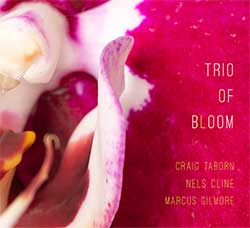
Of the trio recordings in which exploratory guitarist Nels Cline has had a hand of late (and there are several), this one accompanied by keyboardist Craig Taborn and drummer/percussionist Marcus Gilmore seems to me to be the most felicitous for the talents, temperament and style of the guitarist. The reasons for this are several and can be summed up as having to do with the character of the members of this trio who seem more sympathetically aligned with Cline's than in other cases.
This is not to discredit in any way the previous trio recordings featuring Cline; the one that include saxophonist Larry Ochs and drummer Gerald Cleaver and the one with bassist William Parker and Thollem McDonas on piano are marvelous specimens of improvised music as accomplished as the recent release under review. What makes Trio of Bloom stand out is the more subtle interplay and the impressive telepathy that seems to transpire through the 11 cuts, tunes penned, for the most part, by the members of the trio, but also included are a piece by Ronald Shannon Jackson ("Nightwhistlers"), one by Wayne Shorter ("Diana") and one by Terje Rypdal ("Bend It"). But further reflection suggests that the vehicles for improvisation here are quite varied, making for a multi-hued album, which was not notably the case in Cline's other recent trio outings.
Cline, interestingly, also plays 12 string guitar and lap steel, as well as bass on two tracks, all in the service of the trio's aesthetic, which is consistently interesting throughout the 70 minutes of music presented. The sympathetically aligned characteristic of the trio members alluded to above is clear right out of the gate in "Nightwhistlers", with a wonderful full-throttle drum drive by Gilmore over which Taborn weaves an epic left-hand bass line and spellbinding right hand filigree figures, and Cline casts a series of web-like sounds with some fascinating effects.
Many such pulsating moments occur throughout the album, balanced by moments of poetic lyricism of the pleasingly gossamer kind (as in "Unreal Light" or "Breath" or "Eye Shadow Eye"). The many sounds Taborn and Cline get from their instruments are impressive, all while Gilmore keeps a powerfully focused time-sense. A throbbing New-Orleans-like beat sets up "Queen King" for a joyful eight-minute foray into groove. This is followed by a fascinatingly timbral interpretation of Wayne Shorter's "Diana," and right to the end of the album this alternation of high-stepping groove and dreamy beauty coexist, exhibiting along the way, this trio's enviable characteristics of near-telepathic sensitivity and united rhythmic force.





 Amanda Irarrazabal:
 Sylvia Lim:
 Tom Challenger & Evan Parker:
 Louis Armstrong:
![John Tilbury: At Home [4 CD BOX] (Another Timbre)](https://www.teuthida.com/productImages/misc4/37729.jpg "John Tilbury: At Home [4 CD BOX] (Another Timbre)") John Tilbury:
John Tilbury: LDL (Leimgruber/Demierre/Lehn):
 Magda Mayas' Filamental:
 Rodrigues / Rodrigues / Torres / Schlippenbach / Kellers:
 Parkins / Rasmussen / Sawyer:
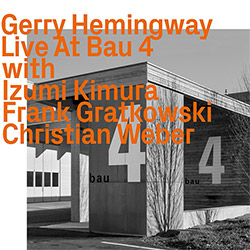 Gerry Hemingway / Izumi Kimura / Frank Gratkowski / Christian Weber: