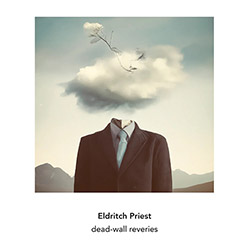
Professor, composer, guitarist, and author Eldritch Priest has a way with unassuming, almost self-deprecating, but contemplative titles. Examples include the two preceding releases include the Omphaloskepsis, essentially navel-gazing, and Dormitive Virtue, a reference to opiate hypnagogia. His most recent, dead-wall reveries references the daydreams provoked by staring at a blank extended canvas and the term itself apparently comes a Herman Melville short story.
What links these works is the focus on dreams, the wanderings of the internal mind, those moments when the most banal objects — an unadorned wall, one’s own belly button — become launching points for introspective exploration. Sure, this theme is self-involved and at times onanistic — as all artistic creations are to a point — but its strength comes from how Priest doubles down on those impulses to produce such varied and engrossing realizations.
Dead-wall reveries is not what one might expect from the man who produced the “glittering and meandering sci-fi soundtrack” that balances “new music suspension and prog rock structures” with “tape collage music and 1980s B-movie distortion” (my words). It is a further departure from what one might expect if they know that Priest literally wrote the book on earworms, none of which are to be found here.
What dead-wall reveries captures sticks abstractly in the mind rather as repeating scraps of melody in the ear. “Dust breeding”, the first composition, features scratchy crystalline structures that slowly agglomerate into a series of striations. Eventually, these fuse further into a melody, but only of sorts. The title is deceptively humble. As much as the piece may have begun as an exercise in watching billows of tiny detritus, what emerges evokes the grandeur of celestial dust coming together and settling over eons into stars and planets. Even these, of course, are imperfect, not spherical but craggy, like the realization here. And they are beautiful in those imperfections and those moments of unity before the underlying law of entropy works its magic. Humble and humbling moments of bliss.
The second piece, “dormitive virtue”, is a softly beautiful counterpart. It is a gradualist solo piano composition on the Feldman side of wandelweiser and showcases Priest’s love for repetition, but of a different sort than a gooey and inescapable pop hook. For those familiar with the electric guitar realization of the composition on Priest’s previous album, this is a very different beast, somewhat more dramatic and discomfiting, as switching from one stage of consciousness to another can be. The third piece, the titular “dead-wall reveries”, returns to the sonic terrain of the first, though the sound is thicker and the strings are less wiry. Sheila Jaffé’s (Arraymusic) violin is the featured instrument, and at first she lays a jaunty monologue, like a happy-go-lucky and mischievous Puck trapsing through the forest. Intermittently, the rest of the quintet break in with a plodding and more darkly hued undercurrent. Around nine-minutes in, the dance calms and that undertow draws the piece into darker but calmer terrain. When the violin returns to the front after a few minutes, it is more tentative and stripped of the initial jouissance. This is a journey, and one well worth taking. And it attests that shadows on a wall or drifting pieces of dust can lead to moments quite profound, if still minute and ephemeral, and situations quite strange.
Comments and Feedback:

More Recent Reviews, Articles, and Interviews @ The Squid's Ear...
|





 Masayo Koketsu / Nava Dunkelman:
 Nicolas Gombert / James Weeks:
 Reuben / Hanslip / Lash / Hession:
 Ivo Perelman / Matthew Shipp:
 Ishmael Ali (Ishmael / Wilkerson / Wilkes / Baker / Tong / Harris):
 Marta Warelis (w/ LaMar Gay / Baars / Ng / Haker Flaten / Rosaly):
 Maya Bennardo / Erik Blennow Calalv / Kristofer Svensson:
 Charles K. Noyes:
 Marco Fusi / Pierre Alexandre Tremblay:
 Dominic Lash / Mark Wastell: