"In this instant-now I'm enveloped by a wandering diffuse desire for marveling and millions of reflections of the sun in the water that runs from the faucet onto the lawn of a garden..." — Clarice Lispector, from Água Viva
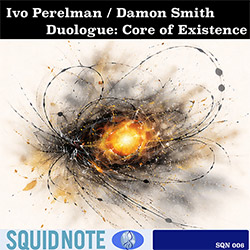
What defines a duologue? What becomes as elements evaporate, what is contained in an instant's inception, and, as if those miracles were insufficient, what infuses the shared connection of a creative act? Just as Lispector expressed the wonder and ineffability of ordinary moments in words, Ivo Perelman and Damon Smith suffuse them with sound, each moment connected to the next, each gesture carrying its own history into a narrative of evolving exchange.
This is the sixth in Perelman's Duologue series, an installment both like and unlike the others. All involve the spontaneous meetings between two musicians and all that those parameters entail. Superficially, each volume combines two languages in counterpoint, but each language is itself an amalgamation, and beyond that, a layered history of influences, techniques, and listening.
The success of this musical meeting, the first for these two improvisers, stems from extraordinary distillation. Apart from further cultivating an already mutual respect, differing approaches to tradition and circumstance elucidate a remarkably similar syntax, but the relationship transcends the purely musical: both musicians demonstrate layered, interconnected philosophies of instrumental and environmental engagement.
Perelman is a proponent of the Alexander method, a series of physical practices meant to decrease tension and promote freedom of movement, but, as several of his album titles indicate, Lispector, among many other artists, has had a profound impact on infusing moments with meaning. Smith is extremely eloquent concerning the radical differences between practice and performance, a subject on which he waxes theoretical. Perelman developed his stunning altissimo register in response to the process of injury and physical healing, at a point when he could not play his instrument. Smith came to his alternately multi-timbral and pure-toned sonic language by consciously building on the trans-genre traditions informing his work over more than three decades. His language is peppered with allusion running the historo-musical gamut but also embracing the work of poets and visual artists.
Both thrive on beauty of expression. Raw power, though present, is sublimated in favor of carefully tuned and timed vibrato, a perfectly placed glissando, the ideal motion from piano to forte or the resonant rustle of bow in strings. They do not sweep the board so much as erect fresh foundations to create miniatures that vary similarly in length and execution. Jim Klaus's superb engineering, another point on which both musicians agree, captures their astonishing range and precision, revealing each player's interwoven microcosm of conjoined pitch and timbre. Historically, metaphorically and philosophically, the tapestries they weave converge even as they subvert.
The first vignette's opening salvo places bass and tenor saxophone well within prescribed pitch limits, but each tone wanders, warps and rattles out of focus, slide, smear and crack akin to the fiery-frigid shock and rebound of sport or debate. Their playing is informed by tradition, deeply manifested in each interaction, like the point and counterpoint projected onto the ninth piece's canvas, the duo nearly in A-Major for one seriocomic second, just as they touch, abandon and re-orbit G-minor in the fourth. They swerve in and out of key, time and timbre, skating around layers of references as they test their boundaries at every turn. 3:30 into the same piece, each reaches the ultimate extreme of register, Smith nearly to the depths of where his strings can take him, Perelman butting against stratosphere, but all recedes, settling down into a glacially murky blues.
Even these boundaries are ultimately proven false. Each player finds space to transform instrument into ensemble, as Smith does in the first 18 seconds of the sixth piece, using great sweeps and speech-like bursts that make the bass feel suddenly communal. Among his many solo flights of fancy, Perelman's atomistic soliloquy opening the eighth duologue distills the care he places on each utterance. The single notes, dyads and truncated arpeggios punctuate the silence even as they float over it in crystalline precision. It would be difficult to imagine a better phrase conclusion than the single one with which Smith enters, a gorgeous study in listening via openness and focus.
A loose palindrome is on display in "Part Six", initially in ecstatic thrust and parry, revealing the essence of the duo's approach. It moves, dispersing and coagulating, from nearly recognizable traditions — "jazz-and-blues" lope, hip-shake, and semi-swing — through the extreme registral and timbral contrasts so integral to the music's multifarious wax and wane. Smith foregrounds as percussionist, Perelman as vocalist, and yet both tropes exist only in the conjoining of imagination and event. Then, anticipating celestial counterpoint and the earthiness of raw exuberance in registral extremis, we enter a drone at 4:23.
A precipitous descent initiates a vibrantly static universe of tone and tide. On the surface, it is a pitched dyad, but rhythmically it undulates, with rhythms nested within rhythms as the deepest bass note pulses. The passage precariously but persistently balances the music's weight, even as it begins to fray and fragment, percussive sinews bolstering ever-increasing glissandi as melody slowly reasserts itself in conventional form. For that moment, before the entire process, register and all, reverses itself at 5:08, becoming molten as before, a fundamental glimpse of an abiding center is offered. Established parameters disappear as pitch and tributaries pervade perception. In that magnetic moment of communication, all other elements can be examined in retrospect: reflections of reflections.
The music's luminous essence emerges undimmed, stars and wind on water, in meditative and exultant ascent.
Comments and Feedback:

More Recent Reviews, Articles, and Interviews @ The Squid's Ear...
|





 Ivo Perelman / Matthew Shipp:
 Ishmael Ali (Ishmael / Wilkerson / Wilkes / Baker / Tong / Harris):
 Marta Warelis (w/ LaMar Gay / Baars / Ng / Haker Flaten / Rosaly):
 Maya Bennardo / Erik Blennow Calalv / Kristofer Svensson:
 Charles K. Noyes:
 Marco Fusi / Pierre Alexandre Tremblay:
 Dominic Lash / Mark Wastell:
 Amanda Irarrazabal:
 Sylvia Lim:
 Tom Challenger & Evan Parker: