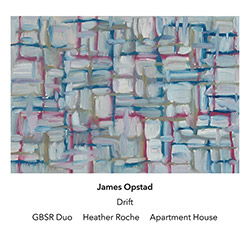
Bassist and composer James Opstad is an active presence in the contemporary music field, predominantly as a performer across a stimulating diversity of genres. Notably, he's a current member of Apartment House, regarded as the primary ensemble for the execution of projects disseminated by Simon Reynell's Another Timbre. Drift signifies Opstad's inaugural recording under his own name, comprising five compositions for a total of approximately 56 minutes. For this occasion, the English artist has enlisted the help of musicians with whom he collaborates closely and regularly. That is to say, GBSR duo (Siwan Rhys, piano; George Barton, vibraphone and temple blocks); Heather Roche (clarinet); the very Apartment House String Quartet (Mira Benjamin & Gordon MacKay, violins; Bridget Carey, viola; Anton Lukoszevieze, cello).
Those familiar with the label's acoustic aesthetic will find no major surprises throughout the program. The essential traits of Opstad's works are rooted in the Feldman-esque precept, marked by the tenets of rarefaction, gestural clarity, and a reflective nature that enables one to collect and rearrange thoughts on existence, potentially discovering interior alignments with particular resonances. A side of Opstad's method reveals an occasional tendency to pursue experimentation purely for its own merit, privileging the practical expression of a specific compositional instinct as opposed to the heartfelt disclosure of (undoubtedly existing) emotional signals indicating the path to follow.
Taking into account the just-mentioned aspect, the lengthy title track, informed by a degree of atonal reiteration with varying tempo implications for each instrument, initially elicited a fairly detached response from this reviewer. As time passed, the viewpoint changed, leading my mental efforts to focus on the potential beneficial elements and possible underlying meanings within the piece. A more immediate engagement was caused by "Nymphaea", thanks to its gently shimmering combination of piano and vibraphone tones, and especially by "Eluvium" for clarinet and resonating tam-tam. In the latter, an evocative contrapuntal environment — somewhat reminiscent of Gavin Bryars, but generated by a live feedback process — ultimately melts into a marvelously reverberating stream that obliterates any definite shape, immersing the audience in a realm of cognitive void. For the technically skilled readers, the score is easily traceable online as a functional complement to the listening act.
For a few days now I've been battling to interpret what my persistent logic still fails to grasp in Drift. However, concurrently, I distinctly perceive a fundamental sincerity behind the composer's intentions. It is a rather uncommon trait nowadays, which needs to be maintained at any expense and suggests that Opstad, when all is said and done, must be doing something right. We should trust him.
Comments and Feedback:

More Recent Reviews, Articles, and Interviews @ The Squid's Ear...
|





 Amanda Irarrazabal:
 Sylvia Lim:
 Tom Challenger & Evan Parker:
 Louis Armstrong:
![John Tilbury: At Home [4 CD BOX] (Another Timbre)](https://www.teuthida.com/productImages/misc4/37729.jpg "John Tilbury: At Home [4 CD BOX] (Another Timbre)") John Tilbury:
John Tilbury: LDL (Leimgruber/Demierre/Lehn):
 Magda Mayas' Filamental:
 Rodrigues / Rodrigues / Torres / Schlippenbach / Kellers:
 Parkins / Rasmussen / Sawyer:
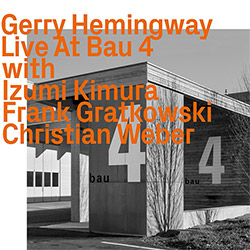 Gerry Hemingway / Izumi Kimura / Frank Gratkowski / Christian Weber: