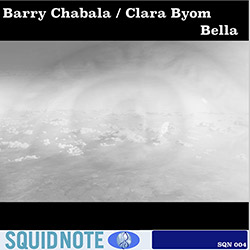
Off the beaten track. Guitarist Barry Chabala has been chiseling out a reputation, though far from the centers of abstract, improvisational, and other progressive music circles of national and international notice. He records, releases, and performs relentlessly and has recently stumbled upon a fitting partner in clarinetist/accordionist Clara Byom, who likewise straddles less trodden convergences: traditional music, contemporary classical, and even harsh noise collages and performative field recordings. Here, Chabala and Byom collaborate on their umpteenth release together, but their first in the studio. In other words, Bella's Ghost is not just another step on their dyadic journey (often with a rotating third) but also a step away from their practice of live performance. In that, it can be considered an attempt to develop and capture different types of instantiations, without the feedback of an audience, or the roasted ambience of a café. For the duo, it is a first, another detour off the beaten track.
Exactly what the studio environment adds is debatable. Both Chabala and Byom dismiss my suggestion that the quiet and calmness of studio sequestration impacted their approach significantly. Rather, their first meeting (luckily captured in 2023's (un)natural) had already been a matter of happenstance rather than intention. They were both called to perform in the same place on the same night and miraculously clicked. Since then, and before Byom's relocation to Texas, they had been performing in the Alburquerque area regularly and Bella's Ghost is a natural product of the symbiosis that developed. Still, there is something more complete in each of these songs — and I do mean songs in the sense of melody and progression — than in their numerous live recordings. It is challenging not to attribute some of that to the different space and the presumed intention to play to record rather than record a performance.
Byom attributes the success of their collaboration to the afterlife of the feelings and sounds of that unintended meeting in October 2023. "We capture a bit of that first gig energy every time we get together and if we can continue to do that, I think our ears and intuition will continue to guide us. Maybe the best way to say it is that we trust rather than try... we trust each other, the sounds, the silence, the starts, the ends, the process, the time, the space, the gathering." Chabala agrees but also emphasizes the importance of their divergent backgrounds: Byom's in folk dance and classical and himself especially in 70s prog. Somehow, through those roots, the two found common rhizomic ground in graphic scores, lowercase aesthetics, free improvisation, and the like.
Bella's Ghost is also a beautiful expression of a unique, and I would argue locally rooted, style of experimental music. Fittingly recorded in the Southwest, where Chabala and Byom have been playing extensively over the last few years, it leans into partial folk melodies and gusty tonal accretions. It sounds very much both in the moment and in situ. It is not as if this music could not have been realized elsewhere, but it was not, and for that one must give some credit to its removal from the beaten tracks of the urban hotbeds of the avant-garde.
Chabala and Byom are doing their own thing. Often that thing is disjointed. Chabala notes the benefits of recording in studio, of taking recorded moments and manipulating, fracturing, and overdubbing them, in essence taking them out of one moment and placing them into multiple others. Often, that thing also glistens with a haunting beauty, like a Sandia Mountain sunset, whose vibrancy is only accentuated by the anthropogenic particulate pollution that serves as both amplifier and poison. The endless mysterious and foreboding passageways of "Corridor", a deceptively soft-hum of a track, is a case in point. Two cuts, "Visitor" and "64 46th Street" are realizations of graphic scores by the late Ann Coman (also a Chabala collaborator), and the latter breaks any idyllic spell cast before in its rawness and Byom's choir of sirenic spirals and sparse but impeccably placed quavers and growls. 64 46th Street also captures the titular "ghost" most directly, though through an homage to Coman rather than the unidentified Bella. These two pieces also sound the most additively progressive and, in that, composed, though the line between graphic score realization and instantaneous composition can be thin. Maybe it suffices to say that the whole lot of Bella's Ghost is a melding of two musical minds that have been revolving around and shifting ever more closely to each other for some time, now. It makes sense that the studio convergence would result in their strongest combined statement, yet, and something wholly their own. And, well, what can beat that?
Comments and Feedback:

More Recent Reviews, Articles, and Interviews @ The Squid's Ear...
|




 Masayo Koketsu / Nava Dunkelman:
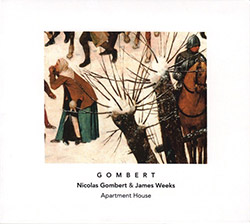 Nicolas Gombert / James Weeks:
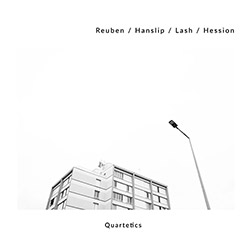 Reuben / Hanslip / Lash / Hession:
 Ivo Perelman / Matthew Shipp:
 Ishmael Ali (Ishmael / Wilkerson / Wilkes / Baker / Tong / Harris):
 Marta Warelis (w/ LaMar Gay / Baars / Ng / Haker Flaten / Rosaly):
 Maya Bennardo / Erik Blennow Calalv / Kristofer Svensson:
 Charles K. Noyes:
 Marco Fusi / Pierre Alexandre Tremblay:
 Dominic Lash / Mark Wastell: