Solo performances are the ultimate test for any musician, let alone for the listener. While keyboards have traditionally been best suited for this context, given their polyphonic/orchestral capabilities, which the guitar and even percussion kits can also achieve, wind instruments do not have the same means in that regard. Of course, many brass and reed players play multiphonics nowadays, but such pitches are more restricted in terms of note combinations, and quite unstable at that (especially for the reeds). That said, a solo outing entails a very different mindset on the player�s behalf. Playing a capella demands both artistic savvy and physical stamina. Any wind player can certainly vouch for the physical demands, but the other issue here entails a number of very different considerations, namely one�s musical imagination and instrumental proficiency and technique. Solo playing is always a technical display of some sort, and can be very telling of a musician�s abilities (or limitations, as the case may be). A performer with great technique has a better chance of keeping his listeners interested, although virtuosity runs the risk of becoming like a hollow shell and, in the end, self-defeating. Both of those factors (imagination and technique) have to be balanced out in order to be artistically convincing.
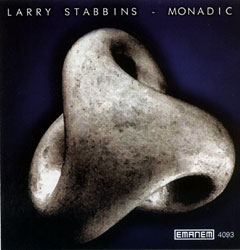
Seen that way, this solo recording by the veteran British tenor and soprano saxophonist Larry Stabbins is a challenge generally well met. At 75 minutes, and 13 cuts, this is a considerable test for the listener as well, but on his first solo album he has precisely built a program on precisely built playing techniques, which he manipulates with a fair deal of imagination.
In this medium, he may well be dwarfed by his comrade Evan Parker, or John Butcher for that matter, but Stabbins should not be measured against either of them. His style has none of the breathtaking virtuosity of the former, nor the abstractness of the latter; instead, he remains at heart a melodist with a playing concept that is clearly anchored in the saxophone tradition and vocabulary. In his pieces, he makes regularly use of low register subtoning effects, where pitches slowly emerge from pure breathing; in many other instances, he creates melodies out of natural overtones from the lower end of the horn, with climaxing forays into the altissimo range of this tenor that match those of the soprano. In fact, his tenor playing is more archetypical than his smaller horn. The titles reveal something of the intentions behind the cuts ("Breathing," "Singing," "Buzzing," "Chirruping," etc.) and the musical actions in themselves. Also of note here is the sequencing of the cuts, in which the soprano is heard from track 4 to 9, framed by three opening tenor pieces and another four closing out the side. As a recommendation, try listening to all cuts on one horn, and then all of the other, one will get a better sense of Stabbins' way of using each of his saxophones. In all art forms, there are innovators known for their bold concepts, those with an almost unfathomable wellspring of ideas and surefire technique, and then there are those credible journeyman who can hold their own with a narrower, but no less interesting, range of playing assets, a niche into which this saxophonist fits very well.
Comments and Feedback:

More Recent Reviews, Articles, and Interviews @ The Squid's Ear...
|





 Julia Eckhardt:
 Lori Goldston:
 Arkady Gotesman:
 Nicolas Collins / Birgit Ulher:
 Albert Ayler Quintet:
 Merzbow / Mats Gustafsson / Balasz Pandi:
 Ivo Perelman / Damon Smith:
 Paul Rogers:
 Camila Nebbia (feat. Marilyn Crispell & Lesley Mok):
 Eric La Casa / Francisco Lopez: