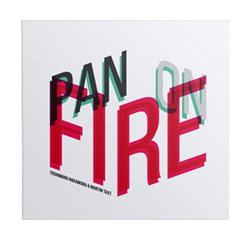
Picture the juxtaposition of an instrument whose input is basically nonexistent (unless you want to include its handler�s creative spirit in there) and a fat member of the brass family typically connected to everything but noisy improvisation. Then add the �guerrilla factor�: namely, Martin Taxt feeding his tuba�s signal to Toshi Nakamura�s mixer, thus disrupting any �nice� intention the Japanese might have had of filling the air with subtle shifts in the color of the frequencies as he often does. Pan On Fire � you guessed it � does not feature sensual sonorities; but, for some strange reason, it allures and ultimately convinces the wary listener.
We could compare our initial response to that of children running on the site of a car crash as soon as it happens; wide-eyed, ears perked up. Ever since the first of ten tracks one�s attacked by fusillades of intrinsically violent discharges. The overall tension is only rarely broken by segments where the couple vary their schismatic methods through sounds characterized by a lesser tendency to disintegration in favor of (still unstable) huge vibrational elongations and about-to-collapse reiterations. However, all we hear contains the seeds of a harmonic development of sorts. At times we identified micro-chords inside a ferocious drone; in other sections, the massive rumbling links the mind skull with the extraordinary acoustic content of an earthquake (if you want to learn more on this subject pick up a copy of Douglas Kahn�s Earth Sound Earth Signal, a book that clarifies numerous aspects of man�s relation with the planet�s subterranean orchestrations). There are even attempts of rudimentary melody in there; Taxt does play �regular� notes every once in a while, as distorted and deformed as they appear.
Whatever angle we look from, this is a solid punch thrown by two improvisers who have no fear of giving something up in terms of aesthetic pleasure, an uncompassionate collection of not-exactly-cordial sonic eruptions. Find a remote corner for your most tolerant being, and observe with detachment: there�s much to build upon to move beyond the needs of the �snug and warm�. Nakamura and Taxt didn�t come here to accept settlements, nor to show easy ways out.
Comments and Feedback:
More Recent Reviews, Articles, and Interviews @ The Squid's Ear...
The Squid's Ear presents reviews about releases sold at Squidco.com written by independent writers.





 Julia Eckhardt:
 Lori Goldston:
 Arkady Gotesman:
 Nicolas Collins / Birgit Ulher:
 Albert Ayler Quintet:
 Merzbow / Mats Gustafsson / Balasz Pandi:
 Ivo Perelman / Damon Smith:
 Paul Rogers:
 Camila Nebbia (feat. Marilyn Crispell & Lesley Mok):
 Eric La Casa / Francisco Lopez: