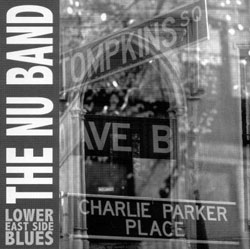
This is one of trumpeter Roy Campbell's best recordings in recent memory, a reminder of the prolific trumpeter's recent session as part of Steve Swell's Rivers Of Sound Ensemble. The musicians have a fine time here playing through some crafty tableaus of short compositional ideas, structured in, at times, ambitiously architectural edifices, with panels of improvisation and motivic pre-conceptions juxtaposed.
The blues play a prominent role, not as a form, per se, but as an aesthetic governing the feel and idiomatic inflections, right from the opening title track, on which Campbell, who composed the piece, takes the first solo, with a ragged edge to his tone, as he eschews facile "pure tone" clich�s of trumpet sound and presents, rather, lines that reinvent the equivalent of the growls and smears of past masters. The effect is of a careening soulfulness, where high register squeals and fat buttery mid-range lines co-exist, as he moves from one to the other with ease and conviction.
Campbell's other composition, "Heavenly Ascending", is less swagger and hip riffing, and more meditative music. From a bowed bass intro, the composition slowly evolves with harmonious sax, trumpet, and bass chords into a heartfelt expression in melismatic wonder, with Lou Grassi's drum colorings buoying the proceedings.
Mark Whitecage's alto sax and clarinet playing are one of many strong features of this session. He seems to be totally centered in all the pieces and provides two interesting compositions. The moving, Afro-esque "Connecticut Solution", which has a very engaging reiterated melody that gets under your skin with each statement, brings out some poignant muted-trumpet soloing from Campbell and a full expressive range from Whitecage's alto. It also features one of Joe Fonda's most interesting bass solos on the session. Whitecage's other piece, "Like Sonny", which, like drummer and percussionist Lou Grassi's piece "The Last of the Beboppers," alludes to some of the influences of the aesthetics of this disc, is a tribute to some past masters, but also gives a nod to what really made them great: i.e. their fresh and original ideas, which served to extend, rather than restate, the tradition.
Bassist Fonda also contributes one composition, the impressionistic, variegated "In a Whitecage/The Path", while drummer and percussionist Lou Grassi turns in the aforementioned "The Last of the Beboppers", and the sauntering "Avanti Galoppi", with its unison line that floats over a cheerful galloping of drums and bass.
The group playing is idiosyncratic and fresh, while acknowledging ties to the past, without the rote restatements that so many jazz players fall into the trap of performing, either for commercial or other practical reasons. These musicians push the envelope, while still delivering the goods.
Comments and Feedback:

More Recent Reviews, Articles, and Interviews @ The Squid's Ear...
|





 Julia Eckhardt:
 Lori Goldston:
 Arkady Gotesman:
 Nicolas Collins / Birgit Ulher:
 Albert Ayler Quintet:
 Merzbow / Mats Gustafsson / Balasz Pandi:
 Ivo Perelman / Damon Smith:
 Paul Rogers:
 Camila Nebbia (feat. Marilyn Crispell & Lesley Mok):
 Eric La Casa / Francisco Lopez: