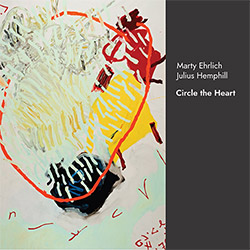
A newly discovered live recording from 1982, Circle the Heart finds multi-reedists Marty Ehrlich and the late Julius Hemphill in top form performing five Ehrlich compositions and as an encore, Hemphill's groove ballad "Border Town".
Hemphill (1938-1995) who plays soprano and alto saxophones and flute here, was one of the avatars of 1970s creative music starting with the BAG association, helped found the World Saxophone Quartet and later played in multiple groups while composing notated and jazz-based music. Ehrlich, born in 1955, and who plays soprano and alto saxophones, flute and bass clarinet on this disc, was a long time participant in Hemphill projects, music director of the Julius Hemphill Saxophone Sextet and led that band after Hemphill's death. Not limited to being a Hemphill helper he records on his own and is associated with sound explorers like John Zorn and Mark Dresser.
Except for the title track where Hemphill sticks to flute and Ehrlich bass clarinet, it's impossible to tell who plays which horn. But that's secondary since both perform with the same mixture of freedom, finesse and friction. The give-away entitled "The All Told Alto Blues" for instance is a realized essay in individual or intertwined invention. The two explore every type of blues from swing affiliated stomps with roadhouse echoes to aggressive blitzkriegs where tones are bent into irregular yelps, vibrated screams and scooping squalls as notes are piled onto notes to create protracted animation. Harmonies evolve alongside harshness though, as during those sequences where horn lines are intertwined, a sheen of cooperative lyricism is heard.
The partnership works as well for the other selections. Similar cries and whistles define each theme so that a distinctive evolution exists, yet as that happens responses from the other player — marginally higher or lower pitched — add distinctive decorations, encompassing reed bites, speedy squeaks and a modulated ostinato which preserves the connective undercurrent. This is particularly obvious on "Pliant Plaint", where a polyphonic cornucopia of sudden slurs and stops almost capsizes the exposition until a throbbing rhythmic figure layers the shards into a confirmed cadenced narrative.
Sadly Hemphill isn't around to create more distinctive music. However this disc not only provides instances of his compositional and improvisational skills, but also confirms how Ehrlich builds on this base to extend the older man's work and meld it with other aspects to project individual statements.





 Masayo Koketsu / Nava Dunkelman:
 Nicolas Gombert / James Weeks:
 Reuben / Hanslip / Lash / Hession:
 Ivo Perelman / Matthew Shipp:
 Ishmael Ali (Ishmael / Wilkerson / Wilkes / Baker / Tong / Harris):
 Marta Warelis (w/ LaMar Gay / Baars / Ng / Haker Flaten / Rosaly):
 Maya Bennardo / Erik Blennow Calalv / Kristofer Svensson:
 Charles K. Noyes:
 Marco Fusi / Pierre Alexandre Tremblay:
 Dominic Lash / Mark Wastell: