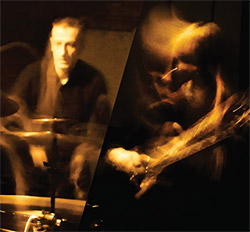
Pierre Favre is a Swiss jazz drummer and percussionist, born 2 June 1937 in Le Locle, Switzerland.
"When Pierre Favre began to explore new worlds of sound in drumming in the 1960s, he had already played with many internationally renowned Europeans and Americans as well as with prominent big bands. But it pushed him to an independent music. It all started in a trio with bassist George Mraz, then with Peter Kowald on double bass and from the start with Irene Schweizer on piano. "It is," says Pierre Favre, "a stroke of luck in a long, independent and yet joint development.
Searching for the melodic aspects of drums and percussion, Pierre Favre found his way to the solo. Together with Paul Motian, Fredy Studer and Nana Vasconcelos, he formed a percussion ensemble that increased the orchestral possibilities of percussive solo playing. "Singing Drums", a quartet with four percussionists, underwent a further transformation in the form of The "European Chamber Ensemble", a line-up with two percussionists, horns and strings.
In 2004, the city of Zurich honored Pierre Favre with the city's art prize."-Bert Noglik, Pierre Favre website
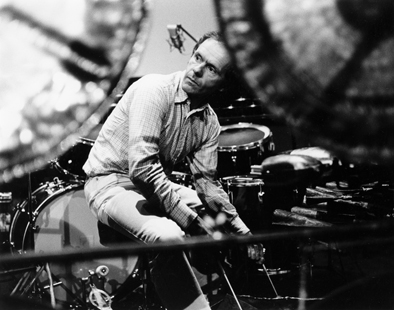
Photo of Pierre Favre
How do you describe music?
First of all, music as I see it is about following the path where it leads, not to become the best, but to become the best of oneself!
Music has everything to sustain one on their life's journey, and it is a continual psychoanalysis. Through music I am constantly reflecting on myself, what I am doing, and in this process, sometimes the music indicates "NO," and this I find important and noble.
What is your relationship to music?
In my relationship to music, it is the joy and the power of life.
I hit a cymbal and I see a star!
What drove you to play the drums?
That was my older brother's design.
My first love was a horse; I would have loved to become a farmer. But one day my brother showed up and said to me, "My drummer is getting married and will not be playing with me anymore, so you are going to play with me."
That is when I said, "NEVER."
So he played me a cha-cha-cha, a Viennese waltz, a French and an English waltz, and then he said, "In ten days we will play at a ball and you will play, so just figure it out yourself."
Today I thank my brother for that. I am happy to be a musician. It has been a wonderful life, full of gifts and surprises. Like Zen says, I like who I am and what I am doing. The key in life is to like and accept who you are, in order to go on.
Which musician or person has influenced your approach to music the most?
There is a huge list, but when I was 14 years old, I used to listen to Louis Armstrong all the time, particularly his 1947 concerts in Boston. His drummer at the time was Sidney Catlett, and without realizing it, I was deeply influenced by Catlett's style of playing the accents, allowing the track to breathe with immense space, which proved to be instrumental in my future development.
The realization of this happened two years ago, when by chance I stumbled across these recordings, and while listening, I started to cry. Suddenly I realized that Sid Catlett had been my grand master without knowing.
Over the years, while playing in the United States, several musicians asked me how come I had so much space in my music. I quickly realized that came from Catlett.
And of course I was very much influenced by the great Black drummers like Max Roach, Philly Joe Jones, Roy Haynes, and Elvin Jones.
And I was also influenced by my father, who was a master of rhythm, a simple worker, but Zen, without noticing it himself.
Who or what influences you most outside of music, and why?
The love I have for my children has made me a more generous person.
At the age of 31, I had a chance meeting with the renowned pianist and composer Siegfried Oelgiesser, who had been a pupil of Anton von Webern. This meeting was to be my introduction to musical composition, and I became a student of his for eight years.
These were my strongest influences.
What deceased performer, improviser, or composer would you most like to have a conversation with, and why?
With Louis Armstrong!
I had the privilege of playing with him, and during that particular session, at one point he turned to look at me twice for a long time. And at the end of the session, his orchestra invited me to have dinner with them, and I never understood why.
Today I would like to ask him why he looked at me so long, and if he had told them to invite me.
Where do you see the music you are involved in heading in the coming years?
Improvised composition
and
composed improvisation.
If you could shape the future of this music, what would it look like?
To itself.
Is there a question they rarely ask you in interviews which you would like to be asked?
They once asked me, "If you die and are reborn, what would you like to do?"
I replied, "The same thing!"
And if I were reborn, I would love to meet my parents again. I do honor my parents. I am speaking to them and thanking them almost every day.
By submitting your responses, you grant The Squid's Ear (operated by Squidco) the non-exclusive right to publish, edit for clarity, and distribute your answers in print and online formats. You retain all rights to your own words beyond this publication.
Comments and Feedback:
More Recent Reviews, Articles, and Interviews @ The Squid's Ear...
The Squid's Ear presents reviews about releases sold at Squidco.com written by independent writers.





 Nicolas Gombert / James Weeks:
 Reuben / Hanslip / Lash / Hession:
 Ivo Perelman / Matthew Shipp:
 Ishmael Ali (Ishmael / Wilkerson / Wilkes / Baker / Tong / Harris):
 Marta Warelis (w/ LaMar Gay / Baars / Ng / Haker Flaten / Rosaly):
 Maya Bennardo / Erik Blennow Calalv / Kristofer Svensson:
 Charles K. Noyes:
 Marco Fusi / Pierre Alexandre Tremblay:
 Dominic Lash / Mark Wastell:
 Amanda Irarrazabal: