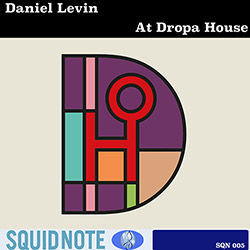
At once one of the premier cellists in free jazz circles and a devotee of everything from scratchy minimalist improv to contemporary, Baroque-inflected classical, Daniel Levin has carved out a unique space for himself. What is remarkable is the acuity with which he performs in any number of these stylistic settings. It can throw the listener off. Is this Daniel Levin teasing out this lush chamber motif the same Daniel Levin who restrained himself to clicks, scrapes, and torques on the last recording, or even just two minutes ago?
Solo cello recordings have been gaining popularity as of late. Once a rarity, they are now a kind of rite of passage in the way that solo saxophone, drum, and bass recordings had already become. At Dropa House, which captures the cellist live in Antwerp, is Levin's fourth solo release and, as far as I can tell, his first formally released live one. On it, he is credited not only with cello, but also paper, chair, and stage. This might seem haughtily postmodern, or a nod to some pseudo-Cageanism, but it is not. If you have ever had the opportunity to see someone actually playing these types of quotidian items and the mise-en-scène around them with real intention, as Levin does here, you will know just how instrumental these other elements can be. These oft-dismissed "incidentals" work especially well with the cello, which can also sound like paper crumbling, or a high-pitched squeal of pinched metal, or the graphitic rasp of rubbed surfaces, in addition to the elevating romantic updrafts or stormy improvisational jaunts one may more frequently associate with the instrument.
On At Dropa House, Levin does play his surroundings, and the paper. However, he does so intermittently and strategically. At its core, this album captures an especially practiced and visionary man on his cello. And, damn, does his cello hum, and click and shutter, and dance. Koen Vandenhoudt and Christel Kumpen's accompanying notes cite Levin's own explanation that classical music and modern improvisation are fused into a unified whole for him. Rather than as discrete but juxtaposed elements — this piece will sound late romantic, that one will be improvised — he integrates the styles into a seamless continuum with rare ease and conviction. One hears this union in the organic transitions between techniques and sounds. Levin embraces melody in some parts and abandons traditional musicality in others. The switch from one to another happens seamlessly, but abruptly. Just listen to the jump from frenetic paroxysms to a chamber run just under five minutes into "Two", then the doleful rumination a half-minute later. Then, hear how, after a few moments of silence, this sentiment glides into the sweet, multiphonic sway of "Three". In this stylistic blurring, Levin resembles the bassist Joëlle Léandre. He shows both a studied comprehension of various techniques and harmonic strategies, but also a concerted joy the act of performance and discovery.
The first four tracks are titled "One" through "Four", as in improvisation one through four. The fifth piece is titled "Underground", potentially indicating more predetermination. It sounds more whole, if not fuller, than the rest and runs the gamut of techniques deployed earlier. Yet, it is one of the most melodic and melancholic and in that is a consummate send-off, paper, chair, stage, strings, and all.
Comments and Feedback:

More Recent Reviews, Articles, and Interviews @ The Squid's Ear...
|





 Ivo Perelman / Matthew Shipp:
 Ishmael Ali (Ishmael / Wilkerson / Wilkes / Baker / Tong / Harris):
 Marta Warelis (w/ LaMar Gay / Baars / Ng / Haker Flaten / Rosaly):
 Maya Bennardo / Erik Blennow Calalv / Kristofer Svensson:
 Charles K. Noyes:
 Marco Fusi / Pierre Alexandre Tremblay:
 Dominic Lash / Mark Wastell:
 Amanda Irarrazabal:
 Sylvia Lim:
 Tom Challenger & Evan Parker: