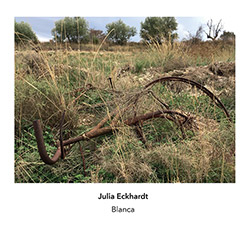
Julia Eckhardt's skills first came to this writer's consciousness around 2008 or shortly thereafter, courtesy of an absorbing record she made with Manu Holterbach, Do-Undo (In G Maze) on Jim Haynes' Helen Scarsdale Agency. Today she is especially remembered as one of the foremost interpreters of Éliane Radigue's more recent scores, and as the editor of a remarkable book on Radigue's opus, Intermediary Spaces (I must confess, with a degree of embarrassment, that I have not begun to read it yet). In this case, however, attention centers on Eckhardt's position both as a performer and composer. Let's put this straight from the beginning: comparing Blanca's music to that of the engineer of Trilogie De La Mort and Occam Ocean would be an error, despite detectable influences. These ears caught instead a few associations remotely reminiscent of Tony Conrad and John Cale's sonorities rather than Radigue's. Nonetheless, there are still major distinctions regarding the work's origin and the diversity of the auditory outcome.
In 2022, during an artistic residency in the Spanish town that lends its name to the album, Eckhardt committed to taking a lengthy walk daily across the nearby hills, encapsulating the spirit of the locations she happened upon in photographs and audio mementos. Following this, the violist took on the responsibility of recording an improvisation for every episode, the substance of which was somewhat related to the experience gained in each exploration. Later on, Eckhardt transcribed the improvisations into notation, aiming to evoke memories linked to those sounds and places, acoustically reviving their essence while simultaneously generating useful material for potential reinterpretations.
Fleeting instants aside, there is no evidence in Blanca of the environmental recordings, which nevertheless did influence the work. Its primary attribute is the voice of the viola, explored and dissected via unpolluted minimalist cycles. The latter serve to magnify the molecular movement inside the vibration of the strings or enhance — with striking gestures — the resonance of the instrument's wood. The dynamics range from a whisper that emulates the sound of the wind to the fortissimo of obstinate repetitions, sporadically stinging the auricular membranes through acute upper partials.
Throughout 40 minutes or so, listeners are encouraged to focus on the core of pitch and noise, not on superfluous aesthetic analysis. It is fair to say that Eckhardt has succeeded in producing substantial music from a limited number of components, also thanks to the determination that allowed her to complete the pre-planned tasks even when the mood was not right. A basic principle in the Berliner's modus operandi, and a valuable lesson for the easily disheartened.





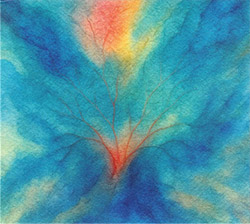 Masayo Koketsu / Nava Dunkelman:
 Nicolas Gombert / James Weeks:
 Reuben / Hanslip / Lash / Hession:
 Ivo Perelman / Matthew Shipp:
 Ishmael Ali (Ishmael / Wilkerson / Wilkes / Baker / Tong / Harris):
 Marta Warelis (w/ LaMar Gay / Baars / Ng / Haker Flaten / Rosaly):
 Maya Bennardo / Erik Blennow Calalv / Kristofer Svensson:
 Charles K. Noyes:
 Marco Fusi / Pierre Alexandre Tremblay:
 Dominic Lash / Mark Wastell: