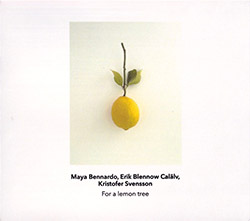
The cover portrays a deceptively simple enigma. It is not colorful, but it is not bland either. A lone ripe lemon, a few inches of pedicel, and three chartreuse leaves set against a white backdrop. I want to say I see hints of a shadow between the object and the background, but every time my eye focuses, those shadows disappear, even as the lemon seems to hover. Then, I notice what is missing. The tree.
I am not sure what to make of that, but, on some level, it synchronizes with the music. For a Lemon Tree consists of two tracks, the first of which, which shares a name with the album title, is the pruned version. It comes across as a tighter and more affective articulation of "Improvisation on Prakāśa", the second selection. Overall, the song "For a Lemon Tree" is slow and drafty. It builds from the sparse early tones into layers, with three instrumental lines — lain by Maya Bennardo on violin, Erik Blennow Calälv on bass clarinet and Kristofer Svensson himself on kacapi (an Indonesian zither) — but also semi-chords and resonances that, over time, well into an updraft. It lifts the listener. The piano slowly meanders a hint of melody before it all resides. I would venture to call this an ode to the title's solitary and curious citrus, whether alive or a distant memory, now properly memorialized with a wistful sincerity. I should also add that such a commemorative reading requires the tree itself to be absent.
The second piece is the 44-minute "Improvisation on Prakāśa", which served as the rough marble block from which the composition underlaying the first piece was chiseled. Though less thoroughly scripted, "Improvision" is no less methodical. It starts as a real time-study of flexible and responsive long tones — pitch ranges are "suggested" in the score — that veer toward a heart-wrenching dialog of moans among the three instruments. One gets the sense a tragedy has befallen each participant. Each calmly and smoothly interrupts the others, as if lost in their own bitter recounting. The resulting harmonies are dissonant and mildly unsettling. I will spare the arboreal hauntology imagery here, but I will say that "Improvisation on Prakāśa" captures a strong sense of longing isolation, which is somewhat odd for a title that evokes light. Then again, maybe one can read a similar brightness into the yellow of the lemon posed over negative space and, through that, the first piece, as well. The congruency is not perfect, and fittingly so. I have been listening to this one for weeks, now, and still find myself lost in its strange and suggestive mystery.
Comments and Feedback:

More Recent Reviews, Articles, and Interviews @ The Squid's Ear...
|





 Charles K. Noyes:
 Marco Fusi / Pierre Alexandre Tremblay:
 Dominic Lash / Mark Wastell:
 Amanda Irarrazabal:
 Sylvia Lim:
 Tom Challenger & Evan Parker:
 Louis Armstrong:
![John Tilbury: At Home [4 CD BOX] (Another Timbre)](https://www.teuthida.com/productImages/misc4/37729.jpg "John Tilbury: At Home [4 CD BOX] (Another Timbre)") John Tilbury:
John Tilbury: LDL (Leimgruber/Demierre/Lehn):