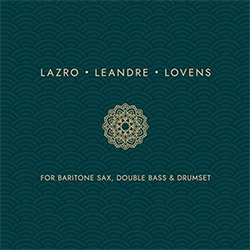
For Baritone Sax, Double Bass and Drumset captures three doyens of the first-wave of European free improv at a meeting at Paris's Les temps du corps club in 2013. The set-up is fittingly spare, as the title describes: a baritone sax, a bass, and a drum kit. No additional frills, no extra horns to explore different timbres, no elaborate toolbox of extra percussion trinkets, at least as far as I can tell.
But a simple set-up does not imply simple music. Rather, these three musicians have proven themselves over the last half-century as masters of improvisation, and they lean into that mastery. The focus is density, mood, and torsion, rather than melody and harmony and the music smolders rather than conflagrates. The screaming sections are well-placed and brief. There is tension and open possibility in every moment, leading to a true unpredictability from passage to passage that only the best of improvisors know how to properly harness and exploit.
I am not sure who first called Lazro, Léandre, and Lovens together. Maybe it was a concert organizer, who chose three sequential names in the L section of the European free jazz legends phonebook. (That would be too perfect, no?) Maybe it was one of the members of the trio. From the first notes of the album, however, it becomes clear that regardless of who convoked this meeting, there is no leader within the group. There is, in the idealistic sense of free improv, no predetermination or hierarchy. All three members throw directives at various points. These create moments of drama, as when Léandre carves out some space about six minutes into the third track, Temps du Corps 3. These also engender moments of anguish, in Lazro's strained but controlled torsion of his baritone, and nervous energy, especially in Lovens's itinerant pattering. They also reveal a deep telekinetic interplay within the trio, wherein the aesthetic emulsions speak to a singular purpose, even if from multiple directions. For Baritone Sax, Double Bass and Drumset is indeed many-sided and multi-angled. Its four tracks, "Temps du Corps 1-4", taken together shape an irregularly angled prism of reflections, deflections, dispersions, and, above all, latticing. The gem that emerges is imperfect. It is scarred and blemished from the process of its materialization, but it is all the more precious as a result.




 Lazro / Leandre / Lovens:
 Sandy Ewen / Damon Smith / Weasel Walter:
 Jason Kahn / Phil Durrant / Mark Wastell / Caius Williams:
 Paul Lytton / Eddie Prevost / Nate Wooley / Seymour Wright:
 Sunny Murray and Sabu Toyozumi:
 Eva-Maria Houben (Nate Wooley):
 Masayo Koketsu / Nava Dunkelman:
 Nicolas Gombert / James Weeks:
 Reuben / Hanslip / Lash / Hession:
 Ivo Perelman / Matthew Shipp: