![John Tilbury: At Home [4 CD BOX] (Another Timbre)](https://www.teuthida.com/productImages/misc4/37729.jpg "John Tilbury: At Home [4 CD BOX] (Another Timbre)")
Nearing the end of his career, pianist John Tilbury agreed to have Another Timbre's Simon Reynell visit on a relaxed time frame to record his solo playing. Tilbury was free to choose what he wanted to play, including new works from friends going back to his Scratch Orchestra days, or favorite compositions ranging across the chronological spectrum. Recorded as Tilbury performed on piano and clavichord in his own home, the resulting set has a personal and intimate feeling unlike conventional studio recordings. When Tilbury reached 90 years of age he felt he could no longer do justice to the music they were recording, so he and Reynell went into Tilbury's archives to select representative and important archival recordings to include in the box, a fascinating complement to his final recordings.
Born in London in 1936, Tilbury began with fairly conventional training at the Royal College of Music while exploring modern approaches, which included founding the Warsaw Music Workshop with Zygmunt Krauze. In 1968 he won the prize in the Gaudeamus International Competition for contemporary music, a forward-thinking Dutch competition created specifically for young performers specializing in new music. Tilbury's career diversified after that event, and he became associated with composer Cornelius Cardew for his interpretations of his work, illustrated in this box through a new recording of "Three Short Piano Pieces", an archival recording of Cardew's "Volo Solo" from 1970, and a 2002 recording of "Bun No. 2 for Orchestra".
In time Tilbury became known for his interpretations of works by distinctive contemporary composers, particularly Morton Feldman, as well as for his engagement with the work of writer Samuel Beckett. The Feldman selections include an unused recording from the 2016 double CD Two Pianos, along with a solo performance from 1971, Madame Press Died Last Week at Ninety. Beckett's texts are represented in several forms, including the 2015 solo organ-and-voice performance What is the Word, a 2005 recording with electroacoustic keyboard player Sebastian Lexer, and a 2023 performance with Mark R. Taylor, Pour Rien. Other composers heard in the box include Christian Wolff, John Lely, and Linda Caitlin Smith.
Tilbury joined the Scratch Orchestra, a radical experimental-music collective founded in London in 1969 by Cornelius Cardew, Howard Skempton and Michael Parsons. The organization was open to musicians of varying levels of training, and worked with conventional scores, graphic notation, improvisation, text instructions, rituals, found sounds and performance actions, perhaps best known for Cardew's The Great Learning. Tilbury was an early member of the collective, and the influence of that group can be heard in his subsequent work, embracing diverse approaches to sound and music.
Of course to Squidco listeners the deepest association with Tilbury may well be with AMM, the shifting non-idiomatic improvisation group founded by the trio of Keith Rowe, Lou Gare, and Eddie Prévost in 1965, with Cardew joining in 1966. When Tilbury joined the group in 1980 the group comprised just Rowe and Prévost. His work complemented those two in his subtle use of isolated tones, resonance, silence, ambiguous harmonics, and the physical decay of the instrument. Tilbury is associated with the later, more mature AMM sound, which can be heard first on the 1983 album Generative Themes, following on with essential albums including The Inexhaustible Document (1987), the extraordinary Newfoundland from 1993, or the three-disc survey of AMM's work, Laminal (1996), where the middle disc illustrated Tilbury's effect on the group's work. While there is no AMM recording on this collection, there is one directly related performance: a 2004 duo improvisation by Keith Rowe & John Tilbury, with Tilbury on organ and Rowe on electronics.
Through the four CDs of this album one moves from recent to archival material in a compelling overview of a magnificent career through his own work and his associates. Tilbury's care in selection and his desire to maintain the highest quality of presentation are felt. The substantial liner notes from Clive Bell take us on a tour of that career, and Another Timbre's presentation makes this an essential collection for anyone interested in his work.
Comments and Feedback:

More Recent Reviews, Articles, and Interviews @ The Squid's Ear...
|





 Masayo Koketsu / Nava Dunkelman:
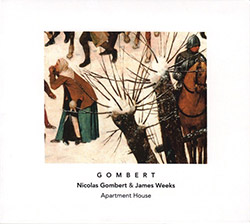 Nicolas Gombert / James Weeks:
 Reuben / Hanslip / Lash / Hession:
 Ivo Perelman / Matthew Shipp:
 Ishmael Ali (Ishmael / Wilkerson / Wilkes / Baker / Tong / Harris):
 Marta Warelis (w/ LaMar Gay / Baars / Ng / Haker Flaten / Rosaly):
 Maya Bennardo / Erik Blennow Calalv / Kristofer Svensson:
 Charles K. Noyes:
 Marco Fusi / Pierre Alexandre Tremblay:
 Dominic Lash / Mark Wastell: