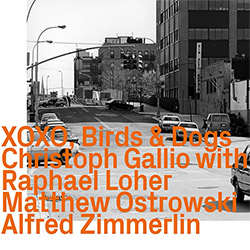
Few records make their structure do as much interpretive work as this one. By juxtaposing a set of miniatures with electronics from 2016 versus a long-buried New York tape from 1988, Swiss saxophonist Christoph Gallio isn't just compiling a career retrospective but staging a conversation between two versions of himself with diverse partners in crime, decades apart, and letting the listener sit in the gap.
The longest opus represents perhaps the more radical gesture. Fifty-five is a number of tracks that announces its own philosophy: nothing here is allowed to overstay its welcome. What could easily become a gimmick is instead functional because Gallio and pianist Raphael Loher treat brevity as a discipline, not as a limitation: each fragment has to earn its shape in a handful of seconds. The containing silence ends up carrying the same weight as the sounds themselves, forcing an attentiveness that a conventional through-composed suite would maybe not demand. It's an effort that rewards distracted listening least, and close listening most; put it on in the background and it evaporates, but lean in and every shard lands like a genuine impression.
The unearthed 1988 material is the “noisy payoff”, and its age is audible in the best way, as Matthew Ostrowski’s ARP synth and Alfred Zimmerlin’s processed cello give it a grain and a period-specific texture that the 2016 session, for all its precision, doesn't have. There's a rawer experimental feel to this piece, saxophone and cello pushing against electronics that appear unstable to the fullest rather than carefully tamed. Where the first section is aphoristic, this one is exploratory in a looser and definitely more physical sense. In a nutshell: closer to the product of musicians uncovering useful materials on the spot than to a finished demonstration.
Whether the pairing fully coheres as a single statement or simply plays like two vaguely related outbursts is a fair question, if probably beside the point. What XOXO, Birds & Dogs actually offers is a portrait of a rational improvisational mind at two pretty dissimilar junctures, refusing to resolve into one tidy “style”. That refusal is indeed the record's real subject — and its most persuasive case for Gallio to retain, to this day, an important place in the avant-jazz context.





 Ishmael Ali (Ishmael / Wilkerson / Wilkes / Baker / Tong / Harris):
 Marta Warelis (w/ LaMar Gay / Baars / Ng / Haker Flaten / Rosaly):
 Maya Bennardo / Erik Blennow Calalv / Kristofer Svensson:
 Charles K. Noyes:
 Marco Fusi / Pierre Alexandre Tremblay:
 Dominic Lash / Mark Wastell:
 Amanda Irarrazabal:
 Sylvia Lim:
 Tom Challenger & Evan Parker:
 Louis Armstrong: