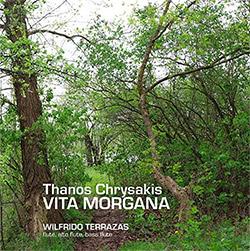
Tackling a lengthy program solely focused on one type of instrument can be a tough assignment, unless we refer to New Age decor. But Thanos Chrysakis and his label Aural Terrains aspire not to promote relaxation; instead, they aim to guide us into domains where the micro-components of sound take center stage, better still if scrutinized and exploited by high-calibre musicians.
In Vita Morgana, master flutist Wilfrido Terrazas exhaustively engages with Chrysakis's scores, accurately reflecting their knottiness. Although this complexity presents few problems for Terrazas as a performer, untrained audiences trying to comprehend the entire spectrum of codes in a single sitting could face issues. To address this problem, this reviewer split his listening into several sessions, arranged over various days to sustain focus on specific tracks.
This approach enables one to acknowledge the diverse range of strategies employed, for instance, in "Eirmos I" and "Eirmos II" (for regular and bass flute, respectively). By combining performance skills that border on the "scientifically detailed", blending voice, breath and multifarious signals, Terrazas leads us across a series of hyperdynamic flourishes — at times acrobatic, elsewhere rather cerebral sounding — consistently revealing insights into Chrysakis's creative effort, which appears especially dedicated to emphasizing the player's virtuosity and responsiveness to the score.
In compositions such as "Carved Continuum" and "Night Ray," the auditory environment becomes a little more subdued, but not devoid of passages characterized by idiosyncratic traits. It is in these pieces that the optimal balance between silence and sonic substance is attained, allowing the mind to rest briefly and get ready for the upcoming developments.
All in all, this is an album that poses repeated challenges to the ears, surely more accessible to modern flute specialists than to less knowledgeable listeners. Definitely not useful for merely aesthetic considerations, Vita Morgana remains nonetheless intriguing from a compositional standpoint, yet — in some spots at least — the connection to the concealed meanings it probably intended to convey feels slightly weaker than the impressive technical display. However, by diffusing the music through the speakers with open windows, the local golden orioles and blackcaps — genuinely superior beings in this devastated planet — seemed to respect what they were hearing. That must mean something.
Comments and Feedback:

More Recent Reviews, Articles, and Interviews @ The Squid's Ear...
|





 Amanda Irarrazabal:
 Sylvia Lim:
 Tom Challenger & Evan Parker:
 Louis Armstrong:
![John Tilbury: At Home [4 CD BOX] (Another Timbre)](https://www.teuthida.com/productImages/misc4/37729.jpg "John Tilbury: At Home [4 CD BOX] (Another Timbre)") John Tilbury:
John Tilbury: LDL (Leimgruber/Demierre/Lehn):
 Magda Mayas' Filamental:
 Rodrigues / Rodrigues / Torres / Schlippenbach / Kellers:
 Parkins / Rasmussen / Sawyer:
 Gerry Hemingway / Izumi Kimura / Frank Gratkowski / Christian Weber: