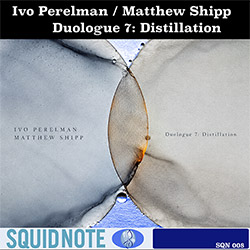
"Playing with Ivo is being on a path." Truer words were never spoken. In a single aphoristic sweep, equivalent to a phrase of his delicately deep pianism, Matthew Shipp charts his thirty-year trajectory with Ivo Perelman. He continues: "... We want to create a universe together, and we want an expanding universe." Perelman observes of what he calls their deep connection, "We share a similar language, but it's constantly evolving, because he is always challenging me and I'm always trying to push him somewhere new."
Converging and diverging paths, languages and dialogues, expanding and contracting universes meeting in the intake of breath and the turn of a phrase: these guide this installment of Perelman's Duologues series toward opposites in spiraling juxtaposition, toward the vicissitudes of freedom.
The music to which we ascribe that fraught term — a false notion only in that it neglects the price paid and investment made for each note to sound — can't be other than it is, can't inhabit time or space other than it does. Its communications are too direct, too immediate. For three decades, Perelman and Shipp have documented all manner of play, interplay and exchange, creating a vast catalog in continuing development. Each sonority is a dichotomy imbued with intersecting histories and the vigor of spontaneous invention.
With startling independence and touching symbiosis, the duo has developed a language of increasing intimacy. Shipp's unique interregistral articulation, a kind of start-stop staccato and legato encompassing the keyboard, has no peer in improvised music. Perelman's range on the tenor inhabits a similarly solitary peak of accomplishment.
Ironically, and despite the inexorable growth allowing such sonic fortitude, everything has changed, and nothing has changed; the contradiction propels the music forward. If Bendito of Santa Cruz, their first duo collaboration from 1996, moved folk-music felicities boldly into the improvisational realms already foundational to them, Perelman and Shipp now inhabit a musical world allegiant to developments from the 1960s. The result is both blatantly tonal and not, its tropes emended and expanded to create a sonic document of youthful vitality.
Points of transformation, too numerous to mention but readily apparent when heard, include the atomistic prelude and dance comprising the fourth part of Titan (2017), or the sweet swing and dizzying counterpoint of "What Is Anguish," from The Gift (2012), featuring William Parker and Michael Bisio respectively. Yet, despite aggregates of varying size and scope, the core duo remains consistent and fresh in equal measure.
All elements converge in an ever-present capable of surprise, Messiaen's charm of impossibility incarnate, even if the points of reference have shifted. Dig the opening of the fifth piece, Shipp sinking each motif and terraced dynamic deep into a seemingly inexhaustible gutbucket, as down and dirty as anything he's ever played. Perelman responds with something akin to the opulence of "When I Fall in Love" mixed with a shadow of "C-Jam Blues"' stark repetitions, before extending the dual metaphor with a series of perfectly timed middle-register salvos.
Yet, regardless of his collaborator's intimations, Shipp keeps the blues anchor firmly in place, half-step ostinati in constant juxtaposition with melodic lines of impossibly intricate dynamic layers. Perelman's own brand of impossibility involves similar dynamic contrast in tandem with the huge registral territory covered, integral to his sound in the past decade and a half. His stratospheric melody at 2:21 is only one manifestation of his astonishing range, his tone buttery and wittily humorous by turn even as it prepares for the raunch, repetition and trills of the passages immediately to follow. If only more soprano saxophonists could scale those heights with such ease!
A similar distillation occurs in the final piece from Volume 1, where something eerily resembling a bit of cloudy Django Reinhardt melody is bolstered by "Impressionistic" swaths and implicational ribbons of harmony and motif. As Shipp sets the entire keyboard vibrating, these elements exist in symbiosis. Listen deeper, and his expert pedaling comes to the fore, a model of virtuosity in understatement. The duo exchanges motives as easily, and with the same instantaneous flexibility, as they deconstructed and celebrated intersecting folk traditions thirty years ago.
Of course, a distillation, with all of its implications, is also a new form, a glance ahead, a seed. The second volume opens in that mode. A gentle song bespeaks wistful revisitation, a reimagined trio sonata with Shipp covering continuo and one upper melody, solemn harmonies and a steady bass line bolstering Perelman's aria of longing and anticipation.
Its pinnacle (4:30) and steep decline set the stage for a defiantly celebratory rhapsody that swings ever closer to midnight indigo moods as it lopes and jounces along. The fourth and fifth pieces, Puckish and achingly serene by turn, prepare for the most imaginative and elusive miniature on tap: a fractured dance replete with raindrop exhortations flanking octave declamations. The storm gathers only to dissipate amidst Perelman's middle-register concluding statements.
Types within types, tropes leading to tropes and overlapping aphorisms guide the creative forces from motion to stasis and back. The narratives ultimately push musical exegesis beyond the breaking point, necessitating literary analogies.
Allen Ginsberg introduced Visions of Cody by referring to Kerouac and Cassady as "two noble men," as is this duo, purveying sound and spirit conjoined. But rather than pushing toward new external geographies as the Beats did, their adventures uncover inner worlds of reference, sub-reference and varied repetition. The vision is Joycean in its affirmation.
Despite momentary rumbles, the album's final moments reside far from the windstorm preventing Aureliano from deciphering Melquíades' prophecies as Gabriel García Márquez's One Hundred Years of Solitude reaches its apocalypse. Nothing is wiped from existence, and solitude has no part in this vast narrative. Points, plots and parallels signal the way toward a series of connections.
Like Macondo at its glorious and partly imagined zenith, Shipp and Perelman construct, in celebration, walls of mirrors and windows reflecting and enlightening by turn — distillations within the larger distillation of a continuing musical odyssey.





 Ivo Perelman / Matthew Shipp:
 Ishmael Ali (Ishmael / Wilkerson / Wilkes / Baker / Tong / Harris):
 Marta Warelis (w/ LaMar Gay / Baars / Ng / Haker Flaten / Rosaly):
 Maya Bennardo / Erik Blennow Calalv / Kristofer Svensson:
 Charles K. Noyes:
 Marco Fusi / Pierre Alexandre Tremblay:
 Dominic Lash / Mark Wastell:
 Amanda Irarrazabal:
 Sylvia Lim:
 Tom Challenger & Evan Parker: