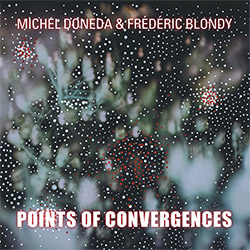
One of France's primary and confirmed reed explorers since the early 1980s, soprano and sopranino saxophonist Michel Doneda is engaged in eight free form improvisations with slightly younger pianist Fr�deric Blondy on this two-CD set. Recorded in 2014, the tracks not only highlight the antiphonic and close-listening skills of the two, but also take advantage of the spatial qualities of Paris' �glise Saint-Merry. First built in the 18th century, the soaring ceiling and open spaces of the Gothic building add additional resonations and a nearly imperceivable drone that underline the improvisations.
Making as much use of his instrument's innards as the keyboard, Blondy call upon the dulcimer or harp-like qualities of internal strings to strum and vibrate passages. On the connected "Un murmure sans origins" and "Respirer l'infini" for instance the piano's atmospheric buzz soon gives way to measured and reasonable individual cord plucks amplified by the church's acoustics and intensifies in latter track with what sounds like an inflexible metallic object scoured across the pressurized string set. While all this takes place Doneda alternates between trilling an unbroken reed line and using the sopranino to shill higher pitched and more fragmented timbres until mouthpiece burbling take on squalling slide-whistle-like squeaks given added density by spatial echoes.
Besides that the saxophonist uses all manner of internal body tube and projected reed extensions to vary his improvisations, many of which are strengthened as they refract off the church walls. Emphasizing toneless breaths, tongue stops, distended note-bending, multiphonics and interludes of circular breathing, Doneda constantly unfolds unique and unexpected timbres. There's even a sequence at the top where his reed flutters buzz decisively when vibrated against the piano's inner strings.
At the same time both players explore various tempos in a catch-as-catch-can order. Tempos will move from andante to presto and back again, while pivots bring in piano sequences from delicate, high-pitched tinkles to stops and pedal point emphasis. Split tones, mouth piece sucks and intense reed growls aren't neglected either.
The near human cry projected by Doneda coupled with Blondy's tolling piano notes confirms the mix of stridency and delicacy that profoundly defines "L'intuition des astres (� la memoire de Barre Philipps)"; while the preceding "Rose rattle" with its prestissimo slurs that reach air-raid siren extreme shrills coupled with energetic key slapping extended projections show that melodic levity is part of the mix as well.
Whether extemporizing in a lengthy or foreshortened manner with intermittent or almost unbroken textures, the patterns and projections duo show the duo's interactive conception. It was worth the 11 year wait for these sounds to be heard more widely.
Comments and Feedback:

More Recent Reviews, Articles, and Interviews @ The Squid's Ear...
| 




 Amanda Irarrazabal:
 Sylvia Lim:
 Tom Challenger & Evan Parker:
 Louis Armstrong:
![John Tilbury: At Home [4 CD BOX] (Another Timbre)](https://www.teuthida.com/productImages/misc4/37729.jpg "John Tilbury: At Home [4 CD BOX] (Another Timbre)") John Tilbury:
John Tilbury: LDL (Leimgruber/Demierre/Lehn):
 Magda Mayas' Filamental:
 Rodrigues / Rodrigues / Torres / Schlippenbach / Kellers:
 Parkins / Rasmussen / Sawyer:
 Gerry Hemingway / Izumi Kimura / Frank Gratkowski / Christian Weber: