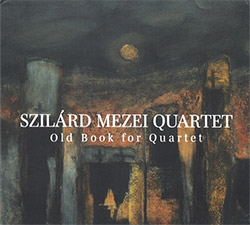
Viola virtuoso Szilárd Mezei — a (luckily) prolific musician — presents us with an eight-track program deftly performed by a group comprising himself plus Ivan Burka on vibraphone and percussion, Ervin Malina on double bass and István Csík on drums and percussion. Recorded in 2023, this is likely to join the numerous works of the Vojvodina-born composer/improviser to be fondly remembered. Mezei's ability to balance written and improvisational integrants is once more in evidence in Old Book For Quartet, making it a required addition to his oeuvre.
In the opener "Vízlevegő ének/Waterair Song" the string melodies are rather evocative, finely supported by sympathetically understated percussiveness. The music's temperament mutates into quasi-transcendental, still remaining firmly rooted in contrapuntal hypotheses. The unconventional metrics and amalgamation of folk and cultural influences — a hallmark of much of Mezei's output — are thus further enhanced. The coalescence of thematic elements and introspective spontaneity is nothing short of perfect. "Supernormal Slap" is informed by a combination of playfulness and inexplicit deception in the pizzicato, the percussive component providing the chiaroscuro. An interweaving of independent paths yields a sense of liberating chaos that systematically resolves within the original compositional order.
Microtonal glimpses, upper partials as the foundation of tonal color, articulate phrases that confirm — if ever there was a need for it — Mezei's hypersensitivity of touch and vision, are but a few of the outstanding features in "Hep 3". Defined by both instinct and rationality, they are perfumed by discernible echoes of the past. The cohesion of the Malina/Csík coalition enables the leader to utilize his bow in the service of elevated creativity. Burka's interventions are significant for their lack of loquacity, retaining a consistent level of intelligence.
Contractions and expansions, increasing speed and subsequent decelerations, are characteristic of "Boszorka/Beldame". Minimalist cues are highlighted by the instrumental simmering, each performer representing a key nuance in the overall palette. An apparent tension might, in reality, constitute the prelude to other ad-libbing flourishes; the complete control of the situation is always being kept. Yet, for this reviewer, the album's zenith is "Innen/From Here". The quartet engenders harmonic halos that, in turn, conjure up an unspeakable depth. Mezei's lines benefit from a high degree of interpretative skill, aligning seamlessly with the instinctive delineations of his comrades. The ensemble's formal integrity is to be praised, and so is the avoidance of acoustic periphrasis in favor of a lucid, functional synthesis. Malina's bowed solo is remarkable for its fluidity and poise.
Interestingly, the last three tracks, in at least a couple of cases, display vague hints to relatively conventional structures. However, they remain distinctly out of step with mainstream trends; not unexpected, given the technical prowess of the participants. Furthermore, the discerning listener may find swing less trite when the fabric that adorns it is made of sharp dissonances and stubborn repetitions in its rebellion against the obvious, as in "Áldozat/Sacrifice".
If "Oszlop/Stanchion" recalls a nocturnal setting of subdued tones and sparse lights, the final "Hetedik/Seventh" introduces a rapid pace, genuine jazz sensibilities permeated by contemporary chamber essences. Burka's solo in this circumstance is brilliant, as he relinquishes restraint while concisely exposing his sonic identity. Mezei responds in kind, allowing the viola to soar as capriciously as an excited wasp. A dynamic conclusion to the set, which as a whole, offers a lot to the ears. And the heart.





 Masayo Koketsu / Nava Dunkelman:
 Nicolas Gombert / James Weeks:
 Reuben / Hanslip / Lash / Hession:
 Ivo Perelman / Matthew Shipp:
 Ishmael Ali (Ishmael / Wilkerson / Wilkes / Baker / Tong / Harris):
 Marta Warelis (w/ LaMar Gay / Baars / Ng / Haker Flaten / Rosaly):
 Maya Bennardo / Erik Blennow Calalv / Kristofer Svensson:
 Charles K. Noyes:
 Marco Fusi / Pierre Alexandre Tremblay:
 Dominic Lash / Mark Wastell: