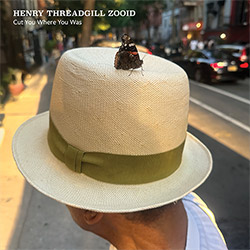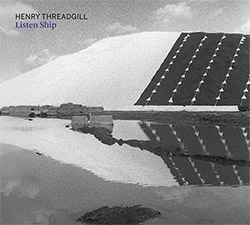
I should probably provide some background on my personal experience with the music of Henry Threadgill. I was a huge fan of Air and his Sextett, and saw them both many times, as well as his playing on others' projects. I was privileged to see him in other contexts as well, including his Society Situation Dance Band. I found his compositional style, which often contained a unique blend of poignant lyricism and cynical sourness, to be bracing and very rewarding. Around the turn of the century, however, his pieces, to these ears, began to take on a more academic feel, kind of forced mixture of funk, jazz and (for lack of a better term) post-serial kind of construction that I found unsatisfying. This trend affected several AACM musicians as they grew older, including Muhal Richard Abrams, George Lewis and, sometimes, Roscoe Mitchell. Maybe it was a natural progression, maybe other factors are in play; might be an interesting research project.
So, while I'm always eager to hear more and to, possibly, lay waste to my prior convictions, this was the baggage i brought to Listen Ship. The recording consists of sixteen tracks, simply titled A through R (IJ together, no K!), and is played by an octet which includes four acoustic guitars (Brandon Ross, Bill Frisell, Gregg Belisle-Chi and Miles Okazaki), two acoustic bass guitars (Jerome Harris and Stomu Takeishi) and two pianos (Maya Keren and Rahul Carlberg), all conducted by Threadgill. However, it's only on occasion that all eight perform at once; most often it's the guitars or the pianos. The pieces tend toward the short; the first track, 'A', just over a minute, is for the pianos, an attractive, somber number while 'B', for the strings, is a playful, spiky affair with complex rhythmic intertwining. Both, for this listener, work well and are devoid of the dryness I often felt with other recent work. The following four pieces repeat this pattern, with equally satisfying results, 'F' generating a little (abstract) funkiness. The brief, delicate 'G' is the first time we hear strings and keyboards together, a piece I wanted to hear extended. This comes to pass in the longer 'H'. There's a collage aspect to it; one thinks momentarily of Braxton's mid-80s notion of overlapping different compositions, though an organic quality is also in effect, the seemingly disparate parts coalescing quite effectively into a shimmering whole.
The rest of the album follows this general line, forming a kind of 16-part suite, the two groupings, the strings and piano, sometimes set in contrasting elements of the same piece, sometimes performing apart, once in a while as a whole ensemble. Threadgill's writing (and, as near as I can determine, it seems the music is very largely written) is imaginative throughout, the piano portions often especially moving, obliquely harkening back to some of his much earlier elegiac compositions. The closing track, 'R', is particularly lyrical, the piano recalling, oddly enough 60s Corea or Paul Bley. All in all, a very engaging, enjoyable effort, one that's caused this listener, on this listen ship, to re-evaluate prior convictions, always a good thing.
Comments and Feedback:

More Recent Reviews, Articles, and Interviews @ The Squid's Ear...
|





 Marta Warelis (w/ LaMar Gay / Baars / Ng / Haker Flaten / Rosaly):
 Maya Bennardo / Erik Blennow Calalv / Kristofer Svensson:
 Charles K. Noyes:
 Marco Fusi / Pierre Alexandre Tremblay:
 Dominic Lash / Mark Wastell:
 Amanda Irarrazabal:
 Sylvia Lim:
 Tom Challenger & Evan Parker:
 Louis Armstrong:
![John Tilbury: At Home [4 CD BOX] (Another Timbre)](https://www.teuthida.com/productImages/misc4/37729.jpg "John Tilbury: At Home [4 CD BOX] (Another Timbre)") John Tilbury:
John Tilbury: