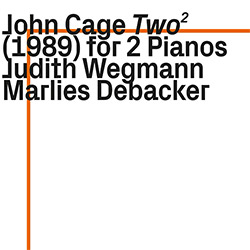
John Cage's text works are among the most challenging � and therefore in true Cagean fashion, some of the most delightful � of his long career in not so much breaking down as simply ignoring boundaries.
What makes them (presumably, at least, for most listeners) so difficult is that we want words, and by extension utterances, to have meaning. A jazz saxophone solo can have emotive impetus and even a vocal quality, but we don't expect it to deliver syntactical meaning. Likewise, a scat vocal by Ella Fitzgerald or Louis Armstrong is clearly a voice performance. but we understand it like we do a sax solo. It is, in a sense, the voice mimicking the voice.
But Cage's text-based performance pieces use voice in an entirely different way. The approach is based more on speaking than singing (although, that said, he did have a very musical speaking voice). In this sense, his text work fits into the 20th century lineage of abstract prose writers, from his beloved James Joyce to Gertrude Stein, Hugo Ball or Tristan Tzara (even if his working methods were quite different). It's not about tone or meaning, but simply the malleability and suggestibility of phonemes.
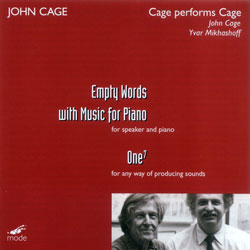
Empty Words (1973-74) in its full realization runs about ten hours, and is built by slowly removing sections from Thoreau's Journal so that at first there are no complete sentences, only letters and silences. There is, of course, nothing antithetical to Cage's philosophy in abbreviating a work or, indeed, performing two at the same time. So the 30-minute realization by the composer on Cage Performs Cage, paired with his Music for Piano (1952-56) performed by Yvar Mikhashoff is not an edit so much as the way the piece was that time (that time being April, 1991, in Buffalo NY, at the premier of Cage's epic Europa 5. It is a magnificently still performance drawn from the final, non-word, section of the piece, and while it is in one sense somewhat static, it does actually build to an understated climax. Cage's voice when delivering narrative (as in Indeterminacy) generally has a bit of a smirk, but here he is intriguingly hard to pin down, with disembodied vowel sounds floating alongside guttural emulsions. Such anti-Cagean notions as "dramatic" or "emotive" almost fit, but not quite. He's more like a bell tree, clangs and rings to which meanings can be attached, although they aren't, of course, really there. The piano portion of the performance is equally measured and inscrutably beautiful, stepping ever so slowly through the field of string preparations emblematic of Cage's 1950s work.
The 1991 composition One⁷ comprises the second half of the record, and reduces the soundfield, in terms of variety and frequency, considerably. Here the vocalizations are presented without musical accompaniment, and can be spaced minutes apart. The composition is a part of the "Numbers Piece" series which occupied much of his attention in the years leading to his death in 1992. Composed to mark Pauline Oliveros' birthday, it is a structurally fascinating work. Ten distinct sound events are sequenced by the composer (the sounds themselves prescribed by the performer) across two overlapping sequences of time brackets. The performer has latitude within a bracket to select the moments of soundmaking, but the ordering of sounds is regulated by the score. As in Empty Words, Cage here uses brief vocal utterances for the sound events, although presumably the piece could be played on clarinet, clavichord or an upside-down garbage can. As performed here, the piece is a double-dare to the attention span, the long silences justified by a narrow range of intrusions, one of which is a "Ga!" so loud it can be frightening. But if successfully viewed from a distance, the skeleton of One⁷, as with Empty Words, is quite beautiful.
Comments and Feedback:

More Recent Reviews, Articles, and Interviews @ The Squid's Ear...
|





 Julia Eckhardt:
 Lori Goldston:
 Arkady Gotesman:
 Nicolas Collins / Birgit Ulher:
 Albert Ayler Quintet:
 Merzbow / Mats Gustafsson / Balasz Pandi:
 Ivo Perelman / Damon Smith:
 Paul Rogers:
 Camila Nebbia (feat. Marilyn Crispell & Lesley Mok):
 Eric La Casa / Francisco Lopez: