Birgit Ulher
The Squid's Ear Interview
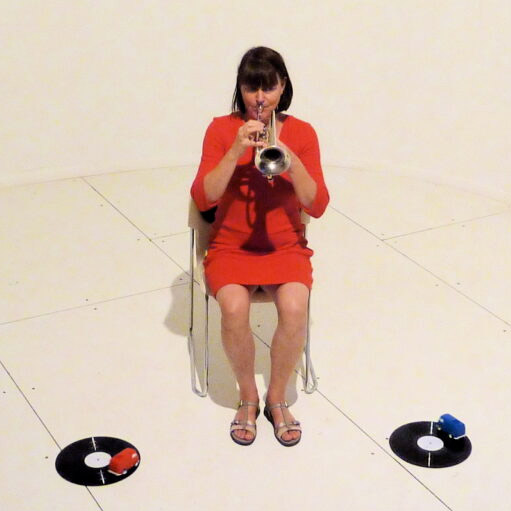
Born 1961 in Nuremberg, she studied the visual arts, which still have an important influence on her music. Since moving to Hamburg in 1982 she has been involved in free improvisation and experimental music. Since then she has "established a distinguished grammar of sounds beyond the open trumpet" (jazzdimensions.de). She works mainly on extending the sounding possiblities of the trumpet by using splitting sounds, multiphonics and granular sounds and has developed her own extended techniques and preparations for producing these sounds. Besides this material research she is especially interested in the relation between sound and silence. Since 2006 Birgit Ulher works with radios and uses extended speakers, fed with radio noise in her trumpet mutes. The trumpet functions as an acoustic chamber and modulates the radio noise, thus the trumpet is transmitter and receiver at the same time.
How would you describe music?
I'll leave that to the critics; I don't have the necessary distance from it.
What is your relationship to music?
I came to music through the visual arts, and my first encounter with improvised music was free jazz. As a child, I had guitar lessons for a few years before I started trumpet lessons. My earliest memories of music are accordion music and songs at family celebrations. Apart from family celebrations, one of my earliest memories of music is sitting in front of the speakers of the record player as a child, listening to records.
As a teenager, I came into contact with free jazz for the first time. What immediately appealed to me about free jazz was the energy and the very personal sound language of the instrumentalists, especially the wind instruments. For me, this had a connection to abstract expressionism, which I later studied in my visual arts studies.
I was also fascinated by the collaborative creation of music in the moment, the non-hierarchical nature of this music, the special concentration, the simultaneity of listening and playing, the playful aspect itself, and the aspect of sound research. The music of Cage, Feldman, etc., and the element of silence were also very important. Projecting sounds in the right place, moving sounds in space, mobile sculptures with positive and negative forms are further aspects. I have also always been fascinated by sounds of the environment, by everyday sounds, which I have sought to incorporate into my music.
What draws you to the instrument(s) you play, and/or to composing?
I love the sound of the instrument; it is very direct; the sounds are malleable and can be very percussive.
Over the years, I have played many instruments on the side, such as percussion, to which I still have a special connection. Over time, I have expanded the trumpet with various objects, such as metal foil, milk frothers, voice changers, radios, whose speakers I have removed and use with other extended speakers as mutes. The radio sounds are projected into the trumpet, so the trumpet becomes both a transmitter and a receiver at the same time.
My compositions are mainly audiovisual concepts for trumpet, robots, flashlights, tin cans, etc. They create a framework, a new situation for one or more players, but chance always plays a role.
What groups or musical communities have you been part of, and how have they influenced your playing or composing today?
The world music orchestra was very important in my early days; it was a form of living and working together. Musically, it was heavily influenced by free jazz, and the extended circle consisted of about 20 musicians. We played our own pieces, but also worked on pieces by Sun Ra, among others. We rehearsed every day, sometimes late into the night.
That was only possible back then because there were many empty factories in Hamburg in the 1980s where you could work and live almost for free.
At Timeta, the aspect of sound research became important: free improvisation, new sounds, trying out ideas for playing together, moving away from solos, developing a shared sound.
Exchange with musician initiatives throughout Germany, mutual invitations, collectives, mutual influence, unique styles were developed in some cities, such as Hamburg and Berlin.
In the European Improvisation Orchestra, with which I have played only a few concerts, concepts for large groups were developed.
Nordzucker Trio: very special sound world, reduced, focused, split sounds.
stark bewölkt: organization and improvisation, similar focus to Nordzucker.
VAMH - Verband für Aktuelle Musik Hamburg: a Hamburg musicians' association that promotes contemporary music (new, improvised, electronic, and experimental music and sound art) and also organizes the blurred edges festival.
What musician(s) most influenced your approach to music, and why?
My early influences in free jazz were: Don Cherry, Bill Dixon, Sun Ra, Archie Shepp, Art Ensemble of Chicago, Barbara Donald, Mongezi Feza, although I would like to highlight Bill Dixon in particular. Their influence was important for the development of a personal sound language on the trumpet.
In new contemporary music, they included Webern, John Cage, and Feldman, whereby the idea of silence and the projection of sounds in space were an important influence. Among the British improvisers, John Stevens, John Butcher, Phil Minton, and Tim Hodgkinson taught me a more open approach to time and rhythm after my beginnings in free jazz.
Musicians from the Feminist Improvising Group such as Annemarie Roelofs, Joëlle Léandre, and Irene Schweizer were also very important, as they were fantastic musicians and the only female role models at the time.
Then, for various reasons, mainly musicians I played with: Roger Turner, Tim Hodgkinson, Martin Klapper, Michael Maierhof, Gregory Büttner, Nicolas Collins and Jaap Blonk.
Who or what influences you most outside of music, and why?
I visit a lot of exhibitions, even when I'm on tour. Visual art has always inspired me because artists have a different perception and way of thinking than musicians and composers. They often make various connections on many different levels. Literature is also an important influence, even though I find it harder to describe the nature of that influence. I think it has to do with different worlds of imagination, understanding various ways of life and perceptions. Even though I often work on very specific aspects of music, I always try to place them in new contexts, including visual ones.
What deceased performer(s), improviser(s), or composer(s) would you most like to have a conversation with, and why?
Bill Dixon, because he influenced me greatly with his sound language and compositions and encouraged me very positively in my work. Barbara Donald, because she was the first trumpeter I heard about in my musical circle and I really liked her playing style. Jamie Branch, a fantastic trumpeter whom I met at the High Zero Festival but unfortunately didn't really get to know.
What advice would you give to a young musician entering your field?
I don't think I can give younger musicians much advice, except to try to find their own voice and not be too influenced by the current hype. Pursue what really interests them, even if it seems far-fetched at first. Listen to a lot of music, preferably live. Find out what has already been done in the various areas of experimental music.
What do you hope audiences take away from experiencing your music?
In the best case, a new perception of the acoustic environment and an expansion of the concept of music, perhaps even a desire to experiment more oneself.
Where do you see the music you're involved in heading in the coming years?
That depends on many things, including the living conditions of musicians and composers. I hope that rising rents and a lack of funding don't further restrict their freedom. I hope it doesn't become too academic.
If you could shape the future of this music, what would it look like?
Music is so diverse and should remain that way. I have no ambitions to influence music exclusively in my direction.
Where are you currently located or musically associated with?
I live in Hamburg, but I'm in Berlin a lot because there are very few musicians in Hamburg I can work with. Right now, I'm working a lot with Jaap Blonk, Nicolas Collins, and Petr Vrba. In Hamburg, I work with the stark bewölkt Trio, Gregory Büttner, and Michael maierhof, but that's mostly organizational work.
What's something you rarely get asked in interviews that you wish people would ask - and how would you answer it?
Questions about the living conditions of musicians and specific aspects of their respective music. Questions about the context of the music, where and how it is presented, what the structures are. Who organizes experimental music? How do they see themselves in the context of society as a whole? To what extent is the music influenced by political developments and to what extent is funding dependent on this?
 Search for Birgit Ulher titles on sale @ Squidco.
Comments and Feedback:

More Recent Reviews, Articles, and Interviews @ The Squid's Ear...
|
|





 Sunny Murray and Sabu Toyozumi:
 Eva-Maria Houben (Nate Wooley):
 Masayo Koketsu / Nava Dunkelman:
 Nicolas Gombert / James Weeks:
 Reuben / Hanslip / Lash / Hession:
 Ivo Perelman / Matthew Shipp:
 Ishmael Ali (Ishmael / Wilkerson / Wilkes / Baker / Tong / Harris):
 Marta Warelis (w/ LaMar Gay / Baars / Ng / Haker Flaten / Rosaly):
 Maya Bennardo / Erik Blennow Calalv / Kristofer Svensson:
 Charles K. Noyes: