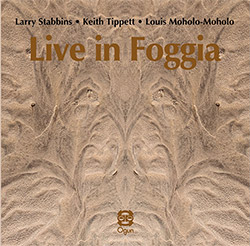
Volcano-like is the best way to describe these two newly discovered 1985 live performances by the short lived Larry Stabbins/Keith Tippett/Louis Moholo-Moholo trio. That's volcano-like not volcanic, because unlike the constant intense sonic eruptions of so-called Ecstatic Jazz, the systematic improvisations on Live In Foggia consist of many stages.
Like the molten magna rocks that collect quietly beneath the volcano surface, the tracks include interludes of restrained, measured and rhythmic swing passages. Only when certain interactive conditions are reached equivalent to pressure forcing magma through cracks in the crust do eruptions occur. Unlike a volcano though temperate passages alternate with those sequences of musical lava-like outbursts.
Besides this trio, its members played together in multiple other groups. Of the two from the UK, pianist Tippett (1947-2020) was noted for his bands such as Mujician. Stabbins, now 76, who plays tenor and soprano saxophones and flute, starting working with Tippett when he was 16 and has since been part of jazz and fusion groups. South African drummer Louis Moholo-Moholo (1940-2025) was a member of the Brotherhood of Breath and his own aggregations.
The distinct paradigm of this approach is expressed at its greatest length on the more than 45 minute "The Greatest Service". Beginning with ascending measured piano clicks, variable drum shuffles and reed slurs that are like dissolved gases and suspended crystals that burble underground, it only take about five minutes for the track to explode into Free Music mode. Reaching a boiling point of speedy reed multiphonics and tongue stops that scream and screech, darkened, jumping piano glissandi and backbeat ruffs add to the exposition. A pivot to Tippett and Moholo vocalizing syllables that seem half-operatic and half-gargle marks a shift that is confirmed by Stabbins' proportional flute trills.
Volcanic spewing with sweeping keyboard cascades and dulcimer-like strums on inner strings, saxophone slurs and drum rolls escalate at the half-way mark until another shift relaxes the three into creating a swelling melody that blends lively African kwela, mellow swing and tinctures of Free Jazz, with the last maintaining tension until the end.
The 27-minute "Shield" offers more of the same, though Stabbins' soprano saxophone snarls are more prominent, the drummer advances shuffles and when lyrical passages are heard, Tippett's patterning briefly touches on snatches of jazz standards.
Notable as is, this set is doubly valuable as one of only two records of this trio.
Comments and Feedback:

More Recent Reviews, Articles, and Interviews @ The Squid's Ear...
| 




 Nicolas Gombert / James Weeks:
 Reuben / Hanslip / Lash / Hession:
 Ivo Perelman / Matthew Shipp:
 Ishmael Ali (Ishmael / Wilkerson / Wilkes / Baker / Tong / Harris):
 Marta Warelis (w/ LaMar Gay / Baars / Ng / Haker Flaten / Rosaly):
 Maya Bennardo / Erik Blennow Calalv / Kristofer Svensson:
 Charles K. Noyes:
 Marco Fusi / Pierre Alexandre Tremblay:
 Dominic Lash / Mark Wastell:
 Amanda Irarrazabal: