
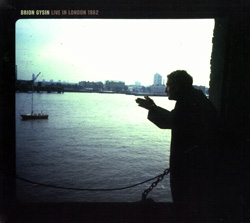
Brion Gysin has become synonymous with that perilous technique known as the cut-up, that would-be form of divination which immobilizes the historical moment, isolates a scattering of details from the totality, and in their rearrangement reveals that the revenge of the repressed comes from nowhere else but the future. A closed continuity of progression has little chance to materialize in such a setting. Parrying before the need for homeostatic balance, Gysin, Tessa (cello and bass), Steve Noble (drums), Jail (percussion), and Ramuntcho Matta (guitar and electronics) instead emphasize the marginal discourses that normally call for repression. Here, compositions are homogeneous and rectilinear, emphasizing a decentered network of plural processes in which the unity of a given experience of meaning is shown to be supported by a pure meaningless signifier without the signified.
"Learning" is a twenty-five minute lecture during which Gysin leapfrogs from recollections of Gene Gennett, to the nature of gifts and teaching. In so doing, language is trumpeted as something of a blind autonomous mechanism. Gysin holds that this deferral of language, that is to say, of one's innermost feelings onto this process, this cut-up technique which then acts in one's stead, harbors a certain liberating potential, allowing one to glean the underlying truth of a statement or text. How much this is in fact the case is neither here nor there. At any rate, Gysin's incisions and combinations prove fairly fruitful. Insofar as Gysin and co. transfer onto this process much of the responsibility for maintaining the smooth running of things, they gain space in which to enjoy themselves and assert their own will. This they do on "Illusion" and others, when a layered, fuzzed out, huge swirl of every assaulting sonic gesture imaginable is played with some aplomb. When not employing a restrained yet irregular vernacular, full of hellishly scything riffs, electronic abuse, and Gysin's hollering vocals, they stitch together somber, gray patches of feral noise that brim with a grainy naivety.
Where these energetic compositions allow for a passive reaction of satisfaction on the part of the listener, the spoken word gambits strip one of this pleasure, encouraging participation not only on the level of the unfolding event, but below, in the very establishment of its rules. In the oscillation between these poles, one thereby has the opportunity to beat one's head in time and in trance - making this a welcome revisitation of one of contemporary music's more prolific figures.