
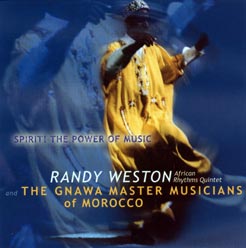
Randy Weston has been mining the rich vein of African music since the 1950s, making him one of the most forward-looking of his contemporaries, as African music has become a wellspring of inspiration for a lot of new directions in jazz and other musical forms. The music on this disc show Weston at his most African, a feat accomplished with the presence of African musicians of the highest order. What we get is authentic North African Soul-melismatic, ululating, a great range of expressiveness of the voice and the varied sounds and timbres that singing in another tongue (in this case Arabic) provides. The music is rhythmic, modal, with spiraling forms and labyrinths of sound that recall the equally melismatic and equally soulful music of the unorthodox 12th century mystic Hildegarde Von Bingen.
The six pieces here (seven with the reprise of "Lalla Mira" at the end of the disc) provide a moving experience. The evening was conceived around a spiritual theme and the venue, the Lafayette Presbyterian Church in Brooklyn on the 24th of September 1999, ensured that the mood was properly set. The results are definitely uplifting.
"Receiving the Spirit," the first piece, serves as an introitus, with a Western, (i.e. American) sound conception, featuring Weston's quintet, made up of Weston on piano, Alex Blake on bass, Benny Powell on trombone, Talib Kibwe on alto sax and flute, and Neil Clarke on African percussion. While the instrumental conception is American-jazz-based, it is tinged, indeed, impregnated by African yearning.
In the "Introduction to Hag' Houge and String Bass," featuring Abdula El Gourd and Alex Blake, the bass takes the melody over an eighth-note atomic rhythm set by the Hag' Houge, a kind of percussive stringed instrument. The effect is reminiscent of Terry Riley and other minimalist composers, looping patterns colored by subtle changes in accent, pitch, and rhythmic displacement.
In "Chalabati," the prominent vocals deliver music as prayer, or "African spirituality through music" as the liner notes declare. But the piece also has a Mississippi blues feel, a deep, deep groove, as does "Who Know Them?" which is developed around the call-and-response of a chanter and a choral reply. All the vocal pieces on the program highlight the significance of language (in this case Arabic) to rhythm and tonal inflection.
The microtonal vocal texture in "El Wali Sidi Mimoun," a strophic tribute to Allah, creates a ululating energy, with dynamic, delicate changes - the simplicity in complexity that is one of the appealing features of African music. Bass, percussion, and string instruments move along with the voices that at first sound out-of-tune to Western ears, but wherein lies the mystery and exotic appeal of the melodic line.
The disc ends with a statement and restatement (probably as encore) of "Lalla Mira," a very hypnotic, rhythmic tune that builds in a circular, spiraling fashion. Its pentatonic theme, stated by all the melodic instruments, has, again, a bluesy quality, this time recalling the minor mode of Dizzy's "Night in Tunisia." Religious, yes, but there is also an atmosphere of revelry created with chanting over the alto statement that resembles the celebratory, euphoric forays of John Coltrane. As the tune climaxes, the alto gives way to a trombone solo over the intense rhythms created by the percussionists of the Gnawa musicians of Marrakech and Tanger (M'Barek Ben Othman, Ahmed Ben Othman, Addenebi Oubella and Mostafa Oubella).
In Weston's one composition ("Receiving the Spirit") and in his arrangements of the other tunes (traditional or composed by the Moroccan guests) we find evidence of an intimate knowledge and profound respect for African music, as well as an obvious commitment to sharing the same. As Weston states in his notes on the concert: "The concept underneath it all was to show the spirituality of our people, how we Africanise everything we touch, how it's really spirituality before actual religion." The results are convincing and authentic, regardless of your belief's evidence that music does, in fact, allow us to transcend cultural and linguistic differences.